Thank you for visiting SNEWPapers!
Sign up free
Edwardsville Spectator
Edwardsville, Madison County, Illinois
What is this article about?
Oration by A. W. Snyder, Esq., delivered July 4, 1822, in Illinois, commemorating American independence. It recounts the colonists' resistance to British tyranny, celebrates the republic's virtues, praises citizen patriotism, contrasts with Roman conquests, and urges safeguarding liberty and union, invoking Washington.
Merged-components note: This is a single oration delivered on July 4, 1822, continued across pages 1 and 2; relabeled the second part from 'editorial' to 'literary' as it fits the narrative speech style.
Clippings
1 of 2
OCR Quality
Full Text
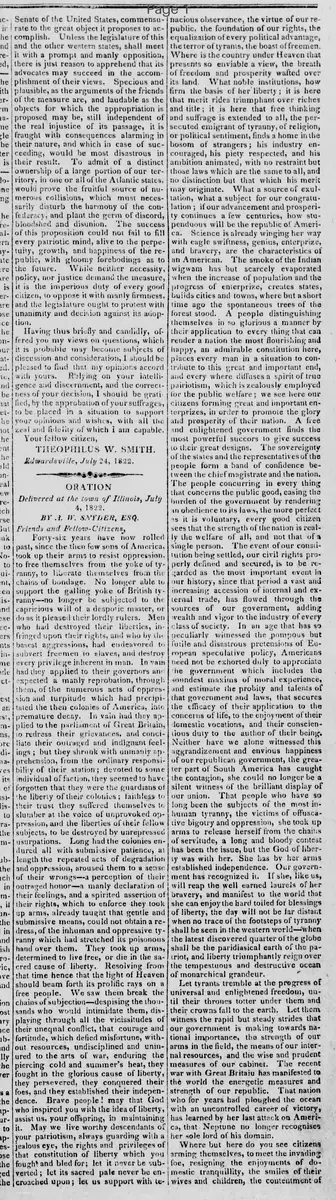
Delivered at the town of Illinois, July 4, 1822.
BY A. W. SNYDER, ESQ.
Friends and Fellow-Citizens,
Forty-six years have now rolled past, since the then few sons of America took up their arms to resist oppression to free themselves from the yoke of tyranny, to liberate themselves from the chains of bondage. No longer able to support the galling yoke of British tyranny—no longer be subjected to the capricious will of a despotic master, or do as it pleased their lordly rulers. Men who had destroyed their liberties, infringed upon their rights, and who by the basest aggressions, had endeavored to subvert freemen to slaves, and destroy every privilege inherent in man. In vain had they applied to their governors and expected a manly reprobation, through them, of the numerous acts of oppression and turpitude which had precipitated the then colonies of America, into premature decay. In vain had they applied to the parliament of Great Britain, to redress their grievances, and conciliate their outraged and indignant feelings; but they shrunck with unmanly apprehension, from the ordinary responsibility of their station; devoted to some individual or faction, they seemed to have forgotten that they were the guardians of the liberty of their colonies; faithless to their trust they suffered themselves to slumber at the voice of unprovoked oppression, and the liberties of their fellow subjects, to be destroyed by unrepressed usurpations. Long had the colonies endured all with submissive patience, at length the repeated acts of degradation and oppression, aroused them to a sense of their wrongs—a perception of their outraged honor—a manly declaration of their feelings, and a spirited assertion of their rights, which to enforce they took up arms, already taught that gentle and submissive means, could not obtain a redress, of the inhuman and oppressive tyranny which had stretched its poisonous hand over them. They took up arms, determined to live free, or die in the sacred cause of liberty. Resolving from that time hence that the light of Heaven should beam forth its prolific rays on a free people. We saw them break the chains of subjection—despising the thousands who would intimidate them, displaying through all the vicissitudes of their unequal conflict, that courage and fortitude, which defied misfortune, without resources, undisciplined and uninured to the arts of war, enduring the piercing cold and summer's heat, they fought in the glorious cause of liberty, they persevered, they conquered their foes, and they established their independence. Brave people! may that God who inspired you with the idea of liberty, assist us, your offspring, in maintaining it. May we live worthy descendants of your patriotism, always guarding with a jealous eye, the rights and privileges of that constitution of liberty which you fought and bled for; let it never be subverted; let its sacred pale never be encroached upon; let us support with tenacious observance, the virtue of our republic, the foundation of our rights, the equalization of every political advantage, the terror of tyrants, the boast of freemen. Where is the country under Heaven that presents so enviable a view, the breath of freedom and prosperity wafted over its land. What noble institutions, how firm the basis of her liberty: it is here that merit rides triumphant over riches and title; it is here that free thinking and suffrage is extended to all, the persecuted emigrant of tyranny, of religion, or political sentiment, finds a home in the bosom of strangers: his industry encouraged, his piety respected, and his ambition animated, with no restraint but those laws which are the same to all, and no distinction but that which his merit may originate. What a source of exultation, what a subject for our congratulation; if our advancement and prosperity continues a few centuries, how stupendous will be the republic of America. Science is already winging her way with eagle swiftness, genius, enterprize, and bravery, are the characteristics of an American. The smoke of the Indian wigwam has but scarcely evaporated when the increase of population and the progress of enterprize, creates states, builds cities and towns, where but a short time ago the spontaneous trees of the forest stood. A people distinguishing themselves in so glorious a manner by their application to every thing that can render a nation the most flourishing and happy, an admirable constitution here, places every man in a situation to contribute to this great and important end, and every where diffuses a spirit of true patriotism, which is zealously employed for the public welfare; we see here our citizens forming great and important enterprizes, in order to promote the glory and prosperity of their nation. A free and enlightened government finds the most powerful succors to give success to their great designs. The sovereignty of the states and the representatives of the people form a band of confidence between the chief magistrate and the nation. The people concurring in every thing that concerns the public good, easing the burden of the government by rendering an obedience to its laws, the more perfect as it is voluntary, every good citizen sees that the strength of the nation is really the welfare of all, and not that of a single person. The event of our constitution being settled, our civil rights properly defined and secured, is to be regarded as the most important event in our history, since that period a vast and increasing accession of internal and external trade, has flowed through the sources of our government, adding wealth and vigor to the industry of every class of society. In an age that has so peculiarly witnessed the pompous but futile and disastrous pretensions of European speculative policy, Americans need not be exhorted duly to appreciate the government which includes the soundest maxims of moral experience, and estimate the probity and talents of that government and laws, that secures the efficacy of their application to the concerns of life, to the enjoyment of their domestic vocations, and their conscientious duty to the author of their being. Neither have we alone witnessed this aggrandizement and envious happiness of our republican government, the greater part of South America has caught the contagion, she could no longer be a silent witness of the brilliant display of our union. That people who have so long been the subjects of the most inhuman tyranny, the victims of offuscative bigotry and oppression, she took up arms to release herself from the chains of servitude, a long and bloody contest has been the issue, but the God of liberty was with her. She has by her arms established independence. Our government has recognized it. If she, like us, will reap the well earned laurels of her bravery, and manifest to the world that she can enjoy the hard toiled for blessings of liberty, the day will not be far distant when no trace of the footsteps of tyranny shall be seen in the western world—when the latest discovered quarter of the globe shall be the paradisiacal earth of the patriot, and liberty triumphantly reign over the tempestuous and destructive ocean of monarchical grandeur.
Let tyrants tremble at the progress of universal and enlightened freedom, until their thrones totter under them and their crowns fall to the earth. Let them witness the rapid but steady strides that our government is making towards national importance, the strength of our arms in the field, the means of our internal resources, and the wise and prudent measures of our cabinet. The recent war with Great Britain has manifested to the world the energetic measures and strength of our republic. That nation who for years had ploughed the ocean with an uncontrolled career of victory, has learned by her last attack on America, that Neptune no longer recognises her sole lord of his domain.
Where but here do you see citizens arming themselves, to meet the invading foe, resigning the enjoyments of domestic tranquillity, the smiles of their wives and children, the contentment of rural life, for the toils and fatigues of the camp, uncompelled and uninvited, except by the duty every citizen owes to his government, urged on by the love of liberty, the love of glory and patriotism, for a virtuous and republican government, they march to face the enemy in battle, willing to sacrifice their lives for the good of their country, or conquer the foe that would dare aggress on the rights of freemen. Such is the character of Americans, they fight not for rapine and conquest of territory, but in defence of their homes. The illicit conjunction of courage and rapine gave birth and importance to the Roman republic, which in its turn moulded the notions and habits of its citizens to a surprising and formidable perseverance in the same system. The brilliancy of success with which that system operated, on the vast theatre of the world, has attracted that applause which the bulk of mankind too willingly bestow on the triumphs of conquest, however ill they do accord with the principles of justice, the tremendous hostility of the Roman arms was generally unprovoked by aggression, and frequently attended by rapacious and tyrannous insolence, and independently of the disgust which these vices must excite in the mind of the philosophical politician, he will view the narrow and improvident domestic policy of the all victorious commonwealth with a contempt which cannot be dazzled by the splendour of its most unsullied achievements. The Romans were indeed enabled to subsist by the spoils of conquest, while the uncorrupted science and spirit of their military character secured them the superiority in the conflicts of the field; but their notorious and avowed disregard of every pursuit but that of arms, threw a strong shade of wilful ignorance, over the lustre of their warlike exploits, nor when the energies of the republic were effaced by the magnificence of the empire, and satiated conquest afforded time for speculation, did the Romans listen to the suggestions of national prudence, with a disgraceful anxiety the dominating power of the universe depended for subsistence on the tributary harvests of Africa, and the granaries of Egypt were emptied for the idle and licentious populace of Rome. Such are the striking lessons imparted by the free pencil of history, let them be contemplated for instruction, and let us justly deem ourselves respectable, by being enabled by commerce to increase our wealth, and by courage to protect our honor, which is at once enterprising and generous abroad, and the free structure of our government facilitates every improvement at home. Thus shall we be happy and prosperous when the ambition of princes' and the unsatiated desire of monarchs are continually involving mankind in war, impoverishing their subjects, and filling the cup of human misery, to gratify the sensualities of their brutal pride. How many nations have ceased to exist; how many governments have been overthrown by the ambition of a few individuals. Let us profit by their imprudence, let us consider the importance of maintaining indissolubly the federal union, the danger of indulging too much our feelings in party faction, the necessity of supporting the public faith-of encouraging foreign interest free from foreign influence--losing sight of individual aggrandizement for public good, always considering the happiness of our government, and that virtue is its only support, that the blind and erring philosophy of man, has discovered no soil where it may safely be planted but on the firm and indestructible foundation of true patriotism. Let us remember that venerable sage, the immortal Washington, whom history to the present moment has presented us with none like, whose dangers in war and labors in peace, were undertaken, with a single eye to the benefit of his country, whose unparalleled success was the result of wisdom in design, and valor in execution, whom danger never appalled nor defeat depressed, who persevering in the justice of his cause, wooed victory till he won her, who coveted no reward but the well earned approbation of those whose interest he fought to promote, who superior to all monarchs, was content to be called an American citizen, his career of glory through life was untainted by crime, his death felt as a loss by every member of that community whose political existence is the fruit of his exertions. At the recollection of his name let a tear of sympathy and gratitude start in the eye of every American, and brighten with verdure the grave of departed merit. Let our infant offspring be taught to venerate his patriotism and imitate his virtues. Let us always feel for our liberty that precious deposit of our forefathers. Let us hand it down to posterity unpolluted and uncontaminated. Let the amor patriae reign in every breast, the welfare of our political existence, without which our homes would no longer be continent, our fields smile no more, and life itself cease to be a blessing.
What sub-type of article is it?
What themes does it cover?
What keywords are associated?
What entities or persons were involved?
Literary Details
Title
Oration
Author
By A. W. Snyder, Esq.
Subject
Delivered At The Town Of Illinois, July 4, 1822.
Form / Style
Patriotic Oration In Prose
Key Lines