Thank you for visiting SNEWPapers!
Sign up free
The New Hampshire Gazette And General Advertiser
Portsmouth, Exeter, Rockingham County, New Hampshire
What is this article about?
Admiral Graves reports on the British fleet's naval engagement with a superior French fleet off the Chesapeake on September 5, 1781. The British, with 19 ships, fought the French 24 but suffered damage and withdrew to New York after five days, losing 336 men.
Clipping
OCR Quality
Full Text
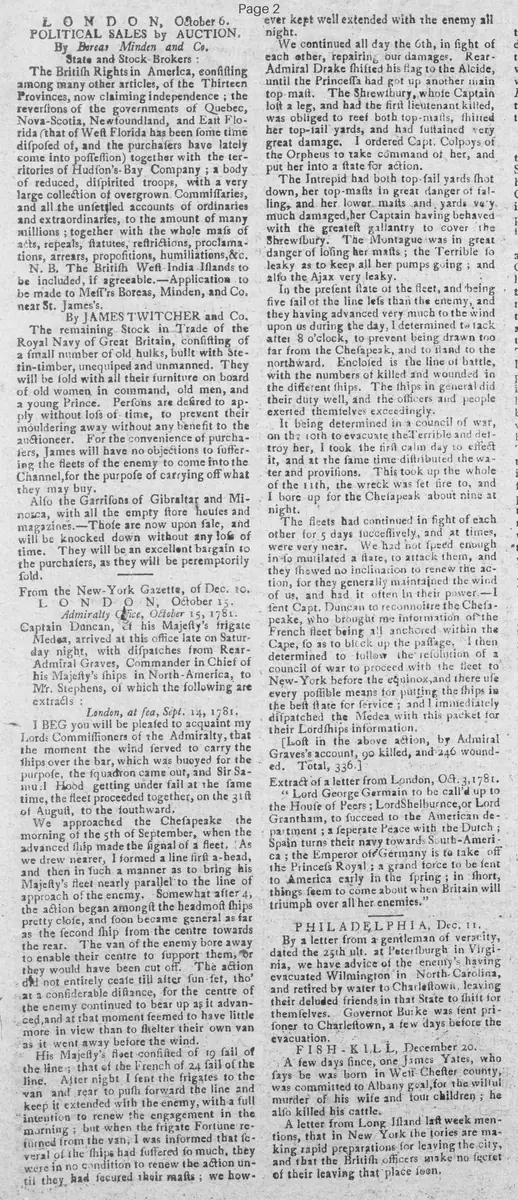
LONDON, October 15.
Admiralty Office, October 15, 1781.
Captain Duncan, of his Majesty's frigate Medea, arrived at this office late on Saturday night, with dispatches from Rear-Admiral Graves, Commander in Chief of his Majesty's ships in North-America, to Mr. Stephens, of which the following are extracts:
London, at sea, Sept. 14, 1781.
I BEG you will be pleased to acquaint my Lords Commissioners of the Admiralty, that the moment the wind served to carry the ships over the bar, which was buoyed for the purpose, the squadron came out, and Sir Samuel Hood getting under sail at the same time, the fleet proceeded together, on the 31st of August, to the southward.
We approached the Chesapeake the morning of the 5th of September, when the advanced ship made the signal of a fleet. As we drew nearer, I formed a line first a-head, and then in such a manner as to bring his Majesty's fleet nearly parallel to the line of approach of the enemy. Somewhat after 4, the action began amongst the headmost ships pretty close, and soon became general as far as the second ship from the centre towards the rear. The van of the enemy bore away to enable their centre to support them, or they would have been cut off. The action did not entirely cease till after sun-set, tho at a considerable distance, for the centre of the enemy continued to bear up as it advanced, and at that moment seemed to have little more in view than to shelter their own van as it went away before the wind.
His Majesty's fleet consisted of 19 sail of the line; that of the French of 24 sail of the line. After night I sent the frigates to the van and rear to push forward the line and keep it extended with the enemy, with a full intention to renew the engagement in the morning; but when the frigate Fortune returned from the van, I was informed that several of the ships had suffered so much, they were in no condition to renew the action until they had secured their masts; we however kept well extended with the enemy all night.
We continued all day the 6th in sight of each other, repairing our damages. Rear-Admiral Drake shifted his flag to the Alcide, until the Princess had got up another main top-mast. The Shrewsbury, whose Captain lost a leg, and had the first lieutenant killed, was obliged to reef both top-masts, shifted her top-sail yards, and had sustained very great damage. I ordered Capt. Colpoys of the Orpheus to take command of her, and put her into a state for action.
The Intrepid had both top-sail yards shot down, her top-masts in great danger of falling, and her lower masts and yards very much damaged, her Captain having behaved with the greatest gallantry to cover the Shrewsbury. The Montague was in great danger of losing her masts; the Terrible so leaky as to keep all her pumps going; and also the Ajax very leaky.
In the present state of the fleet, and being five sail of the line less than the enemy, and they having advanced very much to the wind upon us during the day, I determined to tack after 8 o'clock, to prevent being drawn too far from the Chesapeake, and to stand to the northward. Enclosed is the line of battle, with the numbers of killed and wounded in the different ships. The ships in general did their duty well, and the officers and people exerted themselves exceedingly.
It being determined in a council of war, on the 9th to evacuate the Terrible and destroy her, I took the first calm day to effect it, and at the same time distributed the water and provisions. This took up the whole of the 11th, the wreck was set fire to, and I bore up for the Chesapeake about nine at night.
The fleets had continued in sight of each other for 5 days successively, and at times, were very near. We had not speed enough in so mutilated a state, to attack them, and they showed no inclination to renew the action, for they generally maintained the wind of us, and had it often in their power.--I sent Capt. Duncan to reconnoitre the Chesapeake, who brought me information of the French fleet being all anchored within the Cape, so as to block up the passage. I then determined to follow the resolution of a council of war to proceed with the fleet to New-York before the equinox, and there use every possible means for putting the ships in the best state for service; and I immediately dispatched the Medea with this packet for their Lordships information.
Lost in the above action, by Admiral Graves's account, 90 killed, and 246 wounded. Total, 336.
What sub-type of article is it?
What keywords are associated?
What entities or persons were involved?
Where did it happen?
Foreign News Details
Primary Location
Chesapeake
Event Date
September 5, 1781
Key Persons
Outcome
british losses: 90 killed, 246 wounded (total 336). fleet heavily damaged, terrible scuttled; withdrew to new york without decisive victory; french fleet blockaded chesapeake.
Event Details
British fleet under Rear-Admiral Graves, 19 ships of the line, engaged French fleet of 24 off Chesapeake on Sept. 5. Action lasted until sunset; British ships damaged, unable to renew fight. Fleets in sight for 5 days; British repaired and tacked north to avoid being drawn away, then proceeded to New York after scuttling the Terrible.