Thank you for visiting SNEWPapers!
Sign up free
Literary
October 17, 1803
The National Intelligencer And Washington Advertiser
Washington, District Of Columbia
What is this article about?
Critical biographical sketch of Charles Francois Dumouriez, born 1739, detailing his military career from early wounds in Seven Years' War, adventures in Italy, Corsica, Spain, Poland, to roles in French Revolution: minister, general, victories at Jemappes, defeats, and 1793 defection to Austrians, portraying him as restless intriguer.
Clipping
OCR Quality
95%
Excellent
Full Text
GENERAL DUMOURIER.
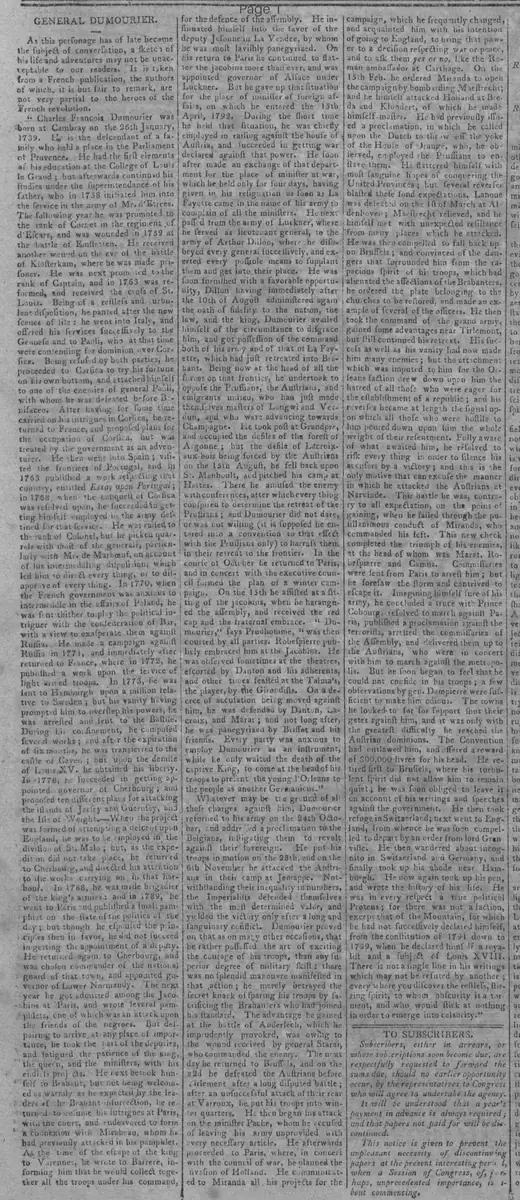
As this personage has of late become the subject of conversation, a sketch of his life and adventures may not be unacceptable to our readers. It is taken from a French publication, the authors of which, it is but fair to remark, are not very partial to the heroes of the French revolution.
"Charles Francois Dumourier was born at Cambray on the 26th January, 1739. He is the descendant of a family who held a place in the Parliament of Provence. He had the first elements of his education at the College of Louis le Grand: but afterwards continued his studies under the superintendence of his father, who in 1758 initiated him into the service in the army of M. d'Etrees. The following year he was promoted to the rank of Cornet in the regiment of d'Escars, and was wounded in 1759 at the battle of Hastenbeck. He received another wound on the eve of the battle of Closter-camp, where he was made prisoner. He was next promoted to the rank of Captain, and in 1763 was reformed, and received the cross of St. Louis. Being of a restless and turbulent disposition, he panted after the new scenes of life: he went into Italy, and offered his services successively to the Genoese and to Paoli, who at that time were contending for dominion over Corsica. Being refused by both parties, he proceeded to Corsica to try his fortune on his own bottom, and attached himself to one of the enemies of general Paoli, with whom he was defeated before Bastia. After having for some time carried on his intrigues in Corsica, he returned to France, and proposed plans for the occupation of Corsica, but was treated by the government as an adventurer. He then went into Spain; visited the frontiers of Portugal, and in 1763 published a work reflecting on that country, entitled Essay upon Portugal; in 1768 when the conquest of Corsica was resolved upon, he succeeded in getting himself employed in the army destined for that service. He was raised to the rank of Colonel, but he picked quarrels with most of the generals, particularly with M. de Marboeuf, on account of his intermeddling disposition, which led him to direct every thing, or to disapprove of every thing. In 1770, when the French government was anxious to intermeddle in the affairs of Poland, he was sent thither to play the political intriguer with the confederation of Bar, with a view to exasperate them against Russia. He made a campaign against Russia in 1771, and immediately after returned to France, where in 1772, he published a work upon the service of light armed troops. In 1773, he was sent to Hamburgh upon a mission relative to Sweden; but his vanity having prompted him to overstep his powers, he was arrested and sent to the Bastile. During his confinement, he composed several works; and after the expiration of six months, he was transferred to the castle of Caen; but upon the demise of Louis XV. he obtained his liberty. In 1778, he succeeded in getting appointed governor of Cherbourg; and proposed ten different plans for attacking the islands of Jersey and Guernsey, and the Isle of Wight. When the project was formed of attempting a descent upon England, he was to be employed in the division of St. Malo: but, as the expedition did not take place, he returned to Cherbourg, and directed his attention to the works carrying on in that harbour. In 1788. he was made brigadier of the king's armies: and in 1789, he went to Paris and published a small pamphlet on the state of the politics of the day; but though he espoused the principles then in favor, he did not succeed in getting the appointment of a deputy. He returned again to Cherbourg, and was chosen commander of the national guard of that town, and appointed governor of Lower Normandy. The next year he got admitted among the Jacobins at Paris, and wrote several pamphlets, one of which was an attack upon the friends of the negroes. But despairing to arrive at any place of importance, he took the part of the deputies, and fatigued the patience of the king, the queen, and the ministers, with his endless projects. He next betook himself to Brabant, but not being welcomed as warmly as he expected by the leaders of the Brabant revolution, he returned to resume his intrigues at Paris. with the court, and endeavored to form a connexion with Mirabeau, whom he had previously attacked in his pamphlet. At the time of the escape of the king to Varennes, he wrote to Barrere, informing him that he would collect together all the troops under his command,
for the defence of the assembly. He insinuated himself into the favor of the deputy Journay in La Vendee, by whom he was most lavishly panegyrized. On his return to Paris he continued to flatter the jacobins more than ever, and was appointed governor of Alsace under Luckner. But he gave up that situation for the place of minister of foreign affairs, on which he entered the 15th April, 1792. During the short time he held that situation, he was chiefly employed in railing against the house of Austria, and succeeded in getting war declared against that power. He soon after made an exchange of that department for the place of minister at war, which he held only for four days, having given in his resignation as soon as La Fayette came in the name of his army to complain of all the ministers. He next passed from the army of Luckner, where he served as lieutenant general, to the army of Arthur Dillon, where he disobeyed every general successively, and exerted every possible means to supplant them and get into their place. He was soon furnished with a favorable opportunity, Dillon having immediately after the 10th of August administered again the oath of fidelity to the nation, the law, and the king, Dumourier availed himself of the circumstance to disgrace him, and got possession of the command both of his army and of that of La Fayette, which had just retreated into Brabant. Being now at the head of all the forces on that frontier, he undertook to oppose the Prussians, the Austrians, and emigrants united, who had just made themselves masters of Longwy and Verdun, and who were advancing towards Champagne. He took post at Grandpre, and occupied the defiles of the forest of Argonne; but the defile of Lacroix-aux-bois being forced by the Austrians on the 15th August, he fell back upon St. Mengoult, and pitched his camp at Hertes. There he amused the enemy with conferences, after which every thing conspired to determine the retreat of the Prussians; and Dumourier did not dare, or was not willing (it is supposed he entered into a convention to that effect with the Prussians only) to harass them in their retreat to the frontier. In the course of October he returned to Paris, and in concert with the executive council formed the plan of a winter campaign. On the 15th he assisted at a sitting of the jacobins, when he harangued the assembly, and received the red cap and the fraternal embrace. "Dumourier," says Prudhomme, "was then courted by all parties. Robespierre publicly embraced him at the Jacobins. He was observed sometimes at the theatres, escorted by Danton and his adherents, and other times feasted at the Talma's, the player, by the Girondists. On a decree of accusation being moved against him, he was defended by Danton, Lacroix, and Marat; and not long after, he was panegyrized by Brissot and his friends. Every party was anxious to employ Dumourier as an instrument, while he only waited the death of the captive King, to come at the head of his troops to present the young D'Orleans to the people as another Germanicus." Whatever may be the ground of all these charges against him, Dumourier returned to his army on the 24th October, and addressed a proclamation to the Belgians, instigating them to revolt against their sovereign. He put his troops in motion on the 23th, and on the 6th November he attacked the Austrians in their camp at Jemappes. Notwithstanding their inequality in numbers, the Imperialists defended themselves with the most determined valor, and yielded the victory only after a long and sanguinary conflict. Dumourier proved on that as on many other occasions, that he rather possessed the art of exciting the courage of his troops, than any superior degree of military skill: there was no splendid manoeuvre manifested in that action; he merely betrayed the secret knack of sparing his troops by sacrificing the Brabanters who had joined his standard. The advantage he gained at the battle of Anderlecht, which he imprudently provoked, was owing to the wound received by general Clairfait, who commanded the enemy. The next day he returned to Brussels, and on the 22d he defeated the Austrians before Tirlemont after a long disputed battle: after an unsuccessful attack of their rear at Wavre, he put his troops into winter quarters. He then began his attack on the minister Pache, whom he accused of leaving his army unprovided with very necessary articles. He afterwards proceeded to Paris, where, in concert with the council of war, he planned the invasion of Holland. He communicated to Miranda all his projects for the
campaign, which he frequently changed, and acquainted him with his intention of going to England, to bring that power to a decision respecting war or peace, and to ask them yes or no, like the Roman ambassador at Carthage. On the 15th Feb. he ordered Miranda to open the campaign by bombarding Maestricht; and he himself attacked Holland at Breda and Klundert, of which he made himself master. He had previously issued a proclamation, in which he called upon the Dutch to throw off the yoke of the House of Orange, who, he observed, employed the Prussians to enslave them. He flattered himself with most sanguine hopes of conquering the United Provinces; but several reverses blasted these fond expectations. Lannoue was defeated on the 1st of March at Aldenhoven; Maestricht relieved, and he himself met with unexpected resistance from many places which he attacked. He was then compelled to fall back upon Brussels; and convinced of the dangers that surrounded him from the rapacious spirit of his troops, which had alienated the affections of the Brabanters, he ordered the plate belonging to the churches to be restored, and made an example of several of the officers. He then took the command of the grand army. gained some advantages near Tirlemont, but still continued his retreat. His success as well as his vanity had now made him many enemies; but the attachment which was imputed to him for the Orleans faction drew down upon him the hatred of all those who were eager for the establishment of a republic; and his reverses became at length the signal upon which all those who were hostile to him poured down upon him the whole weight of their resentment. Fully aware of what awaited him, he resolved to risk every thing in order to silence his accusers by a victory; and this is the only motive that can excuse the manner in which he attacked the Austrians at Neervinden. This battle he was, contrary to all expectation, on the point of gaining, when he failed through the pusillanimous conduct of Miranda, who commanded his left. This new check completed the triumph of his enemies, at the head of whom was Marat, Robespierre and Camus. Commissaries were sent from Paris to arrest him; but he foresaw the storm and contrived to escape it. Imagining himself sure of his army, he concluded a truce with Prince Cobourg. resolved to march against Paris, published a proclamation against the terrorists, arrested the commissaries of the Assembly, and delivered them up to the Austrians, who were in concert with him to march against the metropolis. But he soon began to feel that he could not confide in his troops; a few observations by gen. Dampierre were sufficient to make him odious. The towns he looked to for support shut their gates against him, and it was only with the greatest difficulty he reached the Austrian dominions. The Convention had outlawed him, and offered a reward of 300,000 livres for his head. He retired first to Brussels, where his turbulent spirit did not allow him to remain quiet; he was soon obliged to leave it on account of his writings and speeches against the government. He then took refuge in Switzerland; next went to England, from whence he was soon compelled to depart by an order from lord Grenville. He then wandered about incognito in Switzerland and Germany, and finally took up his abode near Hamburgh. He now again took up his pen, and wrote the history of his life. He was in every respect a true political Proteus; for there was not a faction, except that of the Mountain, for which he had not successively declared himself. from the constitution of 1791 down to 1799, when he declared himself a royalist and a subject of Louis XVIII. There is not a single line in his writings which may not be refuted by another; every where you discover the restless, stirring spirit, to whom obscurity is a torment, and who would stick at nothing in order to emerge into celebrity."
As this personage has of late become the subject of conversation, a sketch of his life and adventures may not be unacceptable to our readers. It is taken from a French publication, the authors of which, it is but fair to remark, are not very partial to the heroes of the French revolution.
"Charles Francois Dumourier was born at Cambray on the 26th January, 1739. He is the descendant of a family who held a place in the Parliament of Provence. He had the first elements of his education at the College of Louis le Grand: but afterwards continued his studies under the superintendence of his father, who in 1758 initiated him into the service in the army of M. d'Etrees. The following year he was promoted to the rank of Cornet in the regiment of d'Escars, and was wounded in 1759 at the battle of Hastenbeck. He received another wound on the eve of the battle of Closter-camp, where he was made prisoner. He was next promoted to the rank of Captain, and in 1763 was reformed, and received the cross of St. Louis. Being of a restless and turbulent disposition, he panted after the new scenes of life: he went into Italy, and offered his services successively to the Genoese and to Paoli, who at that time were contending for dominion over Corsica. Being refused by both parties, he proceeded to Corsica to try his fortune on his own bottom, and attached himself to one of the enemies of general Paoli, with whom he was defeated before Bastia. After having for some time carried on his intrigues in Corsica, he returned to France, and proposed plans for the occupation of Corsica, but was treated by the government as an adventurer. He then went into Spain; visited the frontiers of Portugal, and in 1763 published a work reflecting on that country, entitled Essay upon Portugal; in 1768 when the conquest of Corsica was resolved upon, he succeeded in getting himself employed in the army destined for that service. He was raised to the rank of Colonel, but he picked quarrels with most of the generals, particularly with M. de Marboeuf, on account of his intermeddling disposition, which led him to direct every thing, or to disapprove of every thing. In 1770, when the French government was anxious to intermeddle in the affairs of Poland, he was sent thither to play the political intriguer with the confederation of Bar, with a view to exasperate them against Russia. He made a campaign against Russia in 1771, and immediately after returned to France, where in 1772, he published a work upon the service of light armed troops. In 1773, he was sent to Hamburgh upon a mission relative to Sweden; but his vanity having prompted him to overstep his powers, he was arrested and sent to the Bastile. During his confinement, he composed several works; and after the expiration of six months, he was transferred to the castle of Caen; but upon the demise of Louis XV. he obtained his liberty. In 1778, he succeeded in getting appointed governor of Cherbourg; and proposed ten different plans for attacking the islands of Jersey and Guernsey, and the Isle of Wight. When the project was formed of attempting a descent upon England, he was to be employed in the division of St. Malo: but, as the expedition did not take place, he returned to Cherbourg, and directed his attention to the works carrying on in that harbour. In 1788. he was made brigadier of the king's armies: and in 1789, he went to Paris and published a small pamphlet on the state of the politics of the day; but though he espoused the principles then in favor, he did not succeed in getting the appointment of a deputy. He returned again to Cherbourg, and was chosen commander of the national guard of that town, and appointed governor of Lower Normandy. The next year he got admitted among the Jacobins at Paris, and wrote several pamphlets, one of which was an attack upon the friends of the negroes. But despairing to arrive at any place of importance, he took the part of the deputies, and fatigued the patience of the king, the queen, and the ministers, with his endless projects. He next betook himself to Brabant, but not being welcomed as warmly as he expected by the leaders of the Brabant revolution, he returned to resume his intrigues at Paris. with the court, and endeavored to form a connexion with Mirabeau, whom he had previously attacked in his pamphlet. At the time of the escape of the king to Varennes, he wrote to Barrere, informing him that he would collect together all the troops under his command,
for the defence of the assembly. He insinuated himself into the favor of the deputy Journay in La Vendee, by whom he was most lavishly panegyrized. On his return to Paris he continued to flatter the jacobins more than ever, and was appointed governor of Alsace under Luckner. But he gave up that situation for the place of minister of foreign affairs, on which he entered the 15th April, 1792. During the short time he held that situation, he was chiefly employed in railing against the house of Austria, and succeeded in getting war declared against that power. He soon after made an exchange of that department for the place of minister at war, which he held only for four days, having given in his resignation as soon as La Fayette came in the name of his army to complain of all the ministers. He next passed from the army of Luckner, where he served as lieutenant general, to the army of Arthur Dillon, where he disobeyed every general successively, and exerted every possible means to supplant them and get into their place. He was soon furnished with a favorable opportunity, Dillon having immediately after the 10th of August administered again the oath of fidelity to the nation, the law, and the king, Dumourier availed himself of the circumstance to disgrace him, and got possession of the command both of his army and of that of La Fayette, which had just retreated into Brabant. Being now at the head of all the forces on that frontier, he undertook to oppose the Prussians, the Austrians, and emigrants united, who had just made themselves masters of Longwy and Verdun, and who were advancing towards Champagne. He took post at Grandpre, and occupied the defiles of the forest of Argonne; but the defile of Lacroix-aux-bois being forced by the Austrians on the 15th August, he fell back upon St. Mengoult, and pitched his camp at Hertes. There he amused the enemy with conferences, after which every thing conspired to determine the retreat of the Prussians; and Dumourier did not dare, or was not willing (it is supposed he entered into a convention to that effect with the Prussians only) to harass them in their retreat to the frontier. In the course of October he returned to Paris, and in concert with the executive council formed the plan of a winter campaign. On the 15th he assisted at a sitting of the jacobins, when he harangued the assembly, and received the red cap and the fraternal embrace. "Dumourier," says Prudhomme, "was then courted by all parties. Robespierre publicly embraced him at the Jacobins. He was observed sometimes at the theatres, escorted by Danton and his adherents, and other times feasted at the Talma's, the player, by the Girondists. On a decree of accusation being moved against him, he was defended by Danton, Lacroix, and Marat; and not long after, he was panegyrized by Brissot and his friends. Every party was anxious to employ Dumourier as an instrument, while he only waited the death of the captive King, to come at the head of his troops to present the young D'Orleans to the people as another Germanicus." Whatever may be the ground of all these charges against him, Dumourier returned to his army on the 24th October, and addressed a proclamation to the Belgians, instigating them to revolt against their sovereign. He put his troops in motion on the 23th, and on the 6th November he attacked the Austrians in their camp at Jemappes. Notwithstanding their inequality in numbers, the Imperialists defended themselves with the most determined valor, and yielded the victory only after a long and sanguinary conflict. Dumourier proved on that as on many other occasions, that he rather possessed the art of exciting the courage of his troops, than any superior degree of military skill: there was no splendid manoeuvre manifested in that action; he merely betrayed the secret knack of sparing his troops by sacrificing the Brabanters who had joined his standard. The advantage he gained at the battle of Anderlecht, which he imprudently provoked, was owing to the wound received by general Clairfait, who commanded the enemy. The next day he returned to Brussels, and on the 22d he defeated the Austrians before Tirlemont after a long disputed battle: after an unsuccessful attack of their rear at Wavre, he put his troops into winter quarters. He then began his attack on the minister Pache, whom he accused of leaving his army unprovided with very necessary articles. He afterwards proceeded to Paris, where, in concert with the council of war, he planned the invasion of Holland. He communicated to Miranda all his projects for the
campaign, which he frequently changed, and acquainted him with his intention of going to England, to bring that power to a decision respecting war or peace, and to ask them yes or no, like the Roman ambassador at Carthage. On the 15th Feb. he ordered Miranda to open the campaign by bombarding Maestricht; and he himself attacked Holland at Breda and Klundert, of which he made himself master. He had previously issued a proclamation, in which he called upon the Dutch to throw off the yoke of the House of Orange, who, he observed, employed the Prussians to enslave them. He flattered himself with most sanguine hopes of conquering the United Provinces; but several reverses blasted these fond expectations. Lannoue was defeated on the 1st of March at Aldenhoven; Maestricht relieved, and he himself met with unexpected resistance from many places which he attacked. He was then compelled to fall back upon Brussels; and convinced of the dangers that surrounded him from the rapacious spirit of his troops, which had alienated the affections of the Brabanters, he ordered the plate belonging to the churches to be restored, and made an example of several of the officers. He then took the command of the grand army. gained some advantages near Tirlemont, but still continued his retreat. His success as well as his vanity had now made him many enemies; but the attachment which was imputed to him for the Orleans faction drew down upon him the hatred of all those who were eager for the establishment of a republic; and his reverses became at length the signal upon which all those who were hostile to him poured down upon him the whole weight of their resentment. Fully aware of what awaited him, he resolved to risk every thing in order to silence his accusers by a victory; and this is the only motive that can excuse the manner in which he attacked the Austrians at Neervinden. This battle he was, contrary to all expectation, on the point of gaining, when he failed through the pusillanimous conduct of Miranda, who commanded his left. This new check completed the triumph of his enemies, at the head of whom was Marat, Robespierre and Camus. Commissaries were sent from Paris to arrest him; but he foresaw the storm and contrived to escape it. Imagining himself sure of his army, he concluded a truce with Prince Cobourg. resolved to march against Paris, published a proclamation against the terrorists, arrested the commissaries of the Assembly, and delivered them up to the Austrians, who were in concert with him to march against the metropolis. But he soon began to feel that he could not confide in his troops; a few observations by gen. Dampierre were sufficient to make him odious. The towns he looked to for support shut their gates against him, and it was only with the greatest difficulty he reached the Austrian dominions. The Convention had outlawed him, and offered a reward of 300,000 livres for his head. He retired first to Brussels, where his turbulent spirit did not allow him to remain quiet; he was soon obliged to leave it on account of his writings and speeches against the government. He then took refuge in Switzerland; next went to England, from whence he was soon compelled to depart by an order from lord Grenville. He then wandered about incognito in Switzerland and Germany, and finally took up his abode near Hamburgh. He now again took up his pen, and wrote the history of his life. He was in every respect a true political Proteus; for there was not a faction, except that of the Mountain, for which he had not successively declared himself. from the constitution of 1791 down to 1799, when he declared himself a royalist and a subject of Louis XVIII. There is not a single line in his writings which may not be refuted by another; every where you discover the restless, stirring spirit, to whom obscurity is a torment, and who would stick at nothing in order to emerge into celebrity."
What sub-type of article is it?
Essay
Satire
What themes does it cover?
Political
War Peace
What keywords are associated?
Dumouriez Biography
French Revolution
Military Career
Political Intrigue
Defection
Jemappes Battle
Neervinden
Literary Details
Title
General Dumourier.
Subject
Sketch Of His Life And Adventures