Thank you for visiting SNEWPapers!
Sign up free
Editorial
August 23, 1808
The Enquirer
Richmond, Henrico County, Virginia
What is this article about?
This editorial defends the Republican Embargo policy against Federalist ridicule of the 'Terrapin System,' citing Federalist icon Fisher Ames' 1794 advocacy for a similar embargo against British trade restrictions. It argues current threats from Britain and France justify it more, alongside defensive preparations, preferring embargo to war.
Clipping
OCR Quality
98%
Excellent
Full Text
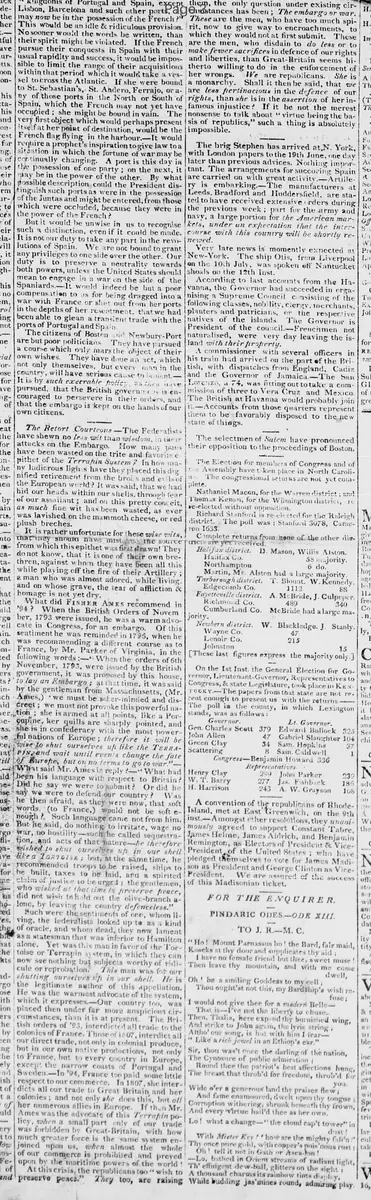
The Retort Courteous—The Federalists have shewn no less wit than wisdom, in their attacks on the Embargo. How many puns have been wasted on the trite and favorite epithet of the Terrapin System? In how many ludicrous lights have they placed this dignified retirement from the broils and evils of the European world? It was said, that we had hid our heads within our shells, through fear of our assailant; and on this pretty conceit, as much fine wit has been wasted, as ever was lavished on the mammoth cheese, or red plush breeches.
It is rather unfortunate for these wise wits, that they should have mistaken the source from which this epithet was first drawn! They do not know, that it is one of their own brethren, against whom they have been all this while playing off the fire of their Artillery; a man who was almost adored, while living, and on whose grave, the tear of affliction & homage is not yet dry.
What did FISHER AMES recommend in '94? When the British Orders of November, 1793 were issued, he was a warm advocate in Congress, for an embargo. Of this sentiment he was reminded in 1796, when he was recommending a different course as to France, by Mr. Parker of Virginia, in the following words:—'When the orders of 6th November, 1793, were issued by the British government, it was proposed by this house, to lay an Embargo; at that time, it was said by the gentleman from Massachusetts, (Mr. Ames,) 'we must be soft er-minded and discreet; we must not provoke this powerful nation; she is armed at all points, like a Porcupine, her quills are sharply pointed, and she is in confederacy with the most powerful nations of Europe; therefore it will be wise to shut ourselves up like the Terrapin and wait until events change the fate of Europe, but on no terms to go to war.'—
What said Mr. Ames in reply? What had been his language with respect to Britain? Did he say we were to submit? Or did he say we were to defend our country? Was he then afraid, as they were now, that soft words, (to France,) would not be soft enough? Such language came not from him. But—he said, do nothing to irritate, wage no war, no hostility—such he called sequestration, and acts of that nature—he therefore wished to shut ourselves up in our shell like a Tortoise; but, at the same time, he recommended troops to be raised, ships to be built, taxes to be laid, and a spirited claim of justice to be urged; the gentlemen, who wished at that time to preserve peace, did not wish to hold out the olive-branch alone, by leaving the country defenceless.
Such were the sentiments of one, whom living, the federalists looked up to as a kind of oracle, and whom dead, they now lament as a statesman that was inferior to Hamilton alone. Yet was this man in favor of the Tortoise or Terrapin system, in which they can now see nothing but subjects worthy of ridicule or reprobation. This man was for our shutting ourselves up in our shell. He is the legitimate author of this appellation. He was the warmest advocate of the system, which it expresses. Our country too, was placed then under far more auspicious circumstances, than it is at present. The British orders of '93, interdicted all trade to the colonies of France. Those of 1807, interdict all our direct trade, not only in colonial produce, but in our own native productions, not only to France, but to every country in Europe, except the narrow coasts of Portugal and Sweden. In '94, France too paid some little respect to our commerce. In 1807, she interdicts all our trade to Great Britain and her colonies: and not only she does this, but all her numerous allies in Europe. If then Mr. Ames was the advocate of this Terrapin policy, when a small part only of our trade was forbidden by Great-Britain, with how much greater force is the same system enjoined upon us, when almost the whole of our commerce is prohibited and preyed upon by the maritime powers of the world!
At this crisis, the republicans too "wish to preserve peace"
They too, are raising troops. They too, are about to arm the militia: to fortify our ports and harbors; and to build such vessels, as may be competent to assist in the defence of our Coast. They too, at such an era, do not wish to leave their country defenceless—whatever the federalists may wish on this subject. But they too, are unwilling to see our property taken captive on the high seas to enrich our assailants—to submit to see our commerce carried on under the licence and taxation of the same nation, whose presumption to tax us without our own consent we once resisted at the hazard of our lives; and to see the honor of their country, a bye-word and a byword among the nations of the earth. With them, the only question under existing circumstances has been; The embargo or war.
These are the men, who have too much spirit, now to give way to encroachments, to which they would not at first submit. These are the men, who disdain to do less or to make fewer sacrifices in defence of our rights and liberties, than Great-Britain seems hitherto willing to do in the enforcement of her wrongs. We are republicans. She is a monarchy. Shall it then be said, that we are less pertinacious in the defence of our rights, than she is in the assertion of her infamous injustice? If it be not the merest nonsense to talk about "virtue being the basis of republics," such a thing is absolutely impossible.
It is rather unfortunate for these wise wits, that they should have mistaken the source from which this epithet was first drawn! They do not know, that it is one of their own brethren, against whom they have been all this while playing off the fire of their Artillery; a man who was almost adored, while living, and on whose grave, the tear of affliction & homage is not yet dry.
What did FISHER AMES recommend in '94? When the British Orders of November, 1793 were issued, he was a warm advocate in Congress, for an embargo. Of this sentiment he was reminded in 1796, when he was recommending a different course as to France, by Mr. Parker of Virginia, in the following words:—'When the orders of 6th November, 1793, were issued by the British government, it was proposed by this house, to lay an Embargo; at that time, it was said by the gentleman from Massachusetts, (Mr. Ames,) 'we must be soft er-minded and discreet; we must not provoke this powerful nation; she is armed at all points, like a Porcupine, her quills are sharply pointed, and she is in confederacy with the most powerful nations of Europe; therefore it will be wise to shut ourselves up like the Terrapin and wait until events change the fate of Europe, but on no terms to go to war.'—
What said Mr. Ames in reply? What had been his language with respect to Britain? Did he say we were to submit? Or did he say we were to defend our country? Was he then afraid, as they were now, that soft words, (to France,) would not be soft enough? Such language came not from him. But—he said, do nothing to irritate, wage no war, no hostility—such he called sequestration, and acts of that nature—he therefore wished to shut ourselves up in our shell like a Tortoise; but, at the same time, he recommended troops to be raised, ships to be built, taxes to be laid, and a spirited claim of justice to be urged; the gentlemen, who wished at that time to preserve peace, did not wish to hold out the olive-branch alone, by leaving the country defenceless.
Such were the sentiments of one, whom living, the federalists looked up to as a kind of oracle, and whom dead, they now lament as a statesman that was inferior to Hamilton alone. Yet was this man in favor of the Tortoise or Terrapin system, in which they can now see nothing but subjects worthy of ridicule or reprobation. This man was for our shutting ourselves up in our shell. He is the legitimate author of this appellation. He was the warmest advocate of the system, which it expresses. Our country too, was placed then under far more auspicious circumstances, than it is at present. The British orders of '93, interdicted all trade to the colonies of France. Those of 1807, interdict all our direct trade, not only in colonial produce, but in our own native productions, not only to France, but to every country in Europe, except the narrow coasts of Portugal and Sweden. In '94, France too paid some little respect to our commerce. In 1807, she interdicts all our trade to Great Britain and her colonies: and not only she does this, but all her numerous allies in Europe. If then Mr. Ames was the advocate of this Terrapin policy, when a small part only of our trade was forbidden by Great-Britain, with how much greater force is the same system enjoined upon us, when almost the whole of our commerce is prohibited and preyed upon by the maritime powers of the world!
At this crisis, the republicans too "wish to preserve peace"
They too, are raising troops. They too, are about to arm the militia: to fortify our ports and harbors; and to build such vessels, as may be competent to assist in the defence of our Coast. They too, at such an era, do not wish to leave their country defenceless—whatever the federalists may wish on this subject. But they too, are unwilling to see our property taken captive on the high seas to enrich our assailants—to submit to see our commerce carried on under the licence and taxation of the same nation, whose presumption to tax us without our own consent we once resisted at the hazard of our lives; and to see the honor of their country, a bye-word and a byword among the nations of the earth. With them, the only question under existing circumstances has been; The embargo or war.
These are the men, who have too much spirit, now to give way to encroachments, to which they would not at first submit. These are the men, who disdain to do less or to make fewer sacrifices in defence of our rights and liberties, than Great-Britain seems hitherto willing to do in the enforcement of her wrongs. We are republicans. She is a monarchy. Shall it then be said, that we are less pertinacious in the defence of our rights, than she is in the assertion of her infamous injustice? If it be not the merest nonsense to talk about "virtue being the basis of republics," such a thing is absolutely impossible.
What sub-type of article is it?
Economic Policy
Foreign Affairs
Partisan Politics
What keywords are associated?
Embargo
Terrapin System
Fisher Ames
Federalists
Republicans
British Orders
French Restrictions
Trade Interdiction
What entities or persons were involved?
Federalists
Republicans
Fisher Ames
British Government
France
Editorial Details
Primary Topic
Defense Of The Embargo Against Federalist Criticism Using Fisher Ames Advocacy
Stance / Tone
Pro Republican Pro Embargo Critical Of Federalists
Key Figures
Federalists
Republicans
Fisher Ames
British Government
France
Key Arguments
Federalists Ridicule The 'Terrapin System' But Fisher Ames Advocated It In 1794
Ames Recommended Embargo Sequestration Alongside Military Preparations
Current British And French Restrictions Are More Severe Than In 1793 94
Republicans Prepare Defenses While Choosing Embargo Over War To Protect Commerce And Honor
Republicans Refuse Submission To Foreign Taxation And Encroachments
Virtue Requires Pertinacious Defense Of Rights Against British Injustice