Thank you for visiting SNEWPapers!
Sign up free
Domestic News
May 13, 1871
The Ottawa Free Trader
Ottawa, La Salle County County, Illinois
What is this article about?
A correspondent in the Germantown Telegraph disputes the notion that sowing grass seeds like clover or timothy with wheat causes rust, attributing it instead to late sowing and poor conditions. He advises early sowing for better yields and warns against post-harvest seeding due to dry weather and weeds.
Clipping
OCR Quality
98%
Excellent
Full Text
FARM, GARDEN, HOUSEHOLD.
The Cause of Rust in Wheat.
A correspondent of the Germantown Telegraph writes to that paper on this topic in this wise:
I have before me an article in last week's paper, stating that it is getting to be the pretty general opinion among farmers that the sowing of grass seed, clover or timothy, in the fall with wheat, is the cause of rust in the same, etc.
I beg leave to differ from that article; first, clover is generally sown in the spring in this region of the country at least—the winter would probably destroy it; but timothy is usually sown with the wheat, or close following it. If any person wishes to raise a crop of wheat and rust, I will give them a receipt how to do so. Sow your wheat very late in the fall in order not to get much root, so that the frosts of winter may raise much of it out of the ground and cause it to perish: it will then start in the spring thin, grow rank, with a very dark color, and ripen very late. You may then expect a good crop of rust. Yet if it is sown in good season, ground good, plenty of seed, timothy moderate, you may expect as bright straw as any of your neighbors, although they may have sown grass seed or not.
Damp or rainy weather is favorable to smut; but that will come if it choose, grass or no. If the wheat is sown early, the timothy need not be quite so thick as formerly the custom when sown later; the reason is, it will supply itself with a stronger root. But the grass seed is of high importance, as the wheat crop will barely pay at the present prices of grain, labor, machinery, fertilizers, etc.
It is also claimed that grass seed, sown after harvesting the wheat, will produce as good crops the following year as it would if sown with the wheat. Here I differ again, very much as to the timothy, and clover also, if it is sown after the wheat harvest: for we well know that we are very liable to have much dry weather after harvest, that would be much against its taking root; we also know that many weeds and much fall grass, as it is usually termed, would be striving for the mastery, and to smother it out, so that in the following fall or spring, we would have to put on our "specs" perhaps to find it; and to have a good crop the following season, the chance, I think, would be slim. With even a wet autumn, the fall grasses and other intruders would even more quickly, perhaps, choke the newly-sown grasses.
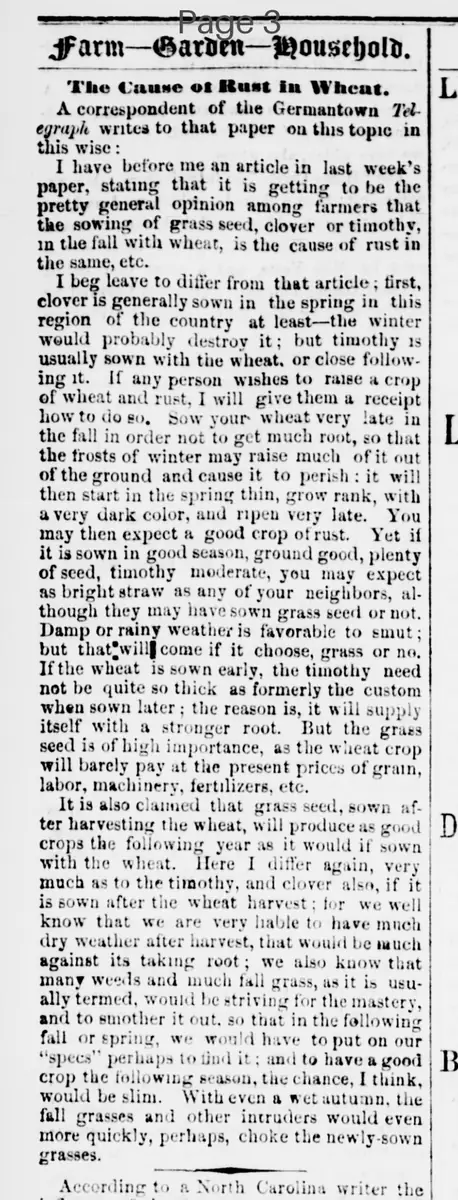
The Cause of Rust in Wheat.
A correspondent of the Germantown Telegraph writes to that paper on this topic in this wise:
I have before me an article in last week's paper, stating that it is getting to be the pretty general opinion among farmers that the sowing of grass seed, clover or timothy, in the fall with wheat, is the cause of rust in the same, etc.
I beg leave to differ from that article; first, clover is generally sown in the spring in this region of the country at least—the winter would probably destroy it; but timothy is usually sown with the wheat, or close following it. If any person wishes to raise a crop of wheat and rust, I will give them a receipt how to do so. Sow your wheat very late in the fall in order not to get much root, so that the frosts of winter may raise much of it out of the ground and cause it to perish: it will then start in the spring thin, grow rank, with a very dark color, and ripen very late. You may then expect a good crop of rust. Yet if it is sown in good season, ground good, plenty of seed, timothy moderate, you may expect as bright straw as any of your neighbors, although they may have sown grass seed or not.
Damp or rainy weather is favorable to smut; but that will come if it choose, grass or no. If the wheat is sown early, the timothy need not be quite so thick as formerly the custom when sown later; the reason is, it will supply itself with a stronger root. But the grass seed is of high importance, as the wheat crop will barely pay at the present prices of grain, labor, machinery, fertilizers, etc.
It is also claimed that grass seed, sown after harvesting the wheat, will produce as good crops the following year as it would if sown with the wheat. Here I differ again, very much as to the timothy, and clover also, if it is sown after the wheat harvest: for we well know that we are very liable to have much dry weather after harvest, that would be much against its taking root; we also know that many weeds and much fall grass, as it is usually termed, would be striving for the mastery, and to smother it out, so that in the following fall or spring, we would have to put on our "specs" perhaps to find it; and to have a good crop the following season, the chance, I think, would be slim. With even a wet autumn, the fall grasses and other intruders would even more quickly, perhaps, choke the newly-sown grasses.
What sub-type of article is it?
Agriculture
What keywords are associated?
Wheat Rust
Timothy Sowing
Clover Seeding
Farming Advice
Crop Conditions
Domestic News Details
Event Details
Correspondent disputes that sowing grass seeds with wheat causes rust, blames late sowing and winter damage; advises early sowing for healthy crops; warns post-harvest seeding risks failure from dry weather and weeds.