Thank you for visiting SNEWPapers!
Sign up free
The Alexandria Gazette
Alexandria, Virginia
What is this article about?
New York article discusses London Courier's commentary on Britain's policy of neutrality toward Spanish South American colonies' independence, withholding recognition until Spain does, and Portugal's Cortes recognizing Chile's independence amid revolutionary contexts.
Clipping
OCR Quality
Full Text
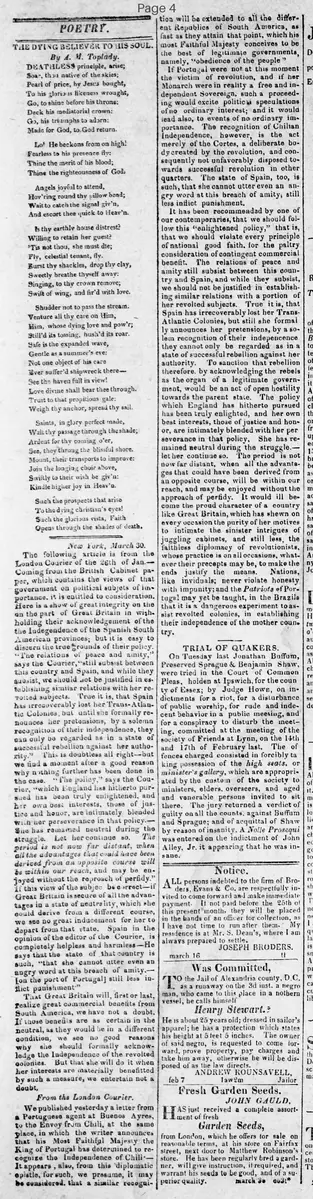
The following article is from the London Courier of the 26th of Jan. Coming from the British Cabinet paper, which contains the views of that government on political subjects of importance, it is entitled to consideration. Here is a show of great integrity on the part of Great Britain in withholding their acknowledgement of the Independence of the Spanish South American provinces; but it is easy to discern the true grounds of their policy.
"In relations of peace and amity," says the Courier, "still subsist between this country and Spain, and while they subsist, we should not be justified in establishing similar relations with her revolted subjects. True it is, that Spain has irrecoverably lost her Trans-Atlantic Colonies, but until she formally renounces her pretensions, by a solemn recognition of their independence, they can only be regarded as in a state of successful rebellion against her authority." This is doubtless all right--but we find a moment after a good reason why nothing further has been done in the case. "The policy," says the Courier, "which England has hitherto pursued has been truly enlightened, and her own best interests, those of justice and honor, are intimately blended with her perseverance in that policy. She has remained neutral during the struggle. Let her continue so. The period is not now far distant, when all the advantages that could have been derived from an opposite course will be within our reach, and may be enjoyed without the reproach of perfidy."
If this view of the subject be correct--if Great Britain is secure of all the advantages in a state of neutrality, which she could derive from a different course, we see no great inducement for her to depart from that state. Spain in the opinion of the editor of the Courier, is completely helpless and harmless. He says that the state of that country is such, "that she cannot utter even an angry word at this breach of amity.--[on the part of Portugal] still less inflict punishment."
That Great Britain will, first or last, realize great commercial benefits from South America, we have not a doubt. If those benefits are as certain in the neutral, as they would be in a different condition, we see no good reasons why she should formally acknowledge the Independence of the revolted colonies. But that she will do it when her interests are materially benefitted by such a measure, we entertain not a doubt.
From the London Courier.
We published yesterday a letter from a Portuguese agent at Buenos Ayres, to the Envoy from Chili, at the same place, in which the writer announces that his Most Faithful Majesty the King of Portugal has determined to recognize the Independence of Chili:--It appears, also, from this diplomatic Epistle, for such, we presume, it may be considered, that a similar recognition will be extended to all the different Republics of South America, as fast as they attain that point, which his most Faithful Majesty conceives to be the best of legitimate governments, namely, "obedience of the people."
If Portugal were not at this moment the victim of revolution, and if her Monarch were in reality a free and independent Sovereign, such a proceeding would excite political speculations of no ordinary interest; and it would lead also, to events of no ordinary importance. The recognition of Chilian Independence, however, is the act merely of the Cortes, a deliberate body created by the revolution, and consequently not unfavorably disposed towards successful revolution in other quarters. The state of Spain, too, is such, that she cannot utter even an angry word at this breach of amity, still less inflict punishment.
It has been recommended by one of our contemporaries, that we should follow this "enlightened policy," that is, that we should violate every principle of national good faith, for the paltry consideration of contingent commercial benefit. The relations of peace and amity still subsist between this country and Spain, and while they subsist we should not be justified in establishing similar relations with a portion of her revolted subjects. True it is, that Spain has irrecoverably lost her Trans-Atlantic Colonies, but still she formally announces her pretensions, by a solemn recognition of their independence they cannot only be regarded as in a state of successful rebellion against her authority. To sanction that rebellion therefore, by acknowledging the rebels as the organ of a legitimate government, would be an act of open hostility towards the parent state. The policy which England has hitherto pursued has been truly enlightened, and her own best interests, those of justice and honor, are intimately blended with her perseverance in that policy. She has remained neutral during the struggle.--Let her continue so. The period is not now far distant, when all the advantages that could have been derived from an opposite course, will be within our reach, and may be enjoyed without the approach of perfidy. It would ill become the proud character of a country like Great Britain, which has shewn on every occasion the purity of her motives to intimate the sinister intrigues of juggling cabinets, and still less, the faithless diplomacy of revolutionists, whose practice is on all occasions, whatever their precepts may be, to make the ends justify the means. Nations, like individuals, never violate honesty with impunity; and the Patriots of Portugal may yet be taught, in the Brazils that it is a dangerous experiment to assist revolted colonies, in establishing their independence of the mother country.
What sub-type of article is it?
What keywords are associated?
What entities or persons were involved?
Where did it happen?
Foreign News Details
Primary Location
South America
Event Date
26th Of Jan.
Key Persons
Outcome
britain maintains neutrality toward spanish colonies' independence; portugal's cortes recognizes chile's independence and plans for other south american republics.
Event Details
The London Courier advocates Britain's continued neutrality in the Spanish South American colonies' struggle for independence, arguing it preserves honor and secures commercial benefits without perfidy. A letter announces Portugal's recognition of Chile's independence by the King via the Cortes, extending to other republics upon achieving stable government, amid Spain's weakened state.