Thank you for visiting SNEWPapers!
Sign up free
Editorial
October 22, 1813
Daily National Intelligencer
Washington, District Of Columbia
What is this article about?
Editorial from National Aegis regrets failed Russian mediation for peace in the War of 1812, criticizes Britain's rejection, defends U.S. efforts for honorable peace, and urges citizens to support vigorous prosecution of the war to uphold national principles and rights.
Clipping
OCR Quality
98%
Excellent
Full Text
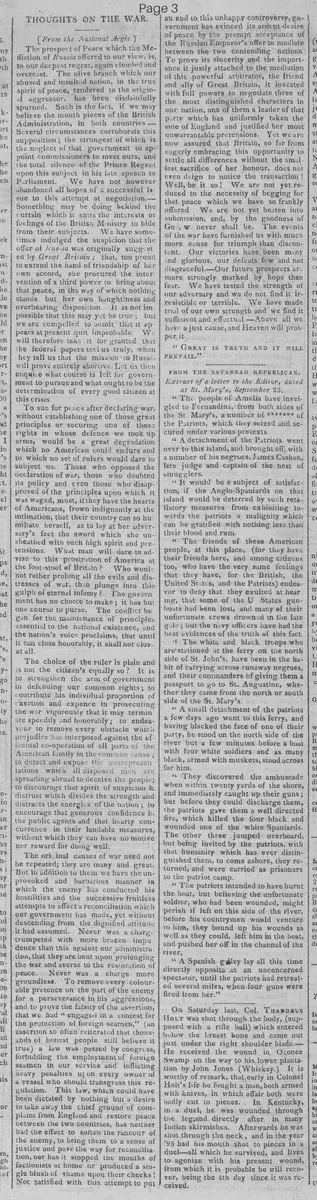
THOUGHTS ON THE WAR.
[From the National Aegis.]
The prospect of Peace which the Mediation of Russia offered to our view, is, to our deepest regret, again clouded and overcast. The olive branch which our abused and insulted nation, in the true spirit of peace, tendered to the original aggressor, has been disdainfully spurned. Such is the fact, if we may believe the mouth pieces of the British Administration, in both countries—
Several circumstances corroborate this supposition; the strongest of which is the neglect of that government to appoint commissioners to meet ours, and the total silence of the Prince Regent upon this subject in his late speech to Parliament. We have not however abandoned all hopes of a successful issue to this attempt at negotiation.—
Something may be doing behind the curtain which it suits the interests or feelings of the British Ministry to hide from their subjects. We have sometimes indulged the suspicion that the offer of Russia was originally suggested by Great Britain; that, too proud to extend the hand of friendship of her own accord, she procured the intervention of a third power to bring about that peace, in the way of which nothing stands but her own haughtiness and overbearing disposition. It is not impossible that this may yet be true; but we are compelled to admit that it appears at present quite improbable. We will therefore take it for granted that the federal papers tell us truly, when they tell us that the mission to Russia will prove entirely abortive. Let us then enquire what course is left for government to pursue and what ought to be the determination of every good citizen at this crisis
To sue for peace after declaring war, without establishing one of those great principles or securing one of those rights in whose defence we took up arms, would be a great degradation which no American could endure and to which no set of rulers would dare to subject us. Those who opposed the declaration of war, those who doubted its policy and even those who disapproved of the principles upon which it was waged, must, if they have the hearts of Americans, frown indignantly at the intimation, that their country can so humiliate herself, as to lay at her adversary's feet the sword which she unsheathed with such high spirit and pretensions. What man will dare to advise to this prostration of America at the foot-stool of Britain? Who would not rather prolong all the evils and distresses of war, than plunge into this gulph of eternal infamy? The government has no choice to make: it has but one course to pursue. The conflict began for the maintenance of principles essential to the national existence, and the nation's voice proclaims, that until it can close honorably, it shall not close at all.
The choice of the ruler is plain and is not the citizen's equally so? It is to strengthen the arm of government in defending our common rights; to contribute his individual proportion of exertion and expence in prosecuting the war vigorously that it may terminate speedily and honorably; to endeavour to remove every obstacle which prejudice has interposed against the effectual co-operation of all parts of the American family in the common cause; to detect and expose the misrepresentations which ill disposed men are spreading abroad to deceive the people; to discourage that spirit of suspicion & distrust which divides the strength and distracts the energies of the nation; to encourage that generous confidence in the public agents and that hearty concurrence in their laudable measures, without which they can have no motive nor reward for doing well.
The original causes of war need not be repeated; they are many and great. But in addition to them we have the unprovoked and barbarous manner in which the enemy has conducted his hostilities and the successive fruitless attempts to effect a reconciliation which our government has made, yet without descending from the dignified attitude it had assumed. Never was a charge trumpeted with more brazen impudence than this against our administration, that they are bent upon prolonging the war and averse to the restoration of peace. Never was a charge more groundless. To remove every colourable pretence on the part of the enemy for a perseverance in his aggressions, and to prove the falsity of the assertion, that we had "engaged in a contest for the protection of foreign seamen," (an assertion so often reiterated that thousands of honest people still believe it true) a law was passed by congress, forbidding the employment of foreign seamen in our service and inflicting heavy penalties upon every owner of a vessel who should transgress this regulation. This law, which could have been dictated by nothing but a desire to take away the chief ground of complaint from England and restore peace between the two countries, has neither had the effect to soften the rancour of the enemy, to bring them to a sense of justice and pave the way for reconciliation, nor has it stopped the mouths of factionists at home or produced a single blush of shame upon their cheeks!
Not satisfied with this attempt to put an end to this unhappy controversy, government has evinced its ardent desire of peace by the prompt acceptance of the Russian Emperor's offer to mediate between the two contending nations. To prove its sincerity and the importance it justly attached to the mediation of this powerful arbitrator, the friend and ally of Great Britain, it invested with full powers to negotiate three of the most distinguished characters in our nation, one of them a leader of that party which has uniformly taken the side of England and justified her most unwarrantable pretensions. Yet we are now assured that Britain, so far from eagerly embracing this opportunity to settle all differences without the smallest sacrifice of her honour, does not even deign to notice the transaction!
Well, be it so! We are not yet reduced to the necessity of begging for that peace which we have so frankly offered We are not yet beaten into submission, and, by the goodness of God, we never shall be. The events of the war have furnished us with much more cause for triumph than discontent. Our victories have been many and glorious, our defeats few and not disgraceful.—Our future prospects are more strongly marked by hope than fear. We have tested the strength of our adversary and we do not find it irresistible or terrible. We have made trial of our own strength and we find it sufficient and effectual—Above all we have a just cause, and Heaven will prosper it.
"GREAT IS TRUTH AND IT WILL PREVAIL."
[From the National Aegis.]
The prospect of Peace which the Mediation of Russia offered to our view, is, to our deepest regret, again clouded and overcast. The olive branch which our abused and insulted nation, in the true spirit of peace, tendered to the original aggressor, has been disdainfully spurned. Such is the fact, if we may believe the mouth pieces of the British Administration, in both countries—
Several circumstances corroborate this supposition; the strongest of which is the neglect of that government to appoint commissioners to meet ours, and the total silence of the Prince Regent upon this subject in his late speech to Parliament. We have not however abandoned all hopes of a successful issue to this attempt at negotiation.—
Something may be doing behind the curtain which it suits the interests or feelings of the British Ministry to hide from their subjects. We have sometimes indulged the suspicion that the offer of Russia was originally suggested by Great Britain; that, too proud to extend the hand of friendship of her own accord, she procured the intervention of a third power to bring about that peace, in the way of which nothing stands but her own haughtiness and overbearing disposition. It is not impossible that this may yet be true; but we are compelled to admit that it appears at present quite improbable. We will therefore take it for granted that the federal papers tell us truly, when they tell us that the mission to Russia will prove entirely abortive. Let us then enquire what course is left for government to pursue and what ought to be the determination of every good citizen at this crisis
To sue for peace after declaring war, without establishing one of those great principles or securing one of those rights in whose defence we took up arms, would be a great degradation which no American could endure and to which no set of rulers would dare to subject us. Those who opposed the declaration of war, those who doubted its policy and even those who disapproved of the principles upon which it was waged, must, if they have the hearts of Americans, frown indignantly at the intimation, that their country can so humiliate herself, as to lay at her adversary's feet the sword which she unsheathed with such high spirit and pretensions. What man will dare to advise to this prostration of America at the foot-stool of Britain? Who would not rather prolong all the evils and distresses of war, than plunge into this gulph of eternal infamy? The government has no choice to make: it has but one course to pursue. The conflict began for the maintenance of principles essential to the national existence, and the nation's voice proclaims, that until it can close honorably, it shall not close at all.
The choice of the ruler is plain and is not the citizen's equally so? It is to strengthen the arm of government in defending our common rights; to contribute his individual proportion of exertion and expence in prosecuting the war vigorously that it may terminate speedily and honorably; to endeavour to remove every obstacle which prejudice has interposed against the effectual co-operation of all parts of the American family in the common cause; to detect and expose the misrepresentations which ill disposed men are spreading abroad to deceive the people; to discourage that spirit of suspicion & distrust which divides the strength and distracts the energies of the nation; to encourage that generous confidence in the public agents and that hearty concurrence in their laudable measures, without which they can have no motive nor reward for doing well.
The original causes of war need not be repeated; they are many and great. But in addition to them we have the unprovoked and barbarous manner in which the enemy has conducted his hostilities and the successive fruitless attempts to effect a reconciliation which our government has made, yet without descending from the dignified attitude it had assumed. Never was a charge trumpeted with more brazen impudence than this against our administration, that they are bent upon prolonging the war and averse to the restoration of peace. Never was a charge more groundless. To remove every colourable pretence on the part of the enemy for a perseverance in his aggressions, and to prove the falsity of the assertion, that we had "engaged in a contest for the protection of foreign seamen," (an assertion so often reiterated that thousands of honest people still believe it true) a law was passed by congress, forbidding the employment of foreign seamen in our service and inflicting heavy penalties upon every owner of a vessel who should transgress this regulation. This law, which could have been dictated by nothing but a desire to take away the chief ground of complaint from England and restore peace between the two countries, has neither had the effect to soften the rancour of the enemy, to bring them to a sense of justice and pave the way for reconciliation, nor has it stopped the mouths of factionists at home or produced a single blush of shame upon their cheeks!
Not satisfied with this attempt to put an end to this unhappy controversy, government has evinced its ardent desire of peace by the prompt acceptance of the Russian Emperor's offer to mediate between the two contending nations. To prove its sincerity and the importance it justly attached to the mediation of this powerful arbitrator, the friend and ally of Great Britain, it invested with full powers to negotiate three of the most distinguished characters in our nation, one of them a leader of that party which has uniformly taken the side of England and justified her most unwarrantable pretensions. Yet we are now assured that Britain, so far from eagerly embracing this opportunity to settle all differences without the smallest sacrifice of her honour, does not even deign to notice the transaction!
Well, be it so! We are not yet reduced to the necessity of begging for that peace which we have so frankly offered We are not yet beaten into submission, and, by the goodness of God, we never shall be. The events of the war have furnished us with much more cause for triumph than discontent. Our victories have been many and glorious, our defeats few and not disgraceful.—Our future prospects are more strongly marked by hope than fear. We have tested the strength of our adversary and we do not find it irresistible or terrible. We have made trial of our own strength and we find it sufficient and effectual—Above all we have a just cause, and Heaven will prosper it.
"GREAT IS TRUTH AND IT WILL PREVAIL."
What sub-type of article is it?
War Or Peace
Foreign Affairs
Partisan Politics
What keywords are associated?
War Of 1812
Russian Mediation
British Rejection
Peace Negotiations
American Resolve
National Unity
Honorable Peace
What entities or persons were involved?
Russia
British Administration
Prince Regent
American Government
Congress
British Ministry
Editorial Details
Primary Topic
Failed Russian Mediation And Resolve To Continue The War Of 1812 Honorably
Stance / Tone
Patriotic Exhortation To Support War Until Honorable Peace
Key Figures
Russia
British Administration
Prince Regent
American Government
Congress
British Ministry
Key Arguments
Britain Has Spurned U.S. Peace Overtures Through Russian Mediation
Cannot Sue For Peace Without Securing Rights That Prompted The War
Citizens Must Support Government In Vigorous War Prosecution
U.S. Has Made Sincere Efforts For Peace, Including Banning Foreign Seamen
War Causes Are Just; U.S. Victories Outweigh Defeats
Expose Misrepresentations And Foster National Unity