Thank you for visiting SNEWPapers!
Sign up free
Editorial
February 16, 1872
Knoxville Daily Chronicle
Knoxville, Knox County, Tennessee
What is this article about?
Editorial defends the U.S. administration against Senator Sumner's resolution inquiring into arms sales to French agents during the Franco-Prussian War, explaining legal sales to other nations, denial of French bids, and affirming neutrality while noting Prussian sympathies.
Clipping
OCR Quality
98%
Excellent
Full Text
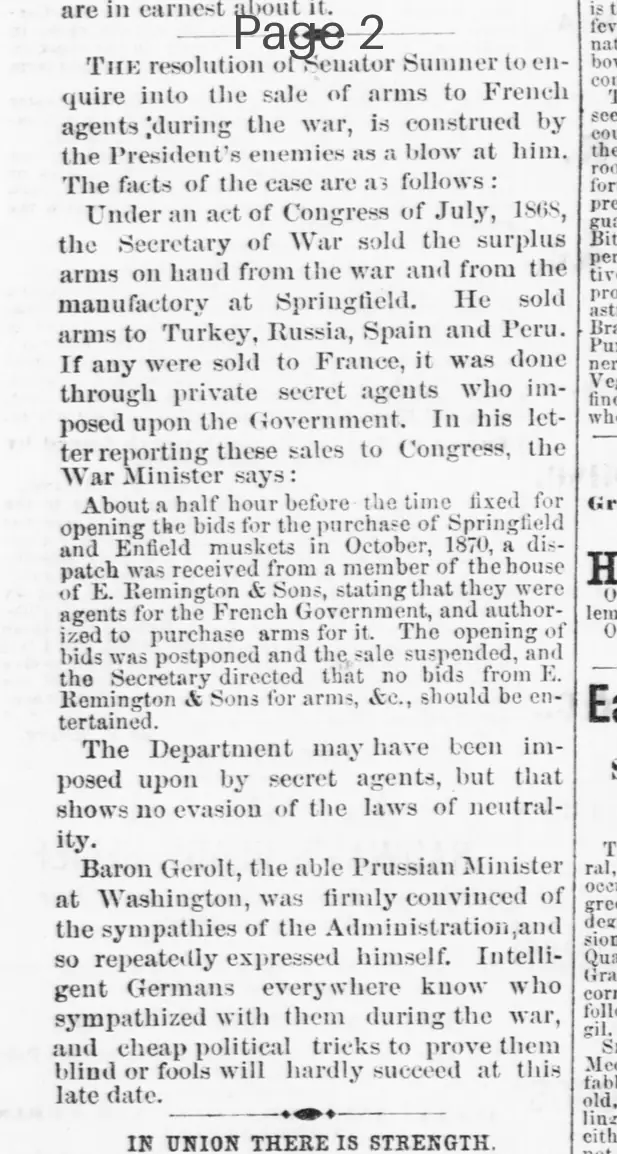
The resolution of Senator Sumner to enquire into the sale of arms to French agents during the war, is construed by the President's enemies as a blow at him.
The facts of the case are as follows:
Under an act of Congress of July, 1862, the Secretary of War sold the surplus arms on hand from the war and from the manufactory at Springfield. He sold arms to Turkey, Russia, Spain and Peru. If any were sold to France, it was done through private secret agents who imposed upon the Government. In his letter reporting these sales to Congress, the War Minister says:
About a half hour before the time fixed for opening the bids for the purchase of Springfield and Enfield muskets in October, 1870, a dispatch was received from a member of the house of E. Remington & Sons, stating that they were agents for the French Government, and authorized to purchase arms for it. The opening of bids was postponed and the sale suspended, and the Secretary directed that no bids from E. Remington & Sons for arms, &c., should be entertained.
The Department may have been imposed upon by secret agents, but that shows no evasion of the laws of neutrality.
Baron Gerolt, the able Prussian Minister at Washington, was firmly convinced of the sympathies of the Administration, and so repeatedly expressed himself. Intelligent Germans everywhere know who sympathized with them during the war, and cheap political tricks to prove them blind or fools will hardly succeed at this late date.
The facts of the case are as follows:
Under an act of Congress of July, 1862, the Secretary of War sold the surplus arms on hand from the war and from the manufactory at Springfield. He sold arms to Turkey, Russia, Spain and Peru. If any were sold to France, it was done through private secret agents who imposed upon the Government. In his letter reporting these sales to Congress, the War Minister says:
About a half hour before the time fixed for opening the bids for the purchase of Springfield and Enfield muskets in October, 1870, a dispatch was received from a member of the house of E. Remington & Sons, stating that they were agents for the French Government, and authorized to purchase arms for it. The opening of bids was postponed and the sale suspended, and the Secretary directed that no bids from E. Remington & Sons for arms, &c., should be entertained.
The Department may have been imposed upon by secret agents, but that shows no evasion of the laws of neutrality.
Baron Gerolt, the able Prussian Minister at Washington, was firmly convinced of the sympathies of the Administration, and so repeatedly expressed himself. Intelligent Germans everywhere know who sympathized with them during the war, and cheap political tricks to prove them blind or fools will hardly succeed at this late date.
What sub-type of article is it?
Foreign Affairs
Partisan Politics
What keywords are associated?
Arms Sales
Neutrality Laws
Franco Prussian War
Senator Sumner
French Agents
Prussian Sympathies
What entities or persons were involved?
Senator Sumner
Secretary Of War
E. Remington & Sons
French Government
Baron Gerolt
Prussian Minister
Editorial Details
Primary Topic
Enquiry Into Arms Sales To French Agents During The War
Stance / Tone
Defensive Of Administration's Neutrality And Sympathies
Key Figures
Senator Sumner
Secretary Of War
E. Remington & Sons
French Government
Baron Gerolt
Prussian Minister
Key Arguments
Sumner's Resolution Seen As Attack On President By His Enemies
Arms Sold Legally To Turkey, Russia, Spain, Peru Under 1862 Act
Any Sales To France Via Private Agents Imposing On Government
Bids From Remington & Sons Suspended Upon Learning Of French Agency
No Evasion Of Neutrality Laws
Baron Gerolt Convinced Of Administration's Prussian Sympathies
Germans Aware Of True Sympathies, Political Tricks Unlikely To Succeed