Thank you for visiting SNEWPapers!
Sign up free
Editorial
October 3, 1788
The Daily Advertiser
New York, New York County, New York
What is this article about?
An editorial from the Albany Gazette critiques the epidemic of 'adventurers' rushing into the legal profession in Albany, leading to overproduction of inadequately trained lawyers. It warns of hasty clerkships, superficial knowledge, unethical practices like fomenting lawsuits, and potential harm to justice, signed 'WATSEY.'
Clipping
OCR Quality
98%
Excellent
Full Text
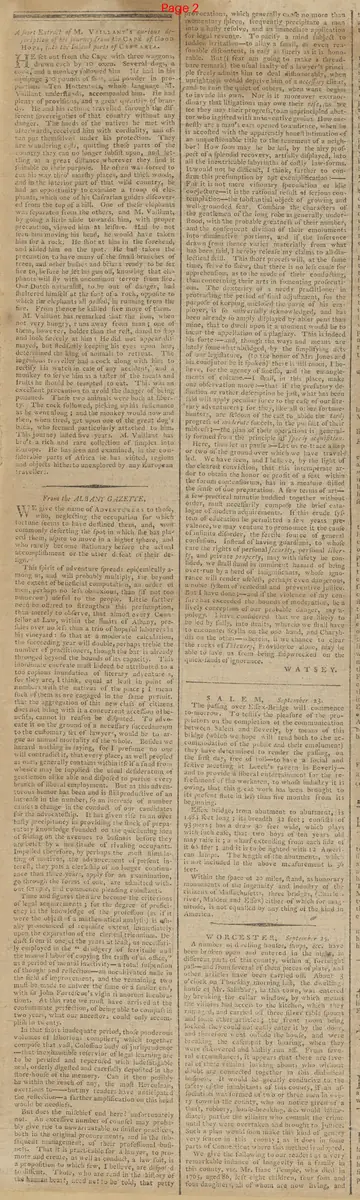
From the Albany Gazette.
We give the name of ADVENTURERS to those, who, neglecting the occupation for which fortune seems to have destined them, and, most commonly deserting the post in which she has placed them, aspire to move in a higher sphere, and who rarely become stationary before the actual accomplishment or the utter defeat of their design.
This spirit of adventure spreads epidemically among us, and will probably multiply, far beyond the extent of beneficial computation, an order of men, perhaps no less obnoxious, than (if not too numerous) useful to the people. Little farther need be offered to strengthen this presumption, than merely to observe, that almost every Counsellor at Law, within the limits of Albany, presides over no less than a trio of hopeful laborers in his vineyard: so that at a moderate calculation, the succeeding year will double, perhaps treble the number of practitioners, though the bar is already thronged beyond the bounds of its capacity. This inordinate increase must indeed be attributed to a too copious inundation of literary adventurers, for they are, I think, equal at least in point of numbers with the natives of the place; I mean such of them as are engaged in the same pursuit. That the aggregation of this new class of citizens does not bring with it a concurrent accession of benefits, cannot in reason be disputed. To advocate it on the ground of a necessary succedaneum to the customary set of lawyers, would be to argue an annual mortality of the whole. Besides we hazard nothing in saying, for I presume no one will contradict it, that every place, as well peopled as ours, generally contains within itself a fund from whence may be supplied the usual desideratum, of gentlemen alike able and disposed to pursue every branch of liberal employment. But as this adventurous humor has been and is still productive of an increase in the number, so an increase of number causes a change in the conduct of our candidates for the advocateship. It has given rise to an over hasty precipitancy in providing the stock of preparatory knowledge founded on the quickening idea of seizing on the avenues to business before they are beset by a multitude of rivaling occupants. Impelled therefore, by perhaps the most stimulating of motives, the advancement of present interest, they pass a clerkship of no longer continuance than three years, apply for an examination, go through the forms of one, are admitted without scruple, and commence pleading constantly. Time and figures then are become the criterions of legal acquirements; for the degree of proficiency in the knowledge of the profession (as if it were the object of a mathematical analysis) is usually pronounced of requisite extent immediately upon the expiration of the clerkly triennium. Deduct from it one of the years at least, as necessarily employed in the drudgery of servitude and the manual labor of copying the trash of an office, as a period of mental inactivity—a total suspension of thought and reflection—an uncultivated state in the field of improvement, and the remaining two must be made to answer the same or a similar end, with Sir John Fortescue's virgin trianorum lucubrations. At this rate we must have arrived at the consummate perfection, of being able to compass in two years, what our ancestors could only accomplish in twenty.
In that short inadequate period, those ponderous volumes of laborious compilers, which together compose that vast, Colossal body of jurisprudence—that inexhaustible reservoir of legal learning are to be perused and reperused with indefatigable zeal, orderly digested and carefully deposited in the store-house of the memory. Can it then possibly be within the reach of any, the most Herculean, exertions to—but my readers have anticipated the reflection—a farther amplification on this head would be needless.
But does the mischief end here? unfortunately not. An excessive number of counsel may probably give rise to unwarrantable or sinister practices, both in the original procurements, and in the subsequent management, of their professional business. That it is practicable for a lawyer, to promote and create, as well as conduct, a law suit, is a proposition to which few, I believe, are disposed to dissent. Those, who are read in the history of the human heart, need not to be told, that petty provocations, which generally cause no more than momentary spleen, frequently precipitate a man into a hasty resolve, and an immediate application for legal revenge. To pacify a mind subject to sudden irritation—to allay a small, or even reasonable discontent, is easy as surely as it is honorable. But (I fear am going to make a threadbare remark) the usual laxity of a lawyer's principles freely admits him to deal dishonorably, when uprightness would deprive him of a necessary client, and to ruin the quiet of others, when want begins to invade his own. Nor is it moreover extraordinary that litigations may owe their rise, as we see they may their progress, to an unprincipled abettor who is gifted with an inventive genius. How earnestly are a man's ears opened to audience, when he is accosted with the apparently honest intimation of an unquestionable title to the tenement of a neighbor! How soon may he be led, by the airy prospect of a splendid recovery, artfully displayed, into all the inextricable labyrinths of costly law-forms. It would not be difficult, I think, farther to confirm this presumption by apt exemplification: For it is not mere visionary speculation or idle conjecture—it is the rational result of serious contemplation—the substantial object of growing and well-grounded fear. Combine the characters of the gentlemen of the long robe as generally understood, with the probable greatness of their number, and the consequent division of their emoluments into diminutive portions, and if the inference drawn from thence varies materially from what has been said, I hereby release my claims to all dialectical skill. This short process will, at the same time, serve to show, that there is no less cause for apprehension, as to the mode of their conducting, than concerning their arts in fomenting prosecutions. The dexterity of a needy practitioner in protracting the period of final adjustment, for the purpose of keeping unclosed the purse of his employer, is so universally acknowledged, and has been already so amply displayed by abler pens than mine, that to dwell upon it a moment would be to incur the appellation of a plagiary. This is indeed his forte: and, though the ways and means are lately somewhat abridged, by the simplifying acts of our legislature, (to the honor of Mr. Jones and his coadjutor be it spoken) there is still room, I believe, for the agency of finesse, and the entanglements of chicane. I shall, in this place, make one observation more:—that if the prefatory definition or rather description be just, what has been said will apply peculiar force to the case of our literary adventurers; for they, like all other fortune-hunters, are seldom of the cast to abide the tardy progress of moderate success, in the pursuit of their mitres;—the plan of their operations is generally formed from the principle of speedy acquisition. Here, then let us pause: Let us re-trace a step or two of the ground over which we have travelled. We have seen, and I believe, by the light of the clearest conviction, that this intemperate ardor to obtain the honor or profit of a seat within the forum contentionsum, has in a measure stifled the sense of due preparation. A few terms of art—a few practical minutiae huddled together without order, must necessarily compose the brief catalogue of modern acquirements. If this crude system of education be permitted a few years prevalence, we may venture to pronounce it the cause of infinite disorder, the fertile source of general confusion. Instead of having guardians, to whose care the rights of personal security, personal liberty, and private property, may with safety be confided, we shall stand in imminent hazard of being over-run by a herd of insignificants, whose ignorance will render useless, perhaps even dangerous, a noble system of remedial and preventive justice. But I have done;—and if the violence of my censure has exceeded the bounds of moderation, be a lively conception of our probable danger, my apology. I have considered that we are likely to be led by folly, into straits, wherein we shall have to encounter Scylla on the one hand, and Charybdis on the other—wherein, if we chance to clear the rocks of Thievery, Providence alone, may be able to save us from being shipwrecked on the quick-sands of ignorance.
WATSEY.
We give the name of ADVENTURERS to those, who, neglecting the occupation for which fortune seems to have destined them, and, most commonly deserting the post in which she has placed them, aspire to move in a higher sphere, and who rarely become stationary before the actual accomplishment or the utter defeat of their design.
This spirit of adventure spreads epidemically among us, and will probably multiply, far beyond the extent of beneficial computation, an order of men, perhaps no less obnoxious, than (if not too numerous) useful to the people. Little farther need be offered to strengthen this presumption, than merely to observe, that almost every Counsellor at Law, within the limits of Albany, presides over no less than a trio of hopeful laborers in his vineyard: so that at a moderate calculation, the succeeding year will double, perhaps treble the number of practitioners, though the bar is already thronged beyond the bounds of its capacity. This inordinate increase must indeed be attributed to a too copious inundation of literary adventurers, for they are, I think, equal at least in point of numbers with the natives of the place; I mean such of them as are engaged in the same pursuit. That the aggregation of this new class of citizens does not bring with it a concurrent accession of benefits, cannot in reason be disputed. To advocate it on the ground of a necessary succedaneum to the customary set of lawyers, would be to argue an annual mortality of the whole. Besides we hazard nothing in saying, for I presume no one will contradict it, that every place, as well peopled as ours, generally contains within itself a fund from whence may be supplied the usual desideratum, of gentlemen alike able and disposed to pursue every branch of liberal employment. But as this adventurous humor has been and is still productive of an increase in the number, so an increase of number causes a change in the conduct of our candidates for the advocateship. It has given rise to an over hasty precipitancy in providing the stock of preparatory knowledge founded on the quickening idea of seizing on the avenues to business before they are beset by a multitude of rivaling occupants. Impelled therefore, by perhaps the most stimulating of motives, the advancement of present interest, they pass a clerkship of no longer continuance than three years, apply for an examination, go through the forms of one, are admitted without scruple, and commence pleading constantly. Time and figures then are become the criterions of legal acquirements; for the degree of proficiency in the knowledge of the profession (as if it were the object of a mathematical analysis) is usually pronounced of requisite extent immediately upon the expiration of the clerkly triennium. Deduct from it one of the years at least, as necessarily employed in the drudgery of servitude and the manual labor of copying the trash of an office, as a period of mental inactivity—a total suspension of thought and reflection—an uncultivated state in the field of improvement, and the remaining two must be made to answer the same or a similar end, with Sir John Fortescue's virgin trianorum lucubrations. At this rate we must have arrived at the consummate perfection, of being able to compass in two years, what our ancestors could only accomplish in twenty.
In that short inadequate period, those ponderous volumes of laborious compilers, which together compose that vast, Colossal body of jurisprudence—that inexhaustible reservoir of legal learning are to be perused and reperused with indefatigable zeal, orderly digested and carefully deposited in the store-house of the memory. Can it then possibly be within the reach of any, the most Herculean, exertions to—but my readers have anticipated the reflection—a farther amplification on this head would be needless.
But does the mischief end here? unfortunately not. An excessive number of counsel may probably give rise to unwarrantable or sinister practices, both in the original procurements, and in the subsequent management, of their professional business. That it is practicable for a lawyer, to promote and create, as well as conduct, a law suit, is a proposition to which few, I believe, are disposed to dissent. Those, who are read in the history of the human heart, need not to be told, that petty provocations, which generally cause no more than momentary spleen, frequently precipitate a man into a hasty resolve, and an immediate application for legal revenge. To pacify a mind subject to sudden irritation—to allay a small, or even reasonable discontent, is easy as surely as it is honorable. But (I fear am going to make a threadbare remark) the usual laxity of a lawyer's principles freely admits him to deal dishonorably, when uprightness would deprive him of a necessary client, and to ruin the quiet of others, when want begins to invade his own. Nor is it moreover extraordinary that litigations may owe their rise, as we see they may their progress, to an unprincipled abettor who is gifted with an inventive genius. How earnestly are a man's ears opened to audience, when he is accosted with the apparently honest intimation of an unquestionable title to the tenement of a neighbor! How soon may he be led, by the airy prospect of a splendid recovery, artfully displayed, into all the inextricable labyrinths of costly law-forms. It would not be difficult, I think, farther to confirm this presumption by apt exemplification: For it is not mere visionary speculation or idle conjecture—it is the rational result of serious contemplation—the substantial object of growing and well-grounded fear. Combine the characters of the gentlemen of the long robe as generally understood, with the probable greatness of their number, and the consequent division of their emoluments into diminutive portions, and if the inference drawn from thence varies materially from what has been said, I hereby release my claims to all dialectical skill. This short process will, at the same time, serve to show, that there is no less cause for apprehension, as to the mode of their conducting, than concerning their arts in fomenting prosecutions. The dexterity of a needy practitioner in protracting the period of final adjustment, for the purpose of keeping unclosed the purse of his employer, is so universally acknowledged, and has been already so amply displayed by abler pens than mine, that to dwell upon it a moment would be to incur the appellation of a plagiary. This is indeed his forte: and, though the ways and means are lately somewhat abridged, by the simplifying acts of our legislature, (to the honor of Mr. Jones and his coadjutor be it spoken) there is still room, I believe, for the agency of finesse, and the entanglements of chicane. I shall, in this place, make one observation more:—that if the prefatory definition or rather description be just, what has been said will apply peculiar force to the case of our literary adventurers; for they, like all other fortune-hunters, are seldom of the cast to abide the tardy progress of moderate success, in the pursuit of their mitres;—the plan of their operations is generally formed from the principle of speedy acquisition. Here, then let us pause: Let us re-trace a step or two of the ground over which we have travelled. We have seen, and I believe, by the light of the clearest conviction, that this intemperate ardor to obtain the honor or profit of a seat within the forum contentionsum, has in a measure stifled the sense of due preparation. A few terms of art—a few practical minutiae huddled together without order, must necessarily compose the brief catalogue of modern acquirements. If this crude system of education be permitted a few years prevalence, we may venture to pronounce it the cause of infinite disorder, the fertile source of general confusion. Instead of having guardians, to whose care the rights of personal security, personal liberty, and private property, may with safety be confided, we shall stand in imminent hazard of being over-run by a herd of insignificants, whose ignorance will render useless, perhaps even dangerous, a noble system of remedial and preventive justice. But I have done;—and if the violence of my censure has exceeded the bounds of moderation, be a lively conception of our probable danger, my apology. I have considered that we are likely to be led by folly, into straits, wherein we shall have to encounter Scylla on the one hand, and Charybdis on the other—wherein, if we chance to clear the rocks of Thievery, Providence alone, may be able to save us from being shipwrecked on the quick-sands of ignorance.
WATSEY.
What sub-type of article is it?
Legal Reform
Social Reform
Education
What keywords are associated?
Lawyer Overproduction
Bar Admission
Legal Training
Unethical Practices
Albany Bar
Adventurers In Law
What entities or persons were involved?
Counsellors At Law In Albany
Literary Adventurers
Mr. Jones
Sir John Fortescue
Editorial Details
Primary Topic
Critique Of Overproduction And Inadequate Training Of Lawyers In Albany
Stance / Tone
Strongly Critical And Warning Of Dangers From Hasty Legal Adventurers
Key Figures
Counsellors At Law In Albany
Literary Adventurers
Mr. Jones
Sir John Fortescue
Key Arguments
Spirit Of Adventure Leads To Excessive Lawyers Beyond Societal Need
Hasty Three Year Clerkships Provide Insufficient Legal Knowledge
Overabundance Fosters Unethical Practices Like Creating Lawsuits
Needy Lawyers Prolong Cases For Fees
Inadequate Preparation Threatens Justice System With Ignorance And Chicanery