Thank you for visiting SNEWPapers!
Sign up free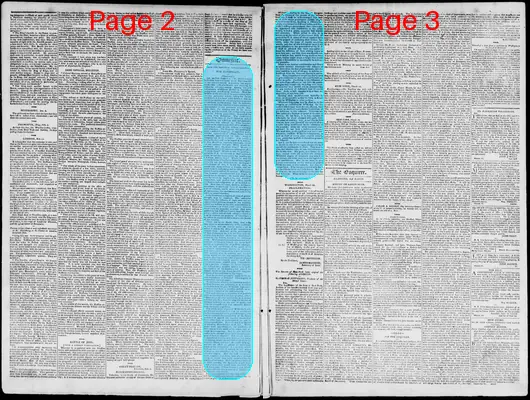
The Enquirer
Richmond, Henrico County, Virginia
What is this article about?
Editorial from the National Intelligencer defending Gen. Wilkinson's measures in New Orleans amid the Burr conspiracy, arguing that executive necessity justifies constitutional violations during threats like Spanish invasion or internal treason, given the territory's vulnerability and distance from government.
Merged-components note: Continuation of the article on the Burr conspiracy from the National Intelligencer; the second part is analytical but part of the same domestic news piece, not a separate editorial.
Clippings

1 of 2
OCR Quality
Full Text
FROM THE NATIONAL INTELLIGENCER.
THE CONSPIRACY.
(Continued.)
Let us then suppose a case, which indeed federalists have not many years since sounded in our ears not merely as possible, but as probable—the case of a sudden and alarming invasion by a foreign enemy. Among the wise instruments of defence devised by republican policy is an overflowing treasury. With five millions at the disposal of the government, without any particular objects calling for its disbursement, it has been justly believed that we would be enabled on any emergency to present a bold front to the enemy. Let it, however, be recollected that this sum remains entirely unappropriated to any particular object. Suppose, then, the invading arm to be on our shores, and the loudest call consequently made upon the federal government, to protect the country from desolation. The constitution makes it the duty of the President to defend the country, and vests him with full authority in the very case referred to. This, however, could not be done to any effect, without money: and in such a case, without a very large sum of money. On this point the constitution holds a different language. It expressly prohibits the expenditure of a single dollar unless previously appropriated by law: Suppose Congress not to be in session. The invading enemy surely could not be expected to wait until they should be regularly convened, to call out the national strength. What would the President do in the mean time? Would he permit the enemy to advance, without an effort to check them? Would he bid the good people of the U.S. to fall back at their approach when he had the means within his reach to arrest if not destroy them? Would he wait still the tardy forms of legislation should have legalized to his use the millions in the exchequer?
No—Instead of this, if he did his duty, he would take them without a scruple, and expend them in embodying and furnishing a competent force to defend the country. Not doing this, however unconstitutional and illegal, he would not do his duty. He would omit doing that for which he ought to be, and would be impeached, and ejected from office, amidst the frowns and indignation of an incensed nation. Here then is a clear, decisive, indisputable instance in which the force of necessity rejects all restraint, and in which the salus populi est suprema lex, the constitution and laws to the contrary notwithstanding.
Cases somewhat analogous, or even of greater strength, may be imagined. The executive magistrate, for instance, if there were not unappropriated millions enough in the treasury, would not hesitate on his own responsibility to borrow them; or if that could not be done, to divert from the purposes to which they were applied by law sufficient sums to meet the emergency; and in case all these resources failed to seize by violence the property of individuals; for which he could not fail to receive the thanks of his country.
There can be no doubt, then, that cases may occur in which violations of the constitution and laws will not only be venial; but in which it will be the duty of the executive to commit them. Arduous as the performance of such duties may be, it is the duty of an executive duly sensible of the high functions attached to his Station, fearlessly to discharge them. Well aware that constitutions and laws, however deliberately framed, can never be so perfect as to provide for all possible emergencies, he will not hesitate, if the good of his country is his supreme motive, to discharge such duties, however perilous it may be to him. The patriot, who in ordinary and tranquil times, would not, for any consideration under heaven, step beyond the orbit of power assigned him, will be the foremost and the most resolute to take upon himself every responsibility that in periods of danger his station requires. He will not for a moment believe in the possible injustice of his country; but even if he should doubt on this score, he will obey the dictates of his conscience at any risque.
How far do these principles apply to the recent transactions at Orleans? This enquiry is reserved for our next paper.
To determine whether the measures pursued at New-Orleans are justifiable, it is necessary to consider how far gen. Wilkinson had reason to believe that such a necessity existed, as required an invasion of the civil authority.
The most obvious consideration that presents itself on this subject is the scene of action, which differed from the other parts of the U.S. in two material respects: from its being the theatre of menaced hostilities on the part of Spain, and from the circumstances that naturally flowed from its recent acquisition.
The whole tenor of general Wilkinson's dispatches and measures show that he considered the frontier exposed to the greatest danger; and that he doubted the competency of his forces to defend it against the superior forces that Spain either had, or contemplated to put in motion against him. He knew that if he should be defeated, New-Orleans must fall. While under these apprehensions, the emissaries of Burr appear in the midst of his army, and attempt to corrupt him. Had he not sufficient reason to be alarmed at the audacity and profligacy of such an attempt? Had he not reason to apprehend that the same motives that led to this attempt would extend itself to efforts to seduce his officers and men? He could fully appreciate the effect on gallant or mercenary minds of the proposition of a project, which held out the promise of reward, in the mines of Mexico, and distinction, in the foundation of a new empire. Had the least encouragement, negative or positive, been given to such views, he might have justly trembled for the fidelity of his army. Had they proved faithless to their country, the Spaniards might have struck a blow, that would have deprived the U.S. for a time, of New-Orleans: and which would inevitably have produced a bloody war between the two nations.
Take in connection with this view of the subject the circumstances naturally arising from its recent acquisition of that country.
Without intending to the least to derogate from the virtues of the people of the Orleans territory, it must be acknowledged that inasmuch as the major population consists of persons of foreign birth, speaking a different language, accustomed to different habits, and born under a different government, there was reason to apprehend that disaffection to the union would, in such a place, naturally find friends and advocates. When added to this, it is known to be the resort of adventurers from all parts of the U. S. many of whom repaired there for the purpose of retrieving their broken fortunes, under the hope of rapidly acquiring wealth, and that of this description were some great defaulters to the government of the U. S. it must be allowed that there was reason to dread the influence of such alluring hopes as were held out; and that there was likewise reason to believe that unless strong measures were taken, treason might attain a height that would enable it successfully to accomplish its destructive purposes.
There is one further consideration well fitted to excite extreme solicitude—the distance of the scene from the seat of government, and the total inability, in case of danger, to wait for instructions from the Supreme Executive authority. This circumstance would necessarily tend to give confidence to men who had formed unlawful projects. Confiding in the diffidence of the subordinate officers to call forth the public forces they would take their steps with an assurance that they would not be countervailed by any measures of sufficient vigor to check them. Such, in fact, appears to have been the impression, in this very case.
Holding these considerations steadfastly in view, let us concisely notice the facts, as stated either by Wilkinson or other persons.
Whatever suspicions may be afloat as to the integrity or credibility of Wilkinson, for the reasons which have been already assigned, they cannot be received towards the invalidation of his testimony in this instance. There has not been adduced a shadow of proof of his want of fidelity. He has been, it is true, accused of dishonesty by those charged with guilt, with the crime of treason: but, is not this the first time we have ever heard of the veracity of the accuser being invalidated by the testimony of the accused; while the latter remained unacquitted? Is not such a doctrine monstrous?
We must then, on the question now under consideration, consider Wilkinson's statements, as well as those of every other credible witness, true, unless they possess in themselves grounds for disbelief.
Let it not be here understood that we mean to decide on any of the vague charges alleged against the commander in chief. They may be true, but whether true, or not, they are inapposite in this view. His guilt, on a former occasion, cannot make his present acts criminal. Whatever degree of turpitude may attach to the former, the latter may be in the highest degree meritorious. Nor do we mean to pronounce conclusively on the motives of general Wilkinson even in this business. Let time develope them. If he has participated with Burr, let the facts be fairly and fully stated. But until they are, we can only judge on the information before us. What is the amount of this information?
(To be continued.)
What sub-type of article is it?
What keywords are associated?
What entities or persons were involved?
Where did it happen?
Domestic News Details
Primary Location
New Orleans
Key Persons
Event Details
Editorial argues that executive necessity justifies constitutional violations in emergencies, such as invasion or internal threats like Burr's conspiracy, and applies this to defend Gen. Wilkinson's invasion of civil authority in New Orleans due to Spanish threats, recent acquisition, population disaffection, and distance from government, amid attempts by Burr's emissaries to corrupt the army.