Thank you for visiting SNEWPapers!
Sign up free
Story
January 31, 1899
Marietta Daily Leader
Marietta, Washington County, Ohio
What is this article about?
An officer from the Judge Advocate General's office explains to a Washington Star reporter the unique procedures of court-martials, including oaths, voting, arrests, attire, and differences from civil trials.
Clipping
OCR Quality
98%
Excellent
Full Text
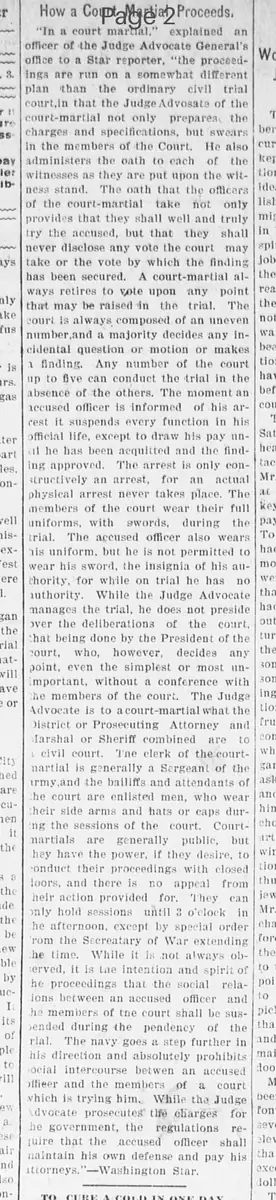
"In a court martial," explained an officer of the Judge Advocate General's office to a Star reporter, "the proceedings are run on a somewhat different plan than the ordinary civil trial. In that the Judge Advocate of the court-martial not only prepares the charges and specifications, but swears in the members of the Court. He also administers the oath to each of the witnesses as they are put upon the witness stand. The oath that the officers of the court-martial take not only provides that they shall well and truly try the accused, but that they shall never disclose any vote the court may take or the vote by which the finding has been secured. A court-martial always retires to vote upon any point that may be raised in the trial. The court is always composed of an uneven number, and a majority decides any incidental question or motion or makes a finding. Any number of the court up to five can conduct the trial in the absence of the others. The moment an accused officer is informed of his arrest it suspends every function in his official life, except to draw his pay until he has been acquitted and the finding approved. The arrest is only constructively an arrest, for an actual physical arrest never takes place. The members of the court wear their full uniforms, with swords, during the trial. The accused officer also wears his uniform, but he is not permitted to wear his sword, the insignia of his authority, for while on trial he has no authority. While the Judge Advocate manages the trial, he does not preside over the deliberations of the court, that being done by the President of the court, who, however, decides any point, even the simplest or most unimportant, without a conference with the members of the court. The Judge Advocate is to a court-martial what the District or Prosecuting Attorney and Marshal or Sheriff combined are to a civil court. The clerk of the court-martial is generally a Sergeant of the army, and the bailiffs and attendants of the court are enlisted men, who wear their side arms and hats or caps during the sessions of the court. Court-martials are generally public, but they have the power, if they desire, to conduct their proceedings with closed doors, and there is no appeal from their action provided for. They can only hold sessions until 3 o'clock in the afternoon, except by special order from the Secretary of War extending the time. While it is not always observed, it is the intention and spirit of the proceedings that the social relations between an accused officer and the members of the court shall be suspended during the pendency of the trial. The navy goes a step further in this direction and absolutely prohibits social intercourse between an accused officer and the members of a court which is trying him. While the Judge Advocate prosecutes the charges for the government, the regulations require that the accused officer shall maintain his own defense and pay his attorneys." - Washington Star.
What sub-type of article is it?
Procedural Explanation
Military Justice
What themes does it cover?
Justice
What keywords are associated?
Court Martial
Military Trial
Judge Advocate
Oath
Arrest
Uniform
Deliberations
What entities or persons were involved?
Officer Of The Judge Advocate General's Office
Star Reporter
Where did it happen?
Washington
Story Details
Key Persons
Officer Of The Judge Advocate General's Office
Star Reporter
Location
Washington
Story Details
Explanation of court-martial procedures, including roles, oaths, voting, arrest, attire, conduct, and differences from civil trials.