Thank you for visiting SNEWPapers!
Sign up free
Story
May 1, 1882
The Daily Gazette
Wilmington, New Castle County, Delaware
What is this article about?
A vivid portrayal of New York's Bowery at night, highlighting its famous theaters such as the Thalia and Atlantic Garden, and adjacent blocks dominated by vice including concert saloons, variety shows, and the exploitative lives of young women, criminals, and sailors.
Clipping
OCR Quality
98%
Excellent
Full Text
THE BOWERY AT NIGHT.
The Gilded Iniquities of New York's Famous Thoroughfare.
(New York Letter.)
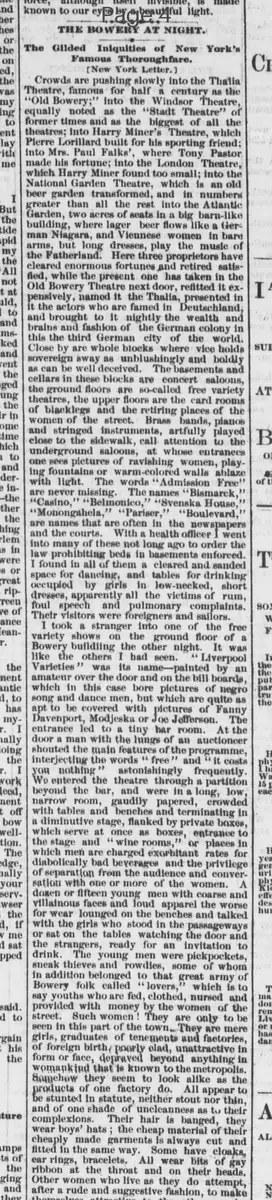
Crowds are pushing slowly into the Thalia Theatre, famous for half a century as the "Old Bowery;" into the Windsor Theatre, equally noted as the "Stadt Theatre" of former times and as the biggest of all the theatres; into Harry Miner's Theatre, which Pierre Lorillard built for his sporting friend; into Mrs. Paul Falk's, where Tony Pastor made his fortune; into the London Theatre, which Harry Miner found too small; into the National Garden Theatre, which is an old beer garden transformed, and in numbers greater than all the rest into the Atlantic Garden, two acres of seats in a big barn-like building, where lager beer flows like a German Niagara, and Viennese women in bare arms, but long dresses, play the music of the Fatherland. Here three proprietors have cleared enormous fortunes and retired satisfied, while the present one has taken in the Old Bowery Theatre next door, refitted it expensively, named it the Thalia, presented in it the actors who are famed in Deutschland, and brought to it nightly the wealth and brains and fashion of the German colony in this the third German city of the world.
Close by are whole blocks where vice holds sovereign sway as unblushingly and boldly as can be well conceived. The basements and cellars in these blocks are concert saloons, the ground floors are so-called free variety theatres, the upper floors are the card rooms of blacklegs and the retiring places of the women of the street. Brass bands, pianos and stringed instruments, artfully played close to the sidewalk, call attention to the underground saloons, at whose entrances one sees pictures of ravishing women, playing fountains or warm-colored walls ablaze with light. The words "Admission Free" are never missing. The names "Bismarck," "Casino," "Belmonico," "Svenska House," "Monongahela," "Pariser," "Boulevard," are names that are often in the newspapers and the courts. With a health officer I went into many of these not long ago to order the law prohibiting beds in basements enforced.
I found in all of them a cleared and sanded space for dancing, and tables for drinking occupied by girls in low-necked, short dresses, apparently all the victims of rum, foul speech and pulmonary complaints. Their visitors were foreigners and sailors.
I took a stranger into one of the free variety shows on the ground floor of a Bowery building the other night. It was like the others I had seen.
"Liverpool Varieties" was its name painted by an amateur over the door and on the bill boards, which in this case bore pictures of negro song and dance men, but which are quite as apt to be covered with pictures of Fanny Davenport, Modjeska or Joe Jefferson. The entrance led to a tiny bar room. At the door a man with the lungs of an auctioneer shouted the main features of the programme, interjecting the words "free" and "it costs you nothing" astonishingly frequently.
We entered the theatre through a partition beyond the bar, and were in a long, low, narrow room, gaudily papered, crowded with tables and benches and terminating in a diminutive stage, flanked by private boxes, which serve at once as boxes, entrance to the stage and "wine rooms," or places in which men are charged exorbitant rates for diabolically bad beverages and the privilege of separation from the audience and conversation with one or more of the women. A dozen or fifteen young men with coarse and villainous faces and loud apparel the worse for wear lounged on the benches and talked with the girls who stood in the passageways or sat on the tables watching the door and the strangers, ready for an invitation to drink. The young men were pickpockets, sneak thieves and rowdies, some of whom in addition belonged to that great army of Bowery folk called "lovers," which is to say youths who are fed, clothed, nursed and provided with money by the women of the street. Such women! They are only to be seen in this part of the town They are mere girls, graduates of tenements and factories, of foreign birth, poorly clad, unattractive in form or face, depraved beyond anything in womankind that is known to the metropolis.
Somehow they seem to look alike as the products of one factory do. All appear to be stunted in stature, neither stout nor thin, and of one shade of uncleanness as to their complexions. Their hair is banged, they wear boys' hats; the cheap material of their cheaply made garments is always cut and fitted in the same way. Some have cloaks, ear rings, bracelets, All wear bits of gay ribbon at the throat and on their heads.
Other women who live as they do attempt, after a rude and suggestive fashion, to make themselves attractive to the other sex by women's wiles. These poor creatures appear to strive to hide all traces of womanhood. They swear and curse, drink like sailors ashore, slap and hit each other and their jail-bird courtiers and are generally clumsy, masculine and rough.
The Gilded Iniquities of New York's Famous Thoroughfare.
(New York Letter.)
Crowds are pushing slowly into the Thalia Theatre, famous for half a century as the "Old Bowery;" into the Windsor Theatre, equally noted as the "Stadt Theatre" of former times and as the biggest of all the theatres; into Harry Miner's Theatre, which Pierre Lorillard built for his sporting friend; into Mrs. Paul Falk's, where Tony Pastor made his fortune; into the London Theatre, which Harry Miner found too small; into the National Garden Theatre, which is an old beer garden transformed, and in numbers greater than all the rest into the Atlantic Garden, two acres of seats in a big barn-like building, where lager beer flows like a German Niagara, and Viennese women in bare arms, but long dresses, play the music of the Fatherland. Here three proprietors have cleared enormous fortunes and retired satisfied, while the present one has taken in the Old Bowery Theatre next door, refitted it expensively, named it the Thalia, presented in it the actors who are famed in Deutschland, and brought to it nightly the wealth and brains and fashion of the German colony in this the third German city of the world.
Close by are whole blocks where vice holds sovereign sway as unblushingly and boldly as can be well conceived. The basements and cellars in these blocks are concert saloons, the ground floors are so-called free variety theatres, the upper floors are the card rooms of blacklegs and the retiring places of the women of the street. Brass bands, pianos and stringed instruments, artfully played close to the sidewalk, call attention to the underground saloons, at whose entrances one sees pictures of ravishing women, playing fountains or warm-colored walls ablaze with light. The words "Admission Free" are never missing. The names "Bismarck," "Casino," "Belmonico," "Svenska House," "Monongahela," "Pariser," "Boulevard," are names that are often in the newspapers and the courts. With a health officer I went into many of these not long ago to order the law prohibiting beds in basements enforced.
I found in all of them a cleared and sanded space for dancing, and tables for drinking occupied by girls in low-necked, short dresses, apparently all the victims of rum, foul speech and pulmonary complaints. Their visitors were foreigners and sailors.
I took a stranger into one of the free variety shows on the ground floor of a Bowery building the other night. It was like the others I had seen.
"Liverpool Varieties" was its name painted by an amateur over the door and on the bill boards, which in this case bore pictures of negro song and dance men, but which are quite as apt to be covered with pictures of Fanny Davenport, Modjeska or Joe Jefferson. The entrance led to a tiny bar room. At the door a man with the lungs of an auctioneer shouted the main features of the programme, interjecting the words "free" and "it costs you nothing" astonishingly frequently.
We entered the theatre through a partition beyond the bar, and were in a long, low, narrow room, gaudily papered, crowded with tables and benches and terminating in a diminutive stage, flanked by private boxes, which serve at once as boxes, entrance to the stage and "wine rooms," or places in which men are charged exorbitant rates for diabolically bad beverages and the privilege of separation from the audience and conversation with one or more of the women. A dozen or fifteen young men with coarse and villainous faces and loud apparel the worse for wear lounged on the benches and talked with the girls who stood in the passageways or sat on the tables watching the door and the strangers, ready for an invitation to drink. The young men were pickpockets, sneak thieves and rowdies, some of whom in addition belonged to that great army of Bowery folk called "lovers," which is to say youths who are fed, clothed, nursed and provided with money by the women of the street. Such women! They are only to be seen in this part of the town They are mere girls, graduates of tenements and factories, of foreign birth, poorly clad, unattractive in form or face, depraved beyond anything in womankind that is known to the metropolis.
Somehow they seem to look alike as the products of one factory do. All appear to be stunted in stature, neither stout nor thin, and of one shade of uncleanness as to their complexions. Their hair is banged, they wear boys' hats; the cheap material of their cheaply made garments is always cut and fitted in the same way. Some have cloaks, ear rings, bracelets, All wear bits of gay ribbon at the throat and on their heads.
Other women who live as they do attempt, after a rude and suggestive fashion, to make themselves attractive to the other sex by women's wiles. These poor creatures appear to strive to hide all traces of womanhood. They swear and curse, drink like sailors ashore, slap and hit each other and their jail-bird courtiers and are generally clumsy, masculine and rough.
What sub-type of article is it?
Curiosity
Historical Event
Personal Triumph
What themes does it cover?
Social Manners
Misfortune
Moral Virtue
What keywords are associated?
Bowery Nightlife
New York Theaters
Vice Districts
Concert Saloons
Prostitution
Pickpockets
What entities or persons were involved?
Harry Miner
Tony Pastor
Pierre Lorillard
Mrs. Paul Falk
Where did it happen?
The Bowery, New York
Story Details
Key Persons
Harry Miner
Tony Pastor
Pierre Lorillard
Mrs. Paul Falk
Location
The Bowery, New York
Story Details
Descriptive account of the Bowery's nightlife, featuring historic theaters like the Thalia, Windsor, and Atlantic Garden, alongside vice districts with concert saloons, free variety shows, and the presence of prostitutes, pickpockets, and rowdies.