Thank you for visiting SNEWPapers!
Sign up free
Alexandria Daily Gazette, Commercial & Political
Alexandria, Virginia
What is this article about?
Editorial from the North American critiques the U.S. Treasury's interpretation of the Non-Intercourse Act, arguing it imposes arbitrary bonds on neutral foreign vessels, infringes on navigation freedoms, risks war with Britain and France, and contradicts Congress's peaceful intent, urging a milder construction to aid negotiations.
Merged-components note: The component on page 3 is a direct continuation of the article on page 2 titled 'FREEDOM OF THE SEAS AND NON INTERCOURSE', which is partisan and opinionated, fitting editorial label.
Clippings
1 of 2
OCR Quality
Full Text
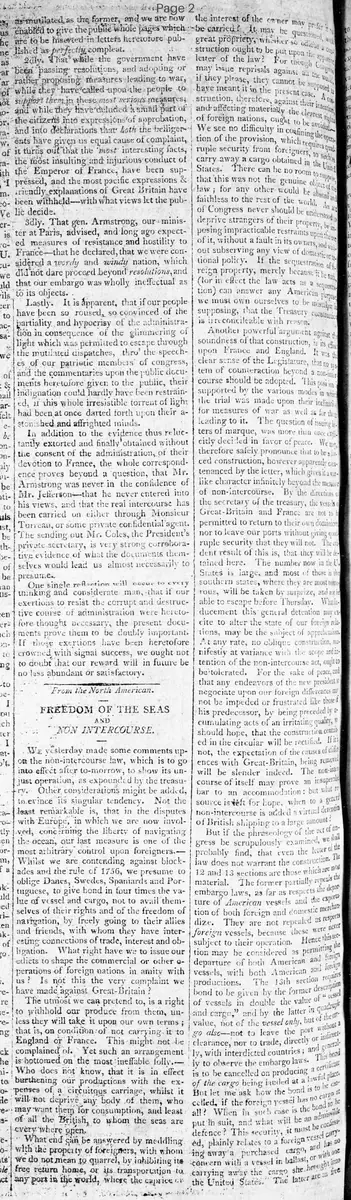
FREEDOM OF THE SEAS
AND
NON INTERCOURSE.
We yesterday made some comments upon the non-intercourse law, which is to go into effect after to-morrow, to show its unjust operation, as expounded by the treasury. Other considerations might be added to evince its singular tendency. Not the least remarkable is, that in the disputes with Europe, in which we are now involved, concerning the liberty of navigating the ocean, our last measure is one of the most arbitrary control upon foreigners. Whilst we are contending against blockades and the rule of 1756, we presume to oblige Danes, Swedes, Spaniards and Portuguese, to give bond in four times the value of vessel and cargo, not to avail themselves of their rights and of the freedom of navigation, by freely going to their allies and friends, with whom they have interesting connections of trade, interest and obligation. What right have we to issue our edicts to shape the commercial or other operations of foreign nations in amity with us? Is not this the very complaint we have made against Great-Britain?
The utmost we can pretend to, is a right to withhold our produce from them, unless they will take it upon our own terms; that is, on condition of not carrying it to England or France. This might not be complained of. Yet such an arrangement is bottomed on the most ineffable folly. Who does not know, that it is in effect burthening our productions with the expenses of a circuitous carriage, whilst it will not deprive any body of them, who may want them for consumption, and least of all the British, to whom the seas are every where open.
What end can be answered by meddling with the property of foreigners, with whom we do not mean to quarrel, by inhibiting its free return home, or its transportation to any port in the world, where the caprice or the interest of the owner may prefer it may be carried? It may be questioned, with great propriety, whether so odious a construction ought to be put upon the apparent letter of the law? For though Congress may issue partials gains a wd if they please, they cannot be supposed to have meant it in the present case. A construction, therefore, against their intent and affecting materially the clearest rights of foreign nations ought to be avoided. A construction of the provision, which requires quadruple security from foreigners, to such as carry away a cargo obtained in the United States.
There can be no room to suppose, that this was not the half of our genuine object of the faithless of Congress strangers to the never rest of should their property be understood by imposing impracticable restraints upon them without a fault in its owners and without subserving any view of domestic or national policy. If the sequestration of foreign property, merely because it be such (for in effect the law acts as a sequestration) can answer any American purpose we must own ourselves to be mistaken in supposing, that the Treasury construction is irreconcileable with reason.
Another powerful argument against the soundness of that construction, is its effect upon France and England. It was the clear sense of the Legislature, that no system of counteraction beyond a non-intercourse should be adopted. This position is supported by the various modes in which the trial was made upon their inclination for measures of war as well as for those leading to it. The question of issuing letters of marque, was more than once explicitly decided in favor of peace. We may therefore safely pronounce that to be a forced construction, however apparently countenanced by the letter, which gives it a war-like character infinitely beyond the measure of non-intercourse. By the directions of the secretary of the treasury, the vessels of Great-Britain and France are not to be permitted to return to their own dominions nor to leave our ports without giving quadruple security that they will not. The evident result of this is, that they will be detained here. The number now in the U. States is large, and most of those in the southern states, where they are most numerous, will be taken by surprise, and not be able to escape before Thursday. What inducement this general detention may excite to alter the state of our foreign relations, may be the subject of apprehension. At any rate, no oblique construction, manifestly at variance with the scope and intention of the non-intercourse act, ought to be tolerated. For the sake of peace, and that any endeavors of the new president to negotiate upon our foreign differences may not be impeded or frustrated like those of his predecessor, by being preceded by accumulating acts of an irritating quality, we should hope, that the construction contained in the circular will be rectified. If it not, the expectation of the causes of differences with Great-Britain, being removed will be slender indeed. The non-intercourse of itself may prove an insuperable bar to an accommodation: but what reason is left for hope, when to a general non-intercourse is added a virtual detention of British shipping to a large amount?
But if the phraseology of the act of Congress be scrupulously examined, we shall probably find, that even the letter of the law does not warrant the construction. The 12 and 13 sections are those which are most material. The former partially repeals the embargo laws, as far as respects the departure of both foreign and domestic merchandize. They are not repealed as respects foreign vessels, because these were never subject to their operation. Hence this section may be considered as permitting the departure of both American and foreign vessels, with both American and foreign productions. The 13th section requires bond to be given by the former description in double the value, not of the vessel only, but of the vessel and cargo, and by the latter in quadruple the value of 'vessel and cargo.' Go also--not to leave the port without a clearance nor to trade directly is to be cancelled unless observing the embargo laws. This hood
But let me ask how the bond is to be cn- being landed lawful ll? When in has he foreign vessel defence? This security, it must be confess what will admit ed, plainly relates to a foreign vessel y concern with a vessel in ballast, or w away cargo and has co carrying away the cargo she brought into the United States. The latter are as free to depart without giving any security, as the spirit were before the present law makes the exportation shall not interfere with the embargo. The U. States by requiring the law on a new provision, almost unattainable bond. For the non-intercourse provision; leaving every thing else upon the old footing. If this be not the sound interpretation, and congress have expressed themselves the act in words have not plain in language to which none but an ex- live officer can venture to prefix the gauge of merchandize from the U. States. Which excludes foreign vessels from the carriage another position of the treasury, will be perceived that this construction is in vain to attempt to discover by sifting the whence this interdiction was deduced, it is from exporting, but, on the contrary, allows of foreign vessels, more than American, contains prohibition colors by the 12th section exportation gene- mount of security to be given by foreign 13th section prescribes vessels in such case; contrasting the two laws by doubling the amount compared with the security given by an American, on account, perhaps, of the greater temptation foreigners might be presumed to lie under, violating the non-intercourse principle.
What sub-type of article is it?
What keywords are associated?
What entities or persons were involved?
Editorial Details
Primary Topic
Criticism Of Treasury's Interpretation Of Non Intercourse Law
Stance / Tone
Strongly Critical Of Arbitrary Restrictions On Foreign Shipping, Advocating Peaceful Interpretation
Key Figures
Key Arguments