Thank you for visiting SNEWPapers!
Sign up free
The Virginia Gazette
Williamsburg, Virginia
What is this article about?
Political letter by Junius criticizing British government, urging public action to influence Parliament dissolution and ministry change, targeting figures like Duke of Grafton and Lord Bute, and praising remonstrants' defense of liberty under the King.
Clipping
OCR Quality
Full Text
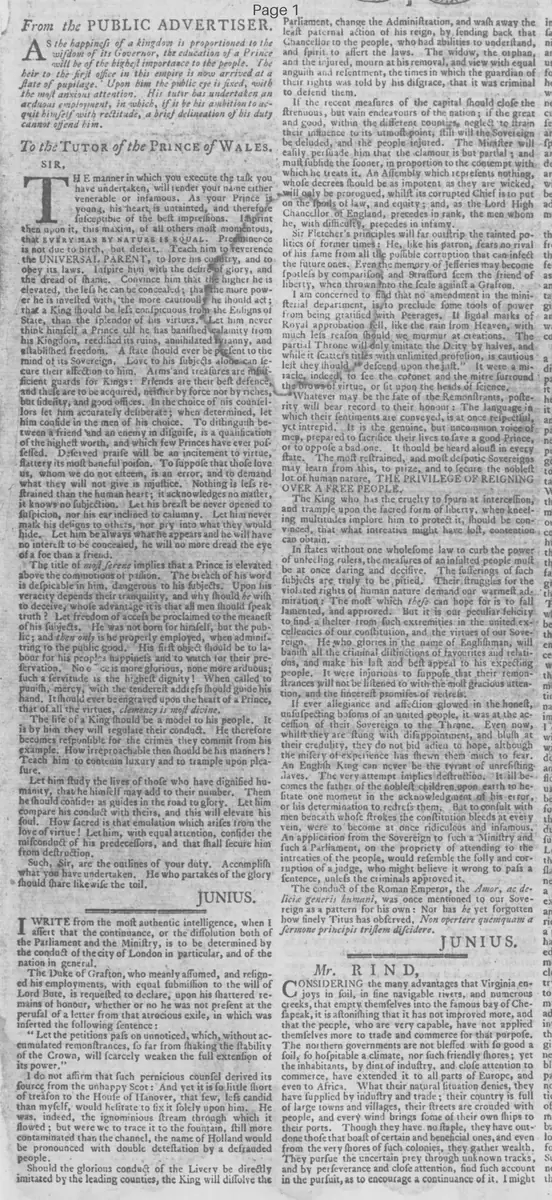
The Duke of Grafton, who meanly assumed, and resigned his employments, with equal submission to the will of Lord Bute, is requested to declare, upon his shattered remains of honour, whether or no he was not present at the perusal of a letter from that atrocious exile, in which was inserted the following sentence:
"Let the petitions pass on unnoticed, which, without accumulated remonstrances, so far from shaking the stability of the Crown, will scarcely weaken the full extension of its power."
I do not affirm that such pernicious counsel derived its source from the unhappy Scot; And yet it is so little short of treason to the House of Hanover, that few, less candid than myself, would hesitate to fix it solely upon him. He was, indeed, the ignominious stream through which it flowed; but were we to trace it to the fountain, still more contaminated than the channel, the name of Holland would be pronounced with double detestation by a defrauded people.
Should the glorious conduct of the Livery be directly imitated by the leading counties, the King will dissolve the Parliament, change the Administration, and wash away the least paternal action of his reign, by sending back that Chancellor to the people, who had abilities to understand, and spirit to assert the laws. The widow, the orphan, and the injured, mourn at his removal, and view with equal anguish and resentment, the times in which the guardian of their rights was told by his disgrace, that it was criminal to defend them.
If the recent measures of the capital should close the strenuous, but vain endeavours of the nation; if the great and good, within the different counties, neglect to strain their influence to its utmost point, still will the Sovereign be deluded, and the people injured. The Minister will easily persuade him that the clamour is but partial; and must subside the sooner, in proportion to the contempt with which he treats it. An Assembly which represents nothing, whose decrees should be as impotent as they are wicked, will only be prorogued, whilst its corrupted Chief is to put on the spoils of law, and equity; and, as the Lord High Chancellor of England, precedes in rank, the men whom he, with difficulty, precedes in infamy.
Sir Fletcher's principles will far outstrip the tainted politics of former times: He, like his patron, fears no rival of his fame from all those possible corruptions that can infect the future ones. Even the memory of Jeffreys may become spotless by comparison, and Strafford seem the friend of liberty, when thrown into the scale against a Grafton.
I am concerned to find that no amendment in the ministerial department, is to preclude some tools of power from being gratified with Peerages. It signal marks of Royal approbation fell, like the rain from Heaven, with much less reason should we murmur at creations. The partial Throne will only imitate the Deity by halves, and while it scatters titles with unlimited profusion, is cautious lest they should "descend upon the just." It were a miracle, indeed, to see the coronet and the mitre surround the brows of virtue, or sit upon the heads of science.
Whatever may be the fate of the Remonstrants, posterity will bear record to their honour: The language in which their sentiments are conveyed, is at once respectful, yet intrepid. It is the genuine, but uncommon voice of men, prepared to sacrifice their lives to save a good Prince, or to oppose a bad one. It should be heard aloud in every state. The most restrained, and most despotic Sovereigns may learn from this, to prize, and to secure the noblest lot of human nature, THE PRIVILEGE OF REIGNING OVER A FREE PEOPLE.
The King who has the cruelty to spurn at intercession, and trample upon the sacred form of liberty, when kneeling multitudes implore him to protect it, should be convinced, that what intreaties might have lost, contention can obtain.
In states without one wholesome law to curb the power of unfeeling rulers, the measures of an insulted people must be at once daring and decisive. The sufferings of such subjects are truly to be pitied. Their struggles for the violated rights of human nature demand our warmest admiration: The most which these can hope for is to fall lamented, and approved. But it is our peculiar felicity to find a shelter from such extremities in the united excellencies of our constitution, and the virtues of our Sovereign. He who glories in the name of Englishman, will banish all the criminal distinctions of favourites and relations, and make his last and best appeal to his expecting people. It were injurious to suppose that their remonstrances will not be listened to with the most gracious attention, and the sincerest promises of redress:
If ever allegiance and affection glowed in the honest, unsuspicious bosoms of an united people, it was at the accession of their Sovereign to the Throne. Even now, whilst they are stung with disappointment, and blush at their credulity, they do not bid adieu to hope, although the misery of experience has shewn them much to fear.
An English King can never be the tyrant of unresisting slaves. The very attempt implies destruction. It ill becomes the father of the noblest children upon earth to hesitate one moment in the acknowledgment of his error, or his determination to redress them. But to consult with men beneath whose strokes the constitution bleeds at every vein, were to become at once ridiculous and infamous.
An application from the Sovereign to such a Ministry and such a Parliament, on the propriety of attending to the intreaties of the people, would resemble the folly and corruption of a judge, who might believe it wrong to pass a sentence, unless the criminals approved it.
The conduct of the Roman Emperor, the amor ac deliciae generis humani, was once mentioned to our Sovereign as a pattern for his own: Nor has he yet forgotten how finely Titus has observed, Non oportet quemquam a sermone principis tristem discedere.
JUNIUS.
What sub-type of article is it?
What keywords are associated?
What entities or persons were involved?
Where did it happen?
Foreign News Details
Primary Location
London
Key Persons
Event Details
A letter asserting that the fate of Parliament and Ministry depends on the conduct of London and the nation. It criticizes the Duke of Grafton for submitting to Lord Bute and references a letter advising to ignore petitions. It accuses Holland of pernicious counsel. It urges counties to imitate London's conduct to prompt the King to dissolve Parliament, change administration, and restore the Chancellor. It warns of continued delusion if efforts cease. It praises the Remonstrants' language and contrasts British felicity with other states. It appeals to the King's virtues and references Roman Emperor Titus.