Thank you for visiting SNEWPapers!
Sign up free
The Virginia Gazette
Richmond, Williamsburg, Richmond County, Virginia
What is this article about?
A letter recounts a historical story from the works of a foreign author about Charles the Bold, Duke of Burgundy, who delivers strict justice against a corrupt governor who murders a woman's husband to possess her, resulting in the governor's execution and the woman's children inheriting his estate. It reflects on justice as essential for society and quotes a colonial governor on enforcing laws rigorously.
Clipping
OCR Quality
Full Text
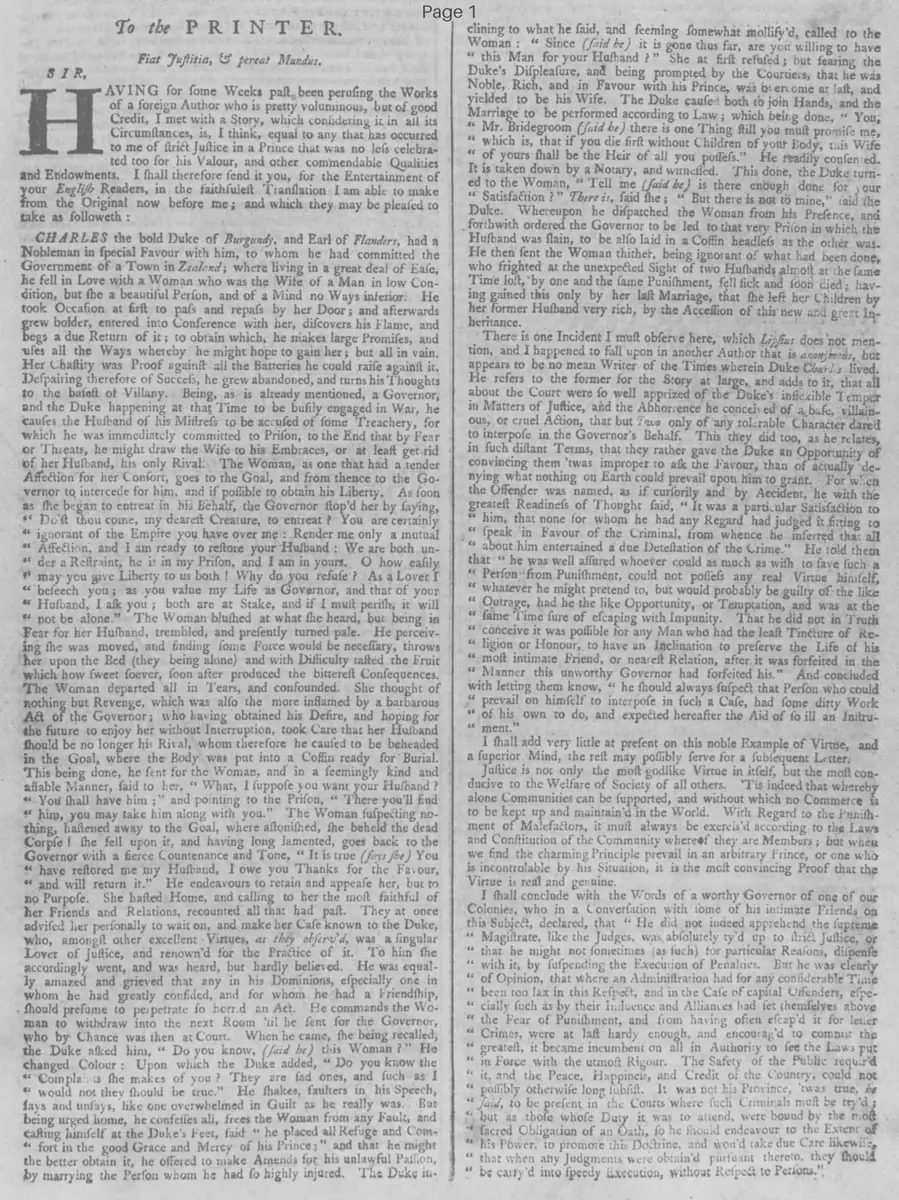
Fiat Justitia, & pereat Mundus.
SIR,
HAVING for some Weeks past been perusing the Works of a foreign Author who is pretty voluminous, but of good Credit, I met with a Story, which considering it in all its Circumstances, is, I think, equal to any that has occurred to me of strict Justice in a Prince that was no less celebrated too for his Valour, and other commendable Qualities and Endowments. I shall therefore send it you, for the Entertainment of your
English Readers, in the faithfullest Translation I am able to make from the Original now before me; and which they may be pleased to take as followeth:
CHARLES the bold Duke of Burgundy, and Earl of Flanders, had a Nobleman in special Favour with him, to whom he had committed the Government of a Town in Zealand; where living in a great deal of Ease, he fell in Love with a Woman who was the Wife of a Man in low Condition, but she a beautiful Person, and of a Mind no Ways inferior. He took Occasion at first to pass and repass by her Door; and afterwards grew bolder, entered into Conference with her, discovers his Flame, and begs a due Return of it; to obtain which, he makes large Promises, and uses all the Ways whereby he might hope to gain her; but all in vain. Her Chastity was Proof against all the Batteries he could raise against it. Despairing therefore of Success, he grew abandoned, and turns his Thoughts to the basest of Villany. Being, as is already mentioned, a Governor, and the Duke happening at that Time to be busily engaged in War, he causes the Husband of his Mistress to be accused of some Treachery, for which he was immediately committed to Prison, to the End that by Fear or Threats, he might draw the Wife to his Embraces, or at least get rid of her Husband, his only Rival. The Woman, as one that had a tender Affection for her Consort, goes to the Goal, and from thence to the Governor to intercede for him, and if possible to obtain his Liberty. As soon as she began to entreat in his Behalf, the Governor stop'd her by saying, "Dost thou come, my dearest Creature, to entreat? You are certainly ignorant of the Empire you have over me: Render me only a mutual Affection, and I am ready to restore your Husband: We are both under a Restraint, he is in my Prison, and I am in yours. O how easily may you give Liberty to us both! Why do you refuse? As a Lover I beseech you; as you value my Life as Governor, and that of your Husband, I ask you; both are at Stake, and if I must perish, it will not be alone." The Woman blushed at what she heard, but being in Fear for her Husband, trembled, and presently turned pale. He perceiving she was moved, and finding some Force would be necessary, throws her upon the Bed (they being alone) and with Difficulty tasted the Fruit which how sweet soever, soon after produced the bitterest Consequences. The Woman departed all in Tears, and confounded. She thought of nothing but Revenge, which was also the more inflamed by a barbarous Act of the Governor; who having obtained his Desire, and hoping for the future to enjoy her without Interruption, took Care that her Husband should be no longer his Rival, whom therefore he caused to be beheaded in the Goal, where the Body was put into a Coffin ready for Burial. This being done, he sent for the Woman, and in a seemingly kind and affable Manner, said to her, "What, I suppose you want your Husband? You shall have him;" and pointing to the Prison, "There you'll find him, you may take him along with you." The Woman suspecting nothing, hastened away to the Goal, where astonished, she beheld the dead Corpe! She fell upon it, and having long lamented, goes back to the Governor with a fierce Countenance and Tone, "It is true (Says she) You have restored me my Husband, I owe you Thanks for the Favour, and will return it." He endeavours to retain and appease her, but to no Purpose. She hated Home, and calling to her the most faithful of her Friends and Relations, recounted all that had past. They at once advised her personally to wait on, and make her Case known to the Duke, who, amongst other excellent Virtues, as they observed, was a singular Lover of Justice, and renowned for the Practice of it. To him she accordingly went, and was heard, but hardly believed. He was equally amazed and grieved that any in his Dominions, especially one in whom he had greatly confided, and for whom he had a Friendship, should presume to perpetrate so horrid an Act. He commands the Woman to withdraw into the next Room 'till he sent for the Governor, who by Chance was then at Court. When he came, she being recalled, the Duke asked him, "Do you know, (Said he) this Woman?" He changed Colour: Upon which the Duke added, "Do you know the Complaint she makes of you? They are bad ones, and such as I would not they should be true." He shakes, falters in his Speech, says and unsays, like one overwhelmed in Guilt as he really was. But being urged home, he confesses all, frees the Woman from any Fault, and casting himself at the Duke's Feet, said "he placed all Refuge and Comfort in the good Grace and Mercy of his Prince;" and that he might the better obtain it, he offered to make Amends for his unlawful Passion, by marrying the Person whom he had so highly injured. The Duke inclining to what he said, and seeming somewhat mollify'd, called to the Woman: "Since (Said he) it is gone thus far, are you willing to have this Man for your Husband?" She at first refused; but fearing the Duke's Displeasure, and being prompted by the Courtiers, that he was Noble, Rich, and in Favour with his Prince, was become at last, and yielded to be his Wife. The Duke caused both to join Hands, and the Marriage to be performed according to Law; which being done, "You, Mr. Bridegroom (Said he) there is one Thing till you must promise me, which is, that if you die first without Children of your Body, this Wife of yours shall be the Heir of all you possess." He readily consented. It is taken down by a Notary, and witnessed. This done, the Duke turned to the Woman, "Tell me (Said he) is there enough done for our Satisfaction?" There is, said she; "But there is not to mine," said the Duke. Whereupon he dispatched the Woman from his Presence, and forthwith ordered the Governor to be led to that very Prison in which the Husband was slain, to be also laid in a Coffin headless as the other was. He then sent the Woman thither, being ignorant of what had been done, who frighted at the unexpected Sight of two Husbands almost at the same Time lost, by one and the same Punishment, fell sick and soon died; having gained this only by her last Marriage, that she left her Children by her former Husband very rich, by the Accession of this new and great Inheritance. There is one Incident I must observe here, which Lipius does not mention, and I happened to fall upon in another Author that is anonymous, but appears to be no mean Writer of the Times wherein Duke Charles lived. He refers to the former for the Story at large, and adds to it, that all about the Court were so well apprized of the Duke's inflexibe Temper in Matters of Justice, and the Abhorrence he conceived of a base, villainous, or cruel Action, that but few only of any tolerable Character dared to interpose in the Governor's Behalf. This they did too, as he relates, in such distant Terms, that they rather gave the Duke an Opportunity of convincing them 'twas improper to ask the Favour, than of actually denying what nothing on Earth could prevail upon him to grant. For when the Offender was named, as if cursorily and by Accident, he with the greatest Readiness of Thought said, "It was a particular Satisfaction to him, that none for whom he had any Regard had judged it fitting to speak in Favour of the Criminal, from whence he inferred that all about him entertained a due Detestation of the Crime." He told them that "he was well assured whoever could as much as wish to save such a Person from Punishment, could not possess any real Virtue himself, whatever he might pretend to, but would probably be guilty of the like Outrage, had he the like Opportunity, or Temptation, and was at the same Time sure of escaping with Impunity. That he did not in Truth conceive it was possible for any Man who had the least Tincture of Religion or Honour, to have an Inclination to preserve the Life of his most intimate Friend, or nearest Relation, after it was forfeited in the Manner this unworthy Governor had forfeited his." And concluded with letting them know, "he should always suspect that Person who could prevail on himself to interpose in such a Case, had some dirty Work of his own to do, and expected hereafter the Aid of so ill an Instrument."
I shall add very little at present on this noble Example of Virtue, and a superior Mind, the rest may possibly serve for a subsequent Letter. Justice is not only the most godlike Virtue in itself, but the most conducive to the Welfare of Society of all others. 'Tis indeed that whereby alone Communities can be supported, and without which no Commerce is to be kept up and maintain'd in the World. With Regard to the Punishment of Malefactors, it must always be exercised according to the Laws and Constitution of the Community whereof they are Members; but when we find the charming Principle prevail in an arbitrary Prince, or one who is uncontrollable by his Situation, it is the most convincing Proof that the Virtue is real and genuine.
I Shall conclude with the Words of a worthy Governor of one of our Colonies, who in a Conversation with some of his intimate Friends on this Subject, declared, that "He did not indeed apprehend the supreme Magistrate, like the Judges, was absolutely ty'd up to strict Justice, or that he might not sometimes (as such) for particular Reasons, dispense with it, by suspending the Execution of Penalties. But he was clearly of Opinion, that where an Administration had for any considerable Time been too lax in this Respect, and in the Case of capital Offenders, especially such as by their Influence and Alliances had set themselves above the Fear of Punishment, and from having often escap'd it for lesser Crimes, were at last hardy enough, and encouraged to commit the greatest, it became incumbent on all in Authority to see the Laws put in Force with the utmost Rigour. The Safety of the Public required it, and the Peace, Happiness, and Credit of the Country, could not possibly otherwise long subsist. It was not his Province, 'twas true, he said, to be present in the Courts where such Criminals must be try'd; but as those whose Duty it was to attend, were bound by the most sacred Obligation of an Oath, so he Should endeavour to the Extent of his Power, to promote this Doctrine, and would take due Care likewise, that when any Judgments were obtained pursuant thereto, they should be carried into speedy Execution, without Respect to Persons."
What sub-type of article is it?
What themes does it cover?
What keywords are associated?
What entities or persons were involved?
Letter to Editor Details
Recipient
The Printer
Main Argument
the letter shares a historical tale of strict justice under duke charles of burgundy against a corrupt governor who murders a rival, emphasizing justice as the godlike virtue essential for societal welfare, even in arbitrary rulers, and quotes a colonial governor on enforcing laws rigorously against influential offenders.
Notable Details