Thank you for visiting SNEWPapers!
Sign up free
The White Pine News
Ely, White Pine County, Nevada
What is this article about?
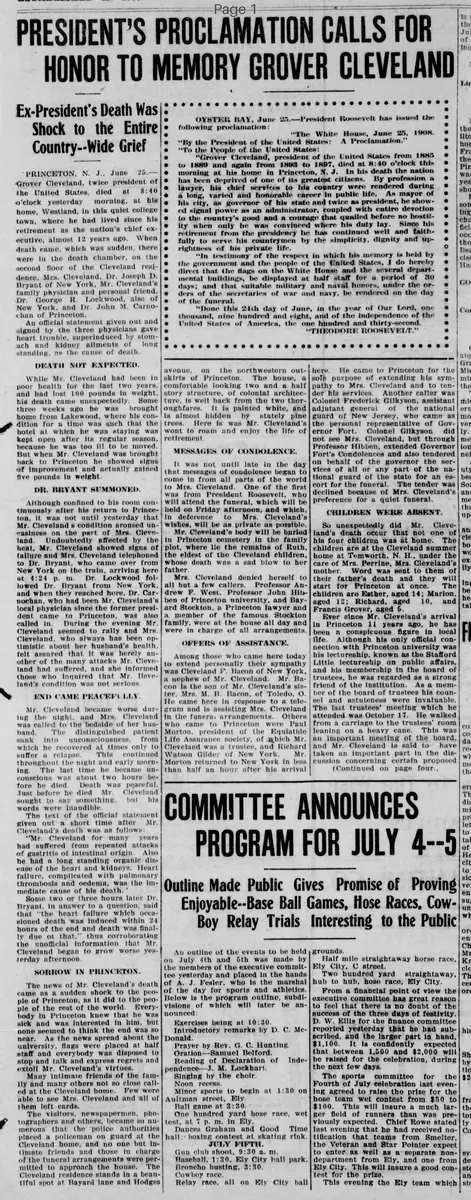
Former U.S. President Grover Cleveland died unexpectedly on June 24 at his Princeton, NJ home from heart failure, after years of health issues. The article covers his final hours, medical details, family absence, public mourning, funeral plans, and praises from officials like Roosevelt and Cortelyou.
Merged-components note: This is the continuation of the major news story on the death of Grover Cleveland from page 1 to page 4; relabel from 'obituary' to 'story' as it is a full narrative news article, not a personal death notice.
Clippings
1 of 2
OCR Quality
Full Text
Ex-President's Death Was Shock to the Entire Country--Wide Grief
PRINCETON, N. J., June 25.--Grover Cleveland, twice president of the United States, died at 8:40 o'clock yesterday morning, at his home, Westland, in this quiet college town, where he had lived since his retirement as the nation's chief executive, almost 12 years ago. When death came, which was sudden, there were in the death chamber, on the second floor of the Cleveland residence, Mrs. Cleveland, Dr. Joseph D. Bryant of New York, Mr. Cleveland's family physician and personal friend, Dr. George R. Lockwood, also of New York, and Dr. John M. Carnochan of Princeton.
An official statement given out and signed by the three physicians gave heart trouble, superinduced by stomach and kidney ailments of long standing, as the cause of death.
DEATH NOT EXPECTED.
While Mr. Cleveland had been in poor health for the last two years, and had lost 100 pounds in weight, his death came unexpectedly. Some three weeks ago he was brought home from Lakewood, where his condition for a time was such that the hotel at which he was staying was kept open after its regular season, because he was too ill to be moved. But when Mr. Cleveland was brought back to Princeton he showed signs of improvement and actually gained five pounds in weight.
DR. BRYANT SUMMONED.
Although confined to his room continuously after his return to Princeton, it was not until yesterday that Mr. Cleveland's condition aroused uneasiness on the part of Mrs. Cleveland. Undoubtedly affected by the heat, Mr. Cleveland showed signs of failure and Mrs. Cleveland telephoned to Dr. Bryant, who came over from New York on the train, arriving here at 4:24 p. m. Dr. Lockwood followed Dr. Bryant from New York, and when they reached here, Dr. Carnochan, who had been Mr. Cleveland's local physician since the former president came to Princeton, was also called in. During the evening Mr. Cleveland seemed to rally and Mrs. Cleveland, who always has been optimistic about her husband's health, felt assured that it was merely another of the many attacks Mr. Cleveland had suffered, and she informed those who inquired that Mr. Cleveland's condition was not serious.
END CAME PEACEFULLY.
Mr. Cleveland became worse during the night, and Mrs. Cleveland was called to the bedside of her husband. The distinguished patient sank into unconsciousness, from which he recovered at times only to suffer a relapse. This continued throughout the night and early morning. The last time he became unconscious was about two hours before he died. Death was peaceful. Just before he died Mr. Cleveland sought to say something, but his words were inaudible.
The text of the official statement given out a short time after Mr. Cleveland's death was as follows:
"Mr. Cleveland for many years had suffered from repeated attacks of gastritis of intestinal origin. Also he had a long standing organic disease of the heart and kidneys. Heart failure, complicated with pulmonary thrombosis and oedema, was the immediate cause of his death."
Some two or three hours later Dr. Bryant, in answer to a question, said that "the heart failure which occasioned death was induced within 24 hours of the end and death was finally due to that," thus corroborating the unofficial information that Mr. Cleveland began to grow worse yesterday afternoon.
SORROW IN PRINCETON.
The news of Mr. Cleveland's death came as a sudden shock to the people of Princeton, as it did to the people of the rest of the world. Everybody in Princeton knew that he was sick and was interested in him, but none seemed to think the end was so near. As the news spread about the university, flags were placed at half staff and everybody was disposed to stop and talk and express regrets and extoll Mr. Cleveland's virtues. Many intimate friends of the family and many others not so close called at the Cleveland home. Few were able to see Mrs. Cleveland and all of them left cards. The visitors, newspapermen, photographers and others, became so numerous that the police authorities placed a policeman on guard at the Cleveland home, and no one but intimate friends and those in charge of the funeral arrangements were permitted to approach the house. The Cleveland residence stands in a beautiful spot at Bayard lane and Hodges avenue, on the northwestern outskirts of Princeton. The house, a comfortable looking two and a half story structure, of colonial architecture, is well back from the two thoroughfares. It is painted white, and is almost hidden by stately pine trees. Here it was Mr. Cleveland's wont to roam and enjoy the life of retirement.
MESSAGES OF CONDOLENCE.
It was not until late in the day that messages of condolence began to come in from all parts of the world to Mrs. Cleveland. One of the first was from President Roosevelt, who will attend the funeral, which will be held on Friday afternoon, and which, in deference to Mrs. Cleveland's wishes, will be as private as possible. Mr. Cleveland's body will be buried in Princeton cemetery in the family plot, where lie the remains of Ruth, the eldest of the Cleveland children, whose death was a sad blow to her father. Mrs. Cleveland denied herself to all but a few callers. Professor Andrew F. West, Professor John Hibben of Princeton university, and Bayard Stockton, a Princeton lawyer and a member of the famous Stockton family, were at the house all day and were in charge of all arrangements.
OFFERS OF ASSISTANCE.
Among those who came here today to extend personally their sympathy was Cleveland F. Bacon of New York, a nephew of Mr. Cleveland. Mr. Bacon is the son of Mr. Cleveland's sister, Mrs. M. B. Bacon, of Toledo, O. He came here in response to a telegram and is assisting Mrs. Cleveland in the funeral arrangements. Others who came to Princeton were Paul Morton, president of the Equitable Life Assurance society, of which Mr. Cleveland was a trustee, and Richard Watson Gilder of New York. Mr. Morton returned to New York in less than half an hour after his arrival here. He came to Princeton for the sole purpose of extending his sympathy to Mrs. Cleveland and to tender his services. Another caller was Colonel Frederick Gilkyson, assistant adjutant general of the national guard of New Jersey, who came as the personal representative of Governor Fort. Colonel Gilkyson did not see Mrs. Cleveland, but through Professor Hibben, extended Governor Fort's condolences and also tendered on behalf of the governor the services of all or any part of the national guard of the state for an escort for the funeral. The tender was declined because of Mrs. Cleveland's preference for a quiet funeral.
CHILDREN WERE ABSENT.
So unexpectedly did Mr. Cleveland's death occur that not one of his four children was at home. The children are at the Cleveland summer home at Temworth, N. H., under the care of Mrs. Perrine, Mrs. Cleveland's mother. Word was sent to them of their father's death and they will start for Princeton at once. The children are Esther, aged 14; Marion, aged 12; Richard, aged 10, and Francis Grover, aged 5.
Ever since Mr. Cleveland's arrival in Princeton 11 years ago, he has been a conspicuous figure in local life. Although his only official connection with Princeton university was his lectureship, known as the Stafford Little lectureship on public affairs, and his membership in the board of trustees, he was regarded as a strong friend of the institution. As a member of the board of trustees his counsel and astuteness were invaluable. The last trustees' meeting which he attended was October 17. He walked from a carriage to the trustees' room leaning on a heavy cane. This was an important meeting of the board, and Mr. Cleveland is said to have taken an important part in the discussion concerning certain proposed...
(Continued on page four.)
DEATH OF CLEVELAND
(Continued from page one.)
changes in the university social system.
TRUE AND FIRM.
Norman J. Coleman Adds Words of Praise for Dead Statesman.
ST. LOUIS, June 25.-Upon being apprised of the death of former President Cleveland, former Lieutenant Governor Norman J. Coleman, who was secretary of agriculture during President Cleveland's first administration, said:
"I am deeply grieved and inexpressibly shocked at the sad intelligence. I can not speak in terms strong enough in commendation of his most excellent qualities of both heart and head. He had but one ambition, and that was to serve the people of the United States in the best and most faithful manner. He was rather slow about forming friendship, but when once the bond of friendship was formed it was a bond that was true and firm. President Cleveland was a most excellent man in every respect, and his passing is a crushing blow to the country. My deepest sympathies go out to his stricken family. I will endeavor, if possible, to attend the funeral."
RUGGED AND SINCERE
WASHINGTON, June 25.-Secretary Cortelyou made this statement regarding Mr. Cleveland, when informed of the former president's death:
"Although not entirely unexpected at this time by those who knew Mr. Cleveland's real condition, his death is none the less a keen sorrow. He was a fine American type, rising from obscurity to the highest office in the people's gift through sheer force of character-a character so rugged, so loyal, and so sincere as to excite not only the respect and affection of those who were privileged to be of his friends but of those who were opposed to him for political or other reasons. I know of no man in our history more unflinching in the performance of what he believed to be his duty. No man realized more fully the ideal of an incorruptible public servant. His example has been most wholesome in these years of social and economic unrest and the influence of his calm, reasonable and hopeful spirit made for a better understanding of our citizenship. His death is a very great loss to the country."
( Signed )
"GEORGE B. CORTELYOU."
Secretary Straus of the department of commerce and labor said:
"Another of the great fathers of the republic has gone to his eternal home. His fame and services belong to the country and will be handed down to a grateful posterity as an example of unswerving devotion to the country's welfare. Our greatest presidents, Washington, Jefferson and Lincoln, each rendered the services to the country which in their time it stood most in need of. Cleveland was one of these mighty giants of political righteousness."
What sub-type of article is it?
What themes does it cover?
What keywords are associated?
What entities or persons were involved?
Where did it happen?
Story Details
Key Persons
Location
Princeton, N. J., Westland
Event Date
June 24
Story Details
Grover Cleveland died suddenly at 8:40 a.m. from heart failure at his Princeton home, after a period of poor health. Surrounded by his wife and physicians, his death shocked the nation, prompting widespread grief, condolences from President Roosevelt, and tributes praising his character, loyalty, and service as an incorruptible public servant.