Thank you for visiting SNEWPapers!
Sign up free
New Haven Daily Herald
New Haven, New Haven County, Connecticut
What is this article about?
A concerned citizen highlights the overlooked injustice of unreliable Irish immigrant house servants who abandon employers after training and care, often without notice, causing hardship to families and boarding house operators. Proposes remedies like requiring verifiable recommendations, withholding wages for early departure, truthful character references, and petitioning legislatures for protective laws.
Merged-components note: This is a continuation of the letter to the editor on house servants from page 2 to page 3; the second component was mislabeled as editorial.
Clippings
1 of 2
OCR Quality
Full Text
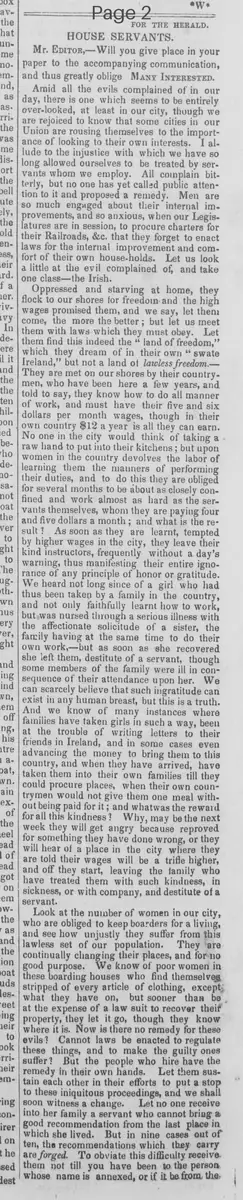
HOUSE SERVANTS.
Mr. Editor,—Will you give place in your paper to the accompanying communication, and thus greatly oblige Many Interested.
Amid all the evils complained of in our day, there is one which seems to be entirely over-looked, at least in our city, though we are rejoiced to know that some cities in our Union are rousing themselves to the importance of looking to their own interests. I allude to the injustice with which we have so long allowed ourselves to be treated by servants whom we employ. All complain bitterly, but no one has yet called public attention to it and proposed a remedy. Men are so much engaged about their internal improvements, and so anxious, when our Legislatures are in session, to procure charters for their Railroads, &c. that they forget to enact laws for the internal improvement and comfort of their own house-holds. Let us look a little at the evil complained of, and take one class—the Irish.
Oppressed and starving at home, they flock to our shores for freedom—and the high wages promised them, and we say, let them come, the more the better; but let us meet them with laws which they must obey. Let them find this indeed the "land of freedom," which they dream of in their own "swate Ireland," but not a land of lawless freedom.—They are met on our shores by their countrymen, who have been here a few years, and told to say, they know how to do all manner of work, and must have their five and six dollars per month wages, though in their own country $12 a year is all they can earn. No one in the city would think of taking a raw hand to put into their kitchens; but upon women in the country devolves the labor of learning them the manners of performing their duties, and to do this they are obliged for several months to be about as closely confined and work almost as hard as the servants themselves, whom they are paying four and five dollars a month; and what is the result? As soon as they are learnt, tempted by higher wages in the city, they leave their kind instructors, frequently without a day's warning, thus manifesting their entire ignorance of any principle of honor or gratitude.
We heard not long since of a girl who had thus been taken by a family in the country, and not only faithfully learnt how to work, but was nursed through a serious illness with the affectionate solicitude of a sister, the family having at the same time to do their own work,—but as soon as she recovered she left them, destitute of a servant, though some members of the family were ill in consequence of their attendance upon her. We can scarcely believe that such ingratitude can exist in any human breast, but this is a truth. And we know of many instances where families have taken girls in such a way, been at the trouble of writing letters to their friends in Ireland, and in some cases even advancing the money to bring them to this country, and when they have arrived, have taken them into their own families till they could procure places, when their own countrymen would not give them one meal without being paid for it; and what was the reward for all this kindness? Why, may be the next week they will get angry because reproved for something they have done wrong, or they will hear of a place in the city where they are told their wages will be a trifle higher, and off they start, leaving the family who have treated them with such kindness, in sickness, or with company, and destitute of a servant.
Look at the number of women in our city, who are obliged to keep boarders for a living, and see how unjustly they suffer from this lawless set of our population. They are continually changing their places, and for no good purpose. We know of poor women in these boarding houses who find themselves stripped of every article of clothing, except what they have on, but sooner than be at the expense of a law suit to recover their property, they let it go, though they know where it is. Now is there no remedy for these evils? Cannot laws be enacted to regulate these things, and to make the guilty ones suffer? But the people who hire have the remedy in their own hands. Let them sustain each other in their efforts to put a stop to these iniquitous proceedings, and we shall soon witness a change. Let no one receive into her family a servant who cannot bring a good recommendation from the last place in which she lived. But in nine cases out of ten, the recommendations which they carry are forged. To obviate this difficulty receive them not till you have been to the person whose name is annexed, or if it be from the Intelligence Office, let the employer there be responsible.
country, till you have written. If the certificate is forged, that is proof positive of the dishonesty of their character. "If it is proved that she has left the family in an unjust manner, let it be a sufficient reason for your not receiving her—for who would take a girl with the knowledge that any moment she might leave you. If a girl leaves before her time for which she engaged to stay has expired, or without giving due warning, let her wages be withheld and let the law sustain us in it, as it does in England. Let those who give letters of recommendation be careful how they do it; that they impose not upon their own country-women; and when applied to for the character of a girl, let them tell the truth—if she is dishonest, say so—if she left you wrongfully, say so. Let us so act as to make them feel if they have not principle enough to do right, they must suffer for doing wrong. Let those who employ servants take a decided stand in this matter, and if we cannot do it without, let us call a meeting of ladies to unite upon some plan for freeing ourselves from this increasing evil.— Men know nothing of the anxiety and trouble which their families suffer on this account. Let our next Legislature be flooded with petitions from the females of our State for a redress of these grievances, and in the meantime let us do all in our power to reform them ourselves.
What sub-type of article is it?
What themes does it cover?
What keywords are associated?
What entities or persons were involved?
Letter to Editor Details
Author
Many Interested
Recipient
Mr. Editor
Main Argument
irish immigrant house servants are unjustly unreliable, leaving employers after training and care without notice, causing significant hardship; remedies include verifiable recommendations, withholding wages for breaches, truthful references, and legislative petitions to regulate their behavior.
Notable Details