Thank you for visiting SNEWPapers!
Sign up free
Norfolk Gazette And Publick Ledger
Norfolk, Virginia
What is this article about?
Excerpt from Cobbett's Political Register critiquing S.V.'s argument for a declaratory law allowing British subjects to expatriate, especially to the U.S. Defends perpetual allegiance under English law, analyzing statutes from Henry VIII, James I, and George I, and rejecting French writer Pecquet's views on natural liberty to change allegiance.
Merged-components note: Continuation of the same editorial article on expatriation across pages 1 and 2.
Clippings
1 of 2
OCR Quality
Full Text
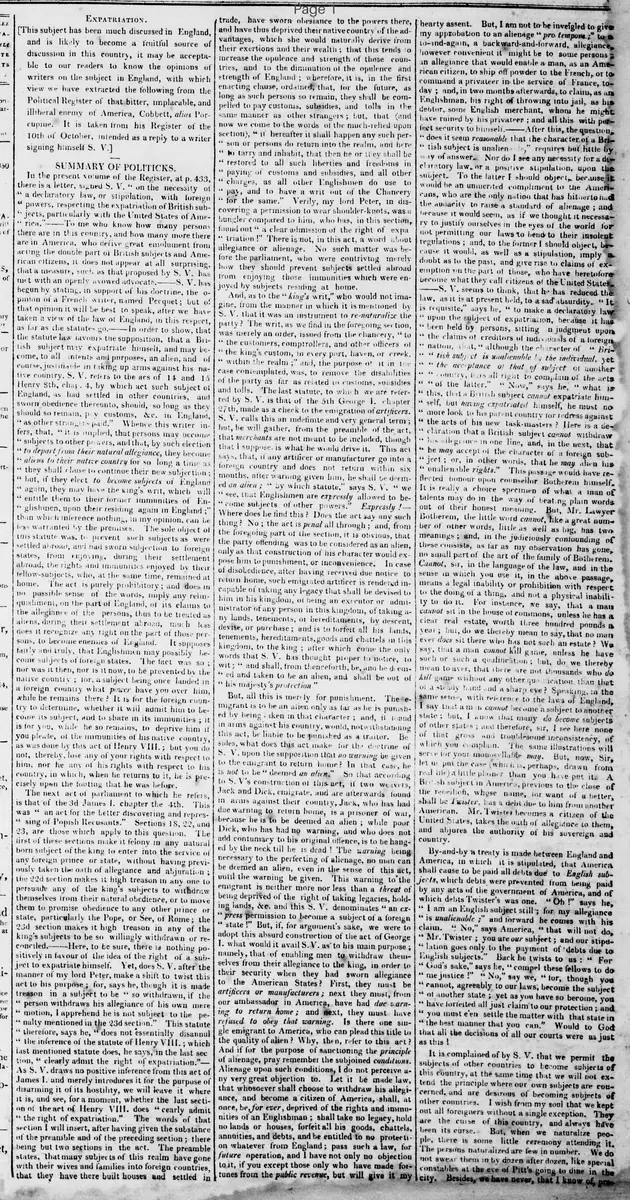
[This subject has been much discussed in England, and is likely to become a fruitful source of discussion in this country, it may be acceptable to our readers to know the opinions of writers on the subject in England, with which view we have extracted the following from the Political Register of that bitter, implacable, and illiberal enemy of America, Cobbett, alias Porcupine. It is taken from his Register of the 10th of October, intended as a reply to a writer signing himself S. V.]
SUMMARY OF POLITICKS.
In the present volume of the Register, at p. 433, there is a letter, signed S. V. "on the necessity of a declaratory law, or stipulation, with foreign powers, respecting the expatriation of British subjects, particularly with the United States of America."—To me who know how many persons there are in this country, and how many more there are in America, who derive great emolument from acting the double part of British subjects and American citizens, it does not appear at all surprising, that a measure, such as that proposed by S. V. has met with an openly avowed advocate.—S. V. has begun by stating, in support of his doctrine, the opinion of a French writer, named Pecquet; but of that opinion it will be best to speak, after we have taken a view of the law of England, in this respect, as far as the statutes go.—In order to show, that the statute law favours the supposition, that a British subject may expatriate himself, and may become, to all intents and purposes, an alien, and of course, justifiable in taking up arms against his native country, S. V. refers to the acts of 14 and 15 Henry VIII. ch. 4, by which act such subject of England, as had settled in other countries, and sworn obedience thereunto, should, so long as they should so remain, pay customs, &c. in England, "as other strangers paid." Whence this writer infers, that, "it is implied, that persons may become subjects to other powers, and that, by such election to depart from their natural allegiance, they become aliens to their native country for so long a time as they shall choose to continue their new subjection; but, if they elect to become subjects of England again, they may have the king's writ, which will entitle them to their former immunities of Englishmen, upon their residing again in England;" than which inference nothing, in my opinion, can be less warranted by the premises. The sole object of this statute was, to prevent such subjects as were settled abroad, and had sworn subjection to foreign states, from enjoying, during their settlement abroad, the rights and immunities enjoyed by their fellow-subjects, who, at the same time, remained at home. The act is purely prohibitory; and does in no possible sense of the words, imply any relinquishment, on the part of England, of its claims to the allegiance of the persons, thus to be treated as aliens, during their settlement abroad, much less does it recognize any right on the part of those persons, to become enemies of England. It supposes fairly and truly, that Englishmen may possibly become subjects of foreign states. The fact was so; nor was it then, nor is it now, to be prevented by the native country; for, a subject being once landed in a foreign country what power have you over him, while he remains there? It is for the foreign country to determine, whether it will admit him to become its subject, and to share in its immunities; it is for you, while he so remains, to deprive him if you please, of the immunities of his native country, as was done by this act of Henry VIII.; but you do not, thereby, lose any of your rights with respect to him, nor he any of his rights with respect to his country, in which, when he returns to it, he is precisely upon the footing that he was before.
The next act of parliament to which he refers, is that of the 3d James I. chapter the 4th. This was "an act for the better discovering and repressing of Popish Recusants." Sections 18, 22, and 23, are those which apply to this question. The first of these sections make it felony in any natural born subject of the king to enter into the service of any foreign prince or state, without having previously taken the oath of allegiance and abjuration; the 22d section makes it high treason in any one to persuade any of the king's subjects to withdraw themselves from their natural obedience, or to move them to promise obedience to any other prince or state, particularly the Pope, or See, of Rome; the 23d section makes it high treason in any of the king's subjects to be so willingly withdrawn or reconciled.—Here, to be sure, there is nothing positively in favour of the idea of the right of a subject to expatriate himself. Yet, does S. V. after the manner of my lord Peter, make a shift to twist this act to his purpose; for, says he, though it is made treason in a subject to be "so withdrawn, if the person withdraws his allegiance of his own mere motion, I apprehend he is not subject to the penalty mentioned in the 23d section." This statute therefore, says he, "does not essentially disannul the inference of the statute of Henry VIII.; which last mentioned statute does, he says, in the last section, "clearly admit the right of expatriation."
As S. V. draws no positive inference from this act of James I. and merely introduces it for the purpose of disarming it of its hostility, we will leave it where it is, and see, for a moment, whether the last section of the act of Henry VIII. does "clearly admit the right of expatriation." The words of that section I will insert, after having given the substance of the preamble and of the preceding section; there being but two sections in the act. The preamble states, that many subjects of this realm have gone with their wives and families into foreign countries, that they have there built houses and settled in trade, have sworn obeisance to the powers there. and have thus deprived their native country of the advantages, which she would naturally derive from their exertions and their wealth: that this tends to increase the opulence and strength of those countries, and to the diminution of the opulence and strength of England; wherefore, it is, in the first enacting clause, ordained, that, for the future, as long as such persons so remain, they shall be compelled to pay customs, subsidies, and tolls in the same manner as other strangers; but, that (and now we come to the words of the much-relied upon section), "if hereafter it shall happen any such person or persons do return into the realm, and here to tarry and inhabit, that then he or they shall be restored to all such liberties and freedoms in paying of customs and subsidies, and all other charges, as all other Englishmen do use to pay, and to have a writ out of the Chancery for the same." Verily, my lord Peter, in discovering a permission to wear shoulder-knots, was a bungler compared to him, who has, in this section, found out "a clear admission of the right of expatriation!" There is not, in this act, a word about allegiance or alienage. No such matter was before the parliament, who were contriving merely how they should prevent subjects settled abroad from enjoying those immunities which were enjoyed by subjects residing at home.
And, as to the "king's writ," who would not imagine, from the manner in which it is mentioned by S. V. that it was an instrument to re-naturalize the party? The writ, as we find in the foregoing section, was merely an order, issued from the chancery, "to the customners, comptrollers, and other officers of the king's custom, in every port, haven, or creek. within the realm;" and, the purpose of it in the case contemplated, was, to remove the disabilities of the party as far as related to customs, subsidies and tolls. The last statute, to which we are referred by S. V. is that of the 5th George I. chapter 27th, made as a check to the emigration of artificers. S. V. calls this an indefinite and very general term; but, he will gather, from the preamble of the act, that merchants are not meant to be included, though that I suppose. is what he would drive it. This act says, that, if any artificer or manufacturer go into a foreign country and does not return within six months, after warning given him, he shall be deemed an alien; "by which statute," says S. V. "we see, that Englishmen are expressly allowed to become subjects of other powers." Expressly!—Where does he find this? Does the act say any such thing? No; the act is penal all through; and, from the foregoing part of the section, it is obvious, that the party offending was to be considered as an alien, only as that construction of his character would expose him to punishment, or inconvenience. In case of disobedience, after having received due notice to return home, such emigrated artificer is rendered incapable of taking any legacy that shall be devised to him in his kingdom, of being an executor or administrator of any person in this kingdom, of taking any lands, tenements, or hereditaments, by descent, devise, or purchase; and is to forfeit all his lands, tenements, hereditaments, goods and chattels in this kingdom, to the king; after which come the only words that S. V. has thought proper to notice, to wit; "and shall, from thenceforth, be, and be deemed and taken to be an alien, and shall be out of his majesty's protection
But, all this is merely for punishment. The emigrant is to be an alien only as far as he is punished by being taken in that character; and, if found in arms against his country, would, notwithstanding this act, be liable to be punished as a traitor. Besides, what does this act make for the doctrine of S. V. upon the supposition that no warning be given to the emigrant to return home? In that case, he is not to be "deemed an alien." So that according to S. V's construction of this act, if two weavers, Jack and Dick, emigrate, and are afterwards found in arms against their country, Jack, who has had due warning to return home, is a prisoner of war, because he is to be deemed an alien; while poor Dick, who has had no warning, and who does not add contumacy to his original offence, is to be hanged by the neck till he is dead! The warning being necessary to the perfecting of alienage, no man can be deemed an alien, even in the sense of this act, until the warning be given. This warning to the emigrant is neither more nor less than a threat of being deprived of the right of taking legacies, holding lands, &c. and this S. V. denominates "an express permission to become a subject of a foreign state!" But, if, for argument's sake, we were to adopt this absurd construction of the act of George I. what would it avail S.V. as to his main purpose; namely, that of enabling men to withdraw themselves from their allegiance to the king, in order to their security when they had sworn allegiance to the American States? First, they must be artificers or manufacturers; next they must, from our ambassador in America, have had due warning to return home; and next, they must have refused to obey that warning. Is there one single emigrant to America, who can plead this title to the quality of alien? Why, then, refer to this act? And if for the purpose of sanctioning the principle of alienage, pray remember the subjoined conditions. Alienage upon such conditions, I do not perceive any very great objection to. Let it be made law, that whosoever shall choose to withdraw his allegiance, and become a citizen of America, shall, at once, be, for ever, deprived of the rights and immunities of an Englishman; shall take no legacy, hold no lands or houses, forfeit all his goods, chattels, annuities, and debts, and be entitled to no protection whatever from England; pass such a law, for future operation, and I have not only no objection to it, if you except those only who have made fortunes from the public revenue, but will give it my hearty assent. But, I am not to be inveigled to give my approbation to an alienage "pro tempore.;" to to-and-again, a backward-and-forward, allegiance however convenient it might be to some persons an allegiance that would enable a man, as an American citizen, to ship off powder to the French, or to command a privateer in the service of France, to-day; and, in two months afterwards, to claim, as an Englishman, his right of throwing into jail, as his debtor, some English merchant, whom he might have ruined by his privateer; and all this with perfect security to himself.—After this, the question. "does it seem reasonable that the character of a British subject is unalienable," requires but little by way of answer. Nor do I see any necessity for a declaratory law, or a positive stipulation, upon the subject. To the latter I should object, because it would be an unmerited compliment to the Americans, who are the only nation that has hitherto had the audacity to raise a standard of alienage; and because it would seem, as if we thought it necessary to justify ourselves in the eyes of the world for not permitting our laws to bend to their insolent regulations; and, to the former I should object, because it would, as well as a stipulation, imply a doubt as to the past, and give rise to claims of exemption on the part of those, who have heretofore become what they call citizens of the United States -S. V. seems to think, that he has reduced the law, as it is at present held, to a sad absurdity. "It is requisite," says he, "to make a declaratory law upon the subject of expatriation, because it has been held by persons, sitting in judgement upon the claims of creditors of individuals of a foreign nation, that," although the character of "British subject is unalienable by the individual, yet the acceptance of that of subject of another country, lessens all right to complain of the acts of the latter." "Now," says he, "what is this, that a British subject cannot expatriate himself, but having expatriated himself, he must no more look to his parent country for redress against the acts of his new task-masters? Here is a declaration that a British subject cannot withdraw his allegiance in one line, and, in the next, that he may accept of the character of a foreign subject; or, in other words, that he may alien his unalienable rights." This passage would have reflected honour upon counsellor Botherem himself. It is really a choice specimen of what a man of talents may do in the way of beating plain words out of their honest meaning. But, Mr. Lawyer Botherem, the little word cannot, like a great number of other words, little as well as big, has two meanings; and, in the judiciously confounding of these consists, as far as my observation has gone, no small part of the art of the family of Botherem. Cannot, sir, in the language of the law, and in the sense in which you use it, in the above passage, means a legal inability or prohibition with respect to the doing of a thing, and not a physical inability to do it. For instance, we say, that a man cannot sit in the house of commons, unless he has a clear real estate, worth three hundred pounds a year; but, do we thereby mean to say, that no man ever does sit there who has not such an estate? We say, that a man cannot kill game, unless he have such or such a qualification; but, do we thereby mean to aver, that there are not thousands who do kill game without any other qualification than that of a steady hand and a sharp eye? Speaking, in the same sense, with reference to the laws of England, I say that a man cannot become a subject to another state; but, I know that many do become subjects of other states; and therefore, sir, I see here none of that gross and troublesome inconsistency, of which you complain. The same illustrations will serve for your monosyllable may. But, now, Sir, let us put the case (which is, perhaps, drawn from real life) a little plainer than you have put it. A British subject in America, previous to the close of the rebellion, whose name, for want of a better, shall be Twister, has a debt due to him from another American. Mr. Twister becomes a citizen of the United States, takes the oath of allegiance to them, and abjures the authority of his sovereign and country.
By-and-by a treaty is made between England and America, in which it is stipulated, that America shall cause to be paid all debts due to English subjects, which debts were prevented from being paid by any acts of the government of America, and of which debts Twister's was one. "Oh!" says he, "I am an English subject still; for my allegiance is unalienable;" and forward he comes with his claim. "No," says America, "that will not do, Mr. Twister; you are our subject; and our stipulation goes only to the payment of debts due to English subjects." Back he twists to us: "For God's sake," says he, "compel these fellows to do me justice!" "No," say we, "for, though you cannot, agreeably to our laws, become the subject of another state; yet as you have so become, you have forfeited all just claim to our protection; and you must e'en settle the matter with that state in the best manner that you can." Would to God that all the decisions of all our courts were as just as this!
It is complained of by S. V. that we permit the subjects of other countries to become subjects of this country, at the same time that we will not extend the principle where our own subjects are concerned, and are desirous of becoming subjects of other countries. I wish from my soul that we kept out all foreigners without a single exception. They are the curse of this country, and always have been its curse. But, when we naturalize people, there is some little ceremony attending it. The persons naturalized are few in number. We do not swear them in by dozen after dozen, like special constables at the eve of Pitt's going to dine in the city. Besides, we have never, that I know of pre
It tended to any right to exonerate these naturalized persons from any of the duties, which they owe to their parent state, and this is precisely the insolent pretension which the Americans put forward. These naturalized persons, as long as they are under our power, are under the protection of the laws, and are entitled to all the rights and immunities here enjoyed; but, if they were to return home, or if they were taken in arms against their native country, they would be left by us to experience whatever treatment that country might think proper to adopt with respect to them. But, what the Americans claim, is, that, in virtue of a little bit of printed paper, the blanks of which are filled up for nine-pence, well and duly paid, to some one of their half million of pettifoggers, a British subject becomes released, for as long a time as he pleases, from all the obligations appertaining to his natural allegiance; that in virtue of the aforesaid nine-penny certificate, he may, though a director of the "Honourable" East India Company, carry on a private trade to Hindostan without risk of seizure by the British power; that he may supply the enemies of Great Britain with provision and arms and ammunition, without subjecting himself to punishment by Great Britain, though he should, at the same time, be residing in London; and, not to tire the reader with an endless list of base and traitorous acts, that he may, if war should break out between America and England, carry arms against the latter, with no other risk than that to which a lawful enemy is exposed.----Now, a word or two upon the reasonableness of our laws, as touching allegiance, in opposition to the opinion of Monsieur Pecquet, whom S. V. has chosen for his guide.
"The citizen," says this writer, "as an inhabitant of the world, reserves always a sort of natural liberty to renounce the particular advantages of his birth, and to become the subject of another state, without which he would be, in reality, a slave. There are no ties of this sort supportable, except such as are formed by affection. Emigrations never takes place but in the hope of being better off in another country than at home."
Suppose this latter assertion to be true, it is no argument in favour of the doctrine before laid down. Apprentices seldom run away, and sailors seldom desert, without the hope of being better off; but, would you, for that reason, conclude, that they have a right to run away, in the one case, or to desert in the other case? But, here, Monsieur Pecquet would say, there is a breach of obligations; and, is there, then, no breach of obligations when the citizen, as he calls him, deserts his country? When a child is born, and, even Monsieur Pecquet would, I suppose, have allowed that he must be born, there are, in the country where he was born, a people, by some of whom he must be nursed and fed and clothed and reared up to man's estate. There was a long time when he was able to do nothing in the way of producing those necessaries of life, by which he himself was sustained; and during all that time, the nation (some or other of them no matter who) were compelled to provide him with those necessaries; and, what is more, to take care—to protect him against all violence, whether from foreign or domestic. And, being now grown a man, shall he say to the nation, I made no bargain with you, I entered into no indentures, nor did I take any bounty money when I was born: and, therefore, you have no claim upon me. and I, "as an inhabitant of the world have a sort of natural right to become a subject of any state that I please, and, if it should so happen to suit, to kill as many of you as I can?" Shall he say this: and will S. V. seriously say, that he is a slave, unless he has a right to act agreeably to his words? Monsieur Pecquet seems to have overlooked the obligations contracted by man with the nation, in his childhood and in his youth. The nation were compelled to support him. No one of them, and no number of them, dared to kill him, either by blows or by starvation. He could reserve no natural right, for he never had any, except, perhaps, the right of using his senses, and of crying for food. The nation, observe, could not cast him out; and cannot now take from him the rights of his birth; but, unless he can, at his pleasure, divest himself of the duties of his birth, S. V. and Monsieur Pecquet hold him to be, "in reality a slave!" The reciprocity, of which, in other cases, S. V. talks so much, is here completely lost sight of; and, indeed, it is utterly impossible to maintain this principle of Monsieur Pecquet, with any shew of justice, unless it be allowed, that as the grown up "citizen" has "a sort of natural right to become the subject of another state whensoever he pleases," the nation have always "a sort of natural right" to throw the new-born "citizen" into the river, or to leave him upon the bare earth to the care of that "world," as an inhabitant of which, he, when grown up, will claim the privilege of acting.--So much for the principle in the abstract; let us now follow S. V. in a view of its application to our present concerns. His main object appears to be to provide beforehand impunity for the persons and security for the property of all those British subjects (and very numerous they are), who may, if war should take place between America and England, be exposed to punishment or loss, in consequence of the part they may take in that war, or in consequence of confiscations levelled at British subjects. He seems to make pretty sure, that some of these persons would, in case of war, be found in arms against their native country, and asks, whether it would not be a "melancholy thing, that such persons should be dealt with as traitors." To which I answer, that it would certainly be melancholy to reflect, that men should be so base as to raise their hands against the nation, in whose bosom they had been warmed into life, nursed, fed, and reared up to manhood: but, that, if, nevertheless, so base they should prove, I, though I never saw punishment of any sort with pleasure, and never saw an execution in my life, should feel no sorrow at seeing such men die upon the gallows. For, observe, the question here, is not, whether, in certain extreme cases, men may or may not be justified in taking up arms against their rulers. The principle of S. V. is of quite a different nature. It justifies taking up arms against one's native country; it justifies universal desertion and universal parricide; a principle well enough to be broached and maintained by the Americans, the greater part of whom have, properly speaking, no country; but, a principle to be held in execration by all the rest of mankind. As to the "perilous situation" in which the Americanized English would be placed, in case of war, there is always a ready way to avoid that; they having nothing to do but to return to their own country, or to remain inactive in America. "This would expose them to great loss, and, perhaps, to great odium, and even to
What sub-type of article is it?
What keywords are associated?
What entities or persons were involved?
Editorial Details
Primary Topic
Defense Of Perpetual British Allegiance Against Expatriation To America
Stance / Tone
Strongly Opposes Expatriation, Defends Unalienable Allegiance
Key Figures
Key Arguments