Thank you for visiting SNEWPapers!
Sign up free
Story
February 7, 1926
The Daily Worker
Chicago, Cook County, Illinois
What is this article about?
Winifred G. Shats describes her two-month stint as a flunky in a Seattle-area logging camp, detailing 15-hour workdays, maggoty meat in lunches, labor law violations, low wages, and failed attempts to report conditions to authorities.
Clipping
OCR Quality
100%
Excellent
Full Text
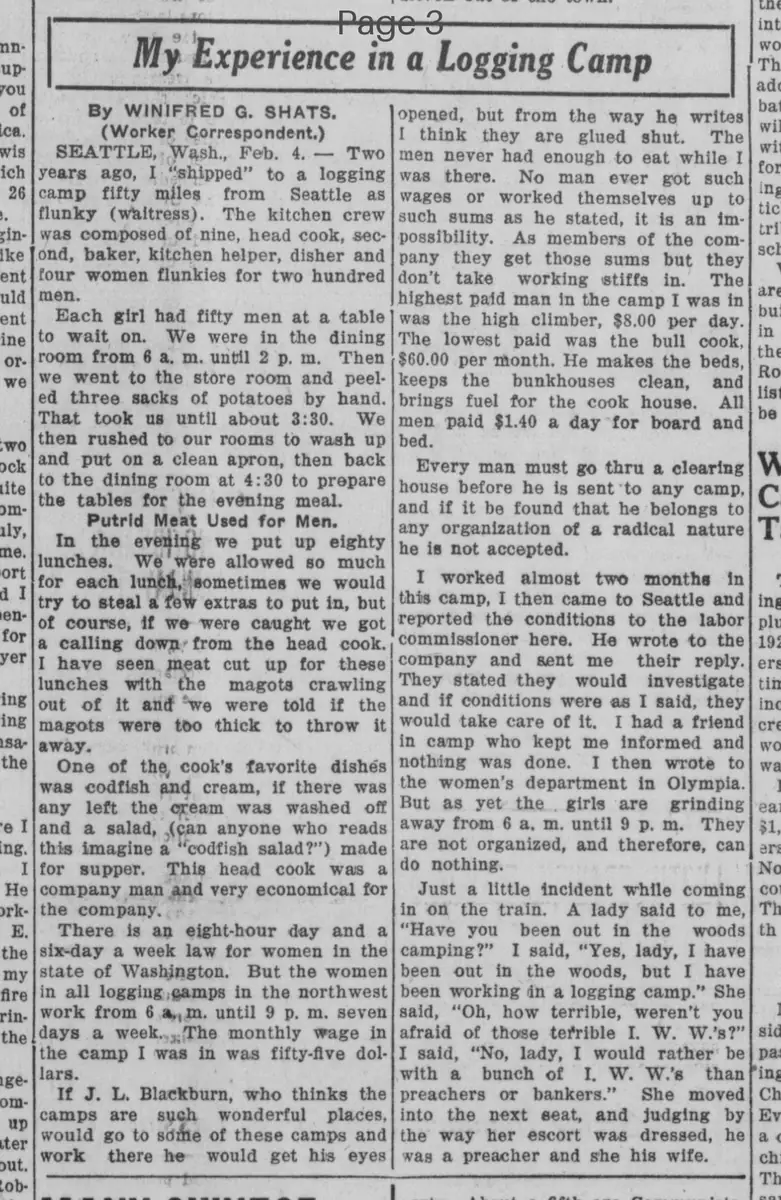
My Experience in a Logging Camp
By WINIFRED G. SHATS.
(Worker Correspondent.)
SEATTLE, Wash., Feb. 4. - Two years ago, I "shipped" to a logging camp fifty miles from Seattle as flunky (waitress). The kitchen crew was composed of nine, head cook, second, baker, kitchen helper, disher and four women flunkies for two hundred men.
Each girl had fifty men at a table to wait on. We were in the dining room from 6 a. m. until 2 p. m. Then we went to the store room and peeled three sacks of potatoes by hand. That took us until about 3:30. We then rushed to our rooms to wash up and put on a clean apron, then back to the dining room at 4:30 to prepare the tables for the evening meal.
Putrid Meat Used for Men.
In the evening we put up eighty lunches. We were allowed so much for each lunch, sometimes we would try to steal a few extras to put in, but of course, if we were caught we got a calling down from the head cook. I have seen meat cut up for these lunches with the maggots crawling out of it and we were told if the maggots were too thick to throw it away.
One of the cook's favorite dishes was codfish and cream, if there was any left the cream was washed off and a salad, (can anyone who reads this imagine a "codfish salad?") made for supper. This head cook was a company man and very economical for the company.
There is an eight-hour day and a six-day a week law for women in the state of Washington. But the women in all logging camps in the northwest work from 6 a.m. until 9 p. m. seven days a week. The monthly wage in the camp I was in was fifty-five dollars.
If J. L. Blackburn, who thinks the camps are such wonderful places, would go to some of these camps and work there he would get his eyes opened, but from the way he writes I think they are glued shut. The men never had enough to eat while I was there. No man ever got such wages or worked themselves up to such sums as he stated. it is an impossibility. As members of the company they get those sums but they don't take working stiffs in. The highest paid man in the camp I was in was the high climber. $80.00 per day. The lowest paid was the bull cook, $60.00 per month. He makes the beds, keeps the bunkhouses clean, and brings fuel for the cook house. All men paid $1.40 a day for board and bed.
Every man must go thru a clearing house before he is sent to any camp, and if it be found that he belongs to any organization of a radical nature he is not accepted.
I worked almost two months in this camp, I then came to Seattle and reported the conditions to the labor commissioner here. He wrote to the company and sent me their reply. They stated they would investigate and if conditions were as I said, they would take care of it, I had a friend in camp who kept me informed and nothing was done. I then wrote to the women's department in Olympia. But as yet the girls are grinding away from 6 a. m. until 9 p. m. They are not organized, and therefore, can do nothing.
Just a little incident while coming in on the train. A lady said to me, "Have you been out in the woods camping?" I said, "Yes, lady, I have been out in the woods, but I have been working in a logging camp." She said, "Oh, how terrible, weren't you afraid of those terrible I. W. W.'s?" I said, "No. lady. I would rather be with a bunch of I. W. W.'s than preachers or bankers." She moved into the next seat, and judging by the way her escort was dressed, he was a preacher and she his wife.
By WINIFRED G. SHATS.
(Worker Correspondent.)
SEATTLE, Wash., Feb. 4. - Two years ago, I "shipped" to a logging camp fifty miles from Seattle as flunky (waitress). The kitchen crew was composed of nine, head cook, second, baker, kitchen helper, disher and four women flunkies for two hundred men.
Each girl had fifty men at a table to wait on. We were in the dining room from 6 a. m. until 2 p. m. Then we went to the store room and peeled three sacks of potatoes by hand. That took us until about 3:30. We then rushed to our rooms to wash up and put on a clean apron, then back to the dining room at 4:30 to prepare the tables for the evening meal.
Putrid Meat Used for Men.
In the evening we put up eighty lunches. We were allowed so much for each lunch, sometimes we would try to steal a few extras to put in, but of course, if we were caught we got a calling down from the head cook. I have seen meat cut up for these lunches with the maggots crawling out of it and we were told if the maggots were too thick to throw it away.
One of the cook's favorite dishes was codfish and cream, if there was any left the cream was washed off and a salad, (can anyone who reads this imagine a "codfish salad?") made for supper. This head cook was a company man and very economical for the company.
There is an eight-hour day and a six-day a week law for women in the state of Washington. But the women in all logging camps in the northwest work from 6 a.m. until 9 p. m. seven days a week. The monthly wage in the camp I was in was fifty-five dollars.
If J. L. Blackburn, who thinks the camps are such wonderful places, would go to some of these camps and work there he would get his eyes opened, but from the way he writes I think they are glued shut. The men never had enough to eat while I was there. No man ever got such wages or worked themselves up to such sums as he stated. it is an impossibility. As members of the company they get those sums but they don't take working stiffs in. The highest paid man in the camp I was in was the high climber. $80.00 per day. The lowest paid was the bull cook, $60.00 per month. He makes the beds, keeps the bunkhouses clean, and brings fuel for the cook house. All men paid $1.40 a day for board and bed.
Every man must go thru a clearing house before he is sent to any camp, and if it be found that he belongs to any organization of a radical nature he is not accepted.
I worked almost two months in this camp, I then came to Seattle and reported the conditions to the labor commissioner here. He wrote to the company and sent me their reply. They stated they would investigate and if conditions were as I said, they would take care of it, I had a friend in camp who kept me informed and nothing was done. I then wrote to the women's department in Olympia. But as yet the girls are grinding away from 6 a. m. until 9 p. m. They are not organized, and therefore, can do nothing.
Just a little incident while coming in on the train. A lady said to me, "Have you been out in the woods camping?" I said, "Yes, lady, I have been out in the woods, but I have been working in a logging camp." She said, "Oh, how terrible, weren't you afraid of those terrible I. W. W.'s?" I said, "No. lady. I would rather be with a bunch of I. W. W.'s than preachers or bankers." She moved into the next seat, and judging by the way her escort was dressed, he was a preacher and she his wife.
What sub-type of article is it?
Biography
Historical Event
What themes does it cover?
Misfortune
Justice
What keywords are associated?
Logging Camp
Women Workers
Labor Conditions
Long Hours
Poor Food
Iww
What entities or persons were involved?
Winifred G. Shats
J. L. Blackburn
Where did it happen?
Logging Camp Fifty Miles From Seattle, Wash.
Story Details
Key Persons
Winifred G. Shats
J. L. Blackburn
Location
Logging Camp Fifty Miles From Seattle, Wash.
Event Date
Two Years Ago From Feb. 4
Story Details
Winifred G. Shats works as a flunky in a logging camp, enduring 15-hour days, preparing lunches with putrid meat, violating labor laws, earning $55 monthly; reports conditions to authorities without improvement; defends IWW against prejudice on train.