Thank you for visiting SNEWPapers!
Sign up free
Phenix Gazette
Alexandria, Virginia
What is this article about?
Biographical sketch of William Frederick, King of Holland, detailing his birth in 1772, military career, exile during French conquest, restoration in 1814, and reign including loss of Belgium. Highlights his character and family's history amid sympathy for Dutch in potential conflict.
Merged-components note: These two components form a continuous article on the reigning family of Holland, split across columns on page 1.
Clipping
OCR Quality
Full Text
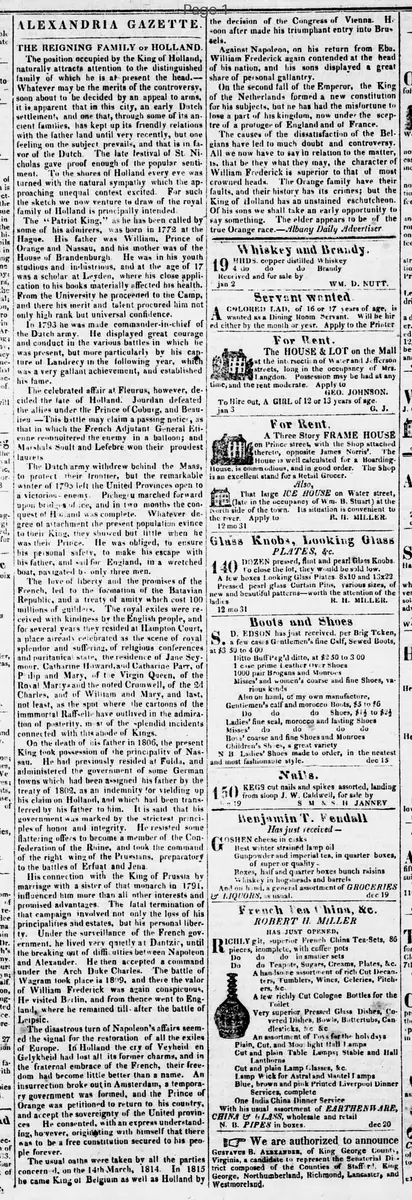
THE REIGNING FAMILY OF HOLLAND.
The position occupied by the King of Holland, naturally attracts attention to the distinguished family of which he is at present the head.-- Whatever may be the merits of the controversy, soon about to be decided by an appeal to arms, it is apparent that in this city, an early Dutch settlement, and one that, through some of its ancient families, has kept up its friendly relations with the father land until very recently, but one feeling on the subject prevails, and that is in favor of the Dutch. The late festival of St. Nicholas gave proof enough of the popular sentiment. To the shores of Holland every eye was turned with the natural sympathy which the approaching unequal contest excited. For such the sketch we now venture to draw of the royal family of Holland is principally intended
The "Patriot King," as he has been called by some of his admirers, was born in 1772 at the Hague. His father was William, Prince of Orange and Nassau, and his mother was of the House of Brandenburg. He was in his youth studious and industrious, and at the age of 17 was a scholar at Leyden, where his close application to his books materially affected his health. From the University he proceeded to the Camp, and there his merit and talent procured him not only high rank but universal confidence.
In 1793 he was made commander-in-chief of the Dutch army. He displayed great courage and conduct in the various battles in which he was present, but more particularly by his capture of Landrecy in the following year, which was a very gallant achievement, and established his fame.
The celebrated affair at Fleurus, however, decided the fate of Holland. Jourdan defeated the allies under the Prince of Coburg, and Beaulieu—This battle may claim a passing notice, as that in which the French Adjutant General Etienne reconnoitered the enemy in a balloon; and Marshals Soult and Lefebvre won their proudest laurels
The Dutch army withdrew behind the Maas, to protect their frontier, but the remarkable winter of 1795 left the United Provinces open to a victorious enemy. Pichegru marched forward upon bridges of ice, and in two months the conquest of Holland was complete. Whatever degree of attachment the present population evince to their King, they showed but little when he was their Prince. He was obliged, to ensure his personal safety, to make his escape with his father, and sailed for England, in a wretched boat, navigated by only three men.
The love of liberty and the promises of the French, led to the formation of the Batavian Republic, and a treaty of affinity which cost 100 millions of guilders. The royal exiles were received with kindness by the English people, and for several years they resided at Hampton Court, a place already celebrated as the scene of royal splendor and suffering, of religious conferences and puritanical state, the residence of Jane Seymour, Catharine Howard, and Catharine Parr, of Philip and Mary, of the Virgin Queen, of the Royal Martyr and the noted Cromwell, of the 2d Charles, and of William and Mary, and last, not least, as the spot where the cartoons of the immortal Raffaelle have outlived in the admiration of posterity, most of the splendid incidents connected with this abode of Kings.
On the death of his father in 1806, the present King took possession of the principality of Nassau. He had previously resided at Fulda, and administered the government of some German towns which had been assigned his father by the treaty of 1802, as an indemnity for yielding up his claim on Holland, and which had been transferred by his father to him. It is said that his government was marked by the strictest principles of honor and integrity. He resisted some flattering offers to become a member of the Confederation of the Rhine, and took the command of the right wing of the Prussians, preparatory to the battles of Erfurt and Jena.
His connection with the King of Prussia by marriage with a sister of that monarch in 1791, influenced him more than all other interests and promised advantages. The fatal termination of that campaign involved not only the loss of his principalities and estates, but his personal liberty. Under the surveillance of the French government, he lived very quietly at Dantzic, until the breaking out of difficulties between Napoleon and Alexander. He then accepted a command under the Archduke Charles. The battle of Wagram took place in 1809, and there the valor of William Frederick was again conspicuous.
He visited Berlin, and from thence went to England, where he remained till after the battle of Leipsic.
The disastrous turn of Napoleon's affairs seemed the signal for the restoration of all the exiles of Europe. In Holland the cry of Vrijheid Gelykheid had lost all its former charms, and in the fraternal embrace of the French, their freedom had become little better than a name. An insurrection broke out in Amsterdam, a temporary government was formed, and the Prince of Orange was petitioned to return to his country, and accept the sovereignty of the United Provinces
He consented, with an express understanding, however, originating with himself that there was to be a free constitution secured to his people forever.
The usual oaths were taken by all the parties concerned, on the 14th March, 1814. In 1815 he became King of Belgium as well as Holland by
the decision of the Congress of Vienna. He soon after made his triumphant entry into Brussels.
Against Napoleon, on his return from Elba, William Frederick again contended at the head of his nation, and his sons displayed a great share of personal gallantry.
On the second fall of the Emperor, the King of the Netherlands formed a new constitution for his subjects, but he has had the misfortune to lose a part of his kingdom, now under the sceptre of a protege of England and of France.
The causes of the dissatisfaction of the Belgians have led to much doubt and controversy. All we now have to say in relation to the matter, is, that be they what they may, the character of William Frederick is superior to that of most crowned heads. The Orange family have their faults, and their history has its crimes; but the King of Holland has an unstained escutcheon.
Of his sons we shall take an early opportunity to say something. The elder appears to be of the true Orange race.—Albany Daily Advertiser
What sub-type of article is it?
What keywords are associated?
What entities or persons were involved?
Where did it happen?
Foreign News Details
Primary Location
Holland
Event Date
1772 1815
Key Persons
Outcome
restoration as sovereign in 1814 with free constitution; became king of belgium and holland in 1815; loss of belgium later; unstained character noted.
Event Details
Biographical account of William Frederick, born 1772, military leader from 1793, exiled after 1795 French conquest, restored in 1814 after Amsterdam insurrection, became King in 1815 per Vienna Congress, fought Napoleon again, formed new constitution post-Waterloo, but lost Belgium amid Belgian dissatisfaction.