Thank you for visiting SNEWPapers!
Sign up free
Keowee Courier
Walhalla, Pickens, Oconee County, Pickens County, South Carolina
What is this article about?
French journals in Paris critique the Anglo-American dispute over the right of search, blaming Britain for overreach and the US for enabling the slave trade, while France is accused of similar practices.
Clipping
OCR Quality
Full Text
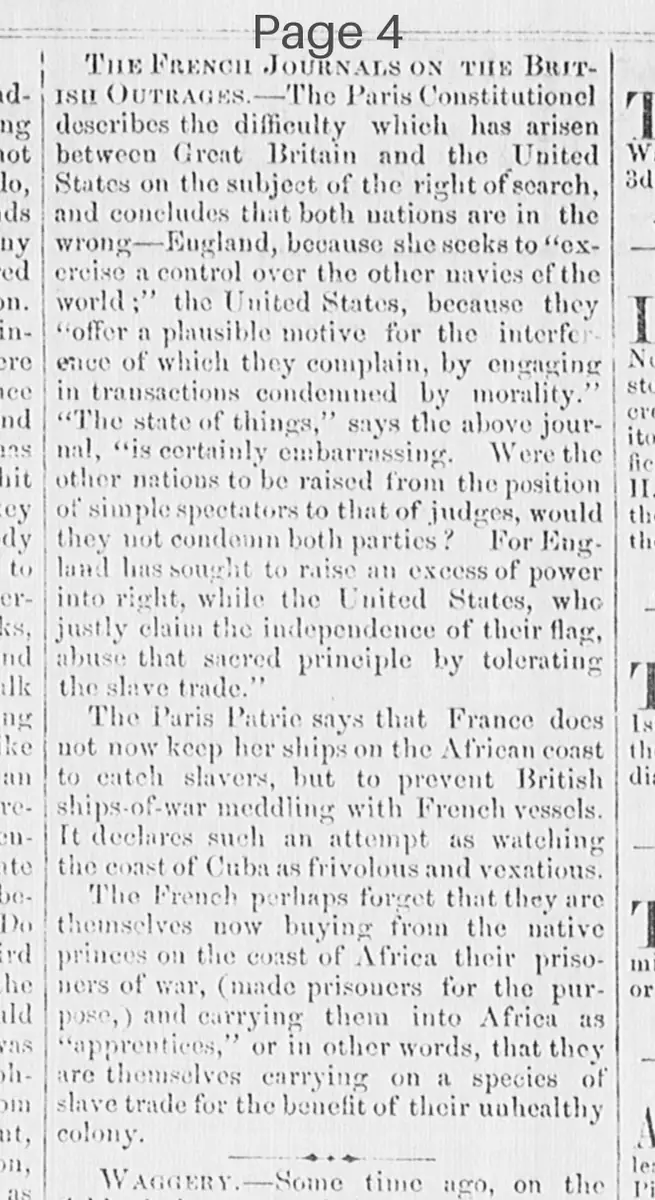
"The state of things," says the above journal, "is certainly embarrassing. Were the other nations to be raised from the position of simple spectators to that of judges, would they not condemn both parties? For England has sought to raise an excess of power into right, while the United States, who justly claim the independence of their flag, abuse that sacred principle by tolerating the slave trade."
The Paris Patrie says that France does not now keep her ships on the African coast to catch slavers, but to prevent British ships-of-war meddling with French vessels. It declares such an attempt as watching the coast of Cuba as frivolous and vexatious.
The French perhaps forget that they are themselves now buying from the native princes on the coast of Africa their prisoners of war, (made prisoners for the purpose,) and carrying them into Africa as "apprentices," or in other words, that they are themselves carrying on a species of slave trade for the benefit of their unhealthy colony.
What sub-type of article is it?
What keywords are associated?
Where did it happen?
Foreign News Details
Primary Location
Paris
Event Details
The Paris Constitutionnel describes the Anglo-American dispute over the right of search, concluding both nations are wrong: Britain for seeking control over other navies, and the US for engaging in immoral transactions like the slave trade. It notes the embarrassing state where other nations might judge both parties, with Britain abusing power and the US misusing flag independence by tolerating slavery. The Paris Patrie states France stations ships off Africa not to catch slavers but to protect French vessels from British interference, calling British actions near Cuba frivolous. The text accuses France of buying African war prisoners as apprentices, effectively continuing a slave trade for its colony.