Thank you for visiting SNEWPapers!
Sign up free
Virginia Argus
Richmond, Virginia
What is this article about?
The U.S. Senate in Washington City resumed the case of John Smith on April 2, reading depositions to discredit witness E. Glover and support Elias Glover's character. Further evidence addressed Peter Taylor's affidavit and Smith's conversation with Col. Taylor. Depositions regarding Smith's journey to meet Col. Burr were presented. Proceedings continued on April 4 and 5 with additional testimonies and a speech by Mr. Key.
Clipping
OCR Quality
Full Text
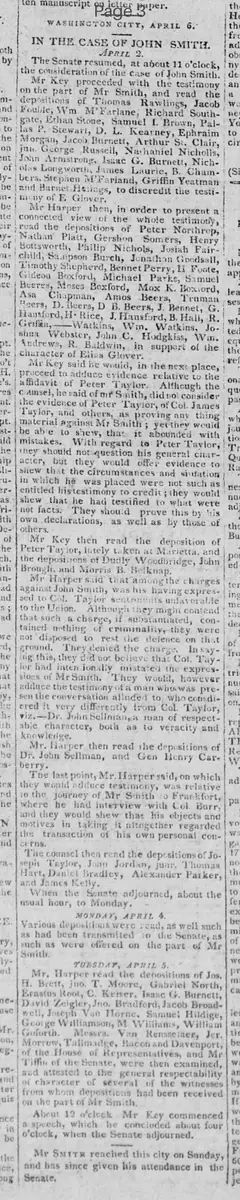
IN THE CASE OF JOHN SMITH.
APRIL 2.
The Senate resumed, at about 11 o'clock, the consideration of the case of John Smith. Mr. Key proceeded with the testimony on the part of Mr. Smith, and read the depositions of Thomas Rawlings, Jacob Fouble, Wm. M'Farlane, Richard Southgate, Ethan Stone, Samuel I. Brown, Pallas P. Stewart, D. L. Kearney, Ephraim Morgan, Jacob Barnett, Arthur St. Clair, jun. George Russell, Nathaniel Nicholls, John Armstrong, Isaac G. Burnett, Nicholas Longworth, James Laurie, B. Chambers, Stephen M'Farland, Griffin Yeatman and Barnet Hastings, to discredit the testimony of E. Glover.
Mr. Harper then, in order to present a connected view of the whole testimony, read the depositions of Peter Northrop, Nathan Plait, Gershon Somers, Henry Bottsworth, Philip Nichols, Josiah Fairchild, Sampson Burch, Jonathan Goodsall, Timothy Shepherd, Bennet Perry, H. Foote, Gideon Boxford, Michael Parks, Samuel Beeres, Moses Boxford, Mox K. Bexford, Asa Chapman, Amos Beers, Truman Beers, D. Beers, D. B. Beers, J. Bennet, G. Hansford, H. Rice, J. Hansford, B. Hall, R. Griffin, Watkins, Wm. Watkins, Joshua Webster, John C. Hodgkiss, Wm. Andrews, R. Baldwin, in support of the character of Elias Glover.
Mr. Key said he would, in the next place, proceed to adduce evidence relative to the affidavit of Peter Taylor. Although the counsel, he said, of Mr. Smith, did not consider the evidence of Peter Taylor, of Col. James Taylor, and others, as proving any thing material against Mr. Smith; yet they would be able to shew, that it abounded with mistakes. With regard to Peter Taylor, they should not question his general character, but they would offer evidence to shew that the circumstances and situation in which he was placed were not such as entitled his testimony to credit; they would shew that he had testified to what were not facts. They should prove this by his own declarations, as well as by those of others.
Mr. Key then read the deposition of Peter Taylor, lately taken at Marietta, and the depositions of Dudley Woodbridge, John Brough, and Morris B. Belknap.
Mr. Harper said that among the charges against John Smith, was his having expressed to Col. Taylor sentiments unfavorable to the Union. Although they might contend that such a charge, if substantiated, contained nothing of criminality, they were not disposed to rest the defence on that ground. They denied the charge. In saying this, they did not believe that Col. Taylor had intentionally misstated the expressions of Mr. Smith. They would, however adduce the testimony of a man who was present the conversation alluded to, who considered it very differently from Col. Taylor, viz. Dr. John Sellman, a man of respectable character, both as to veracity and knowledge.
Mr. Harper then read the depositions of Dr. John Sellman, and Gen. Henry Carrberry.
The last point, Mr. Harper said, on which they would adduce testimony, was relative to the journey of Mr. Smith to Frankfort, where he had interview with Col. Burr, and they would shew that his objects and motives in taking it altogether regarded the transaction of his own personal concerns.
The counsel then read the depositions of Joseph Taylor, John Jordan, jun. Thomas Hart, Daniel Bradley, Alexander Parker, and James Kelly.
When the Senate adjourned, about the usual hour, to Monday.
MONDAY, APRIL 4.
Various depositions were read, as well such as had been transmitted to the Senate, as such as were offered on the part of Mr. Smith.
TUESDAY, APRIL 5.
Mr. Harper read the depositions of Jos. H. Brett, Jno. T. Moore, Gabriel North, Erastus Root, C. Keiser, Isaac G. Burnett, David Zeigler, Jno. Bradford, Jacob Broadwell, Joseph Van Horne, Samuel Hildige, George Williamson, M. Williams, William Coforth. Messrs. Van Rensselaer, Jer. Morrow, Tallmadge, Bacon and Davenport, of the House of Representatives, and Mr. Tiffin of the Senate, were then examined, and attested to the general respectability of character of several of the witnesses from whom depositions had been received on the part of Mr. Smith.
About 12 o'clock Mr. Key commenced a speech, which he concluded about four o'clock, when the Senate adjourned.
Mr. Smith reached this city on Sunday, and has since given his attendance in the Senate.
What sub-type of article is it?
What keywords are associated?
What entities or persons were involved?
Where did it happen?
Domestic News Details
Primary Location
Washington City
Event Date
April 2, 4, 5
Key Persons
Outcome
proceedings ongoing; mr. smith attended the senate.
Event Details
The Senate considered the case of John Smith, reading numerous depositions to discredit E. Glover's testimony, support Elias Glover's character, address Peter Taylor's affidavit and mistakes therein, deny charges of anti-Union sentiments expressed to Col. Taylor, and explain Smith's journey to Frankfort to meet Col. Burr as personal business. Additional depositions and examinations occurred on April 4 and 5, followed by Mr. Key's speech.