Thank you for visiting SNEWPapers!
Sign up free
Alexandria Gazette & Daily Advertiser
Alexandria, Virginia
What is this article about?
In the French Chamber of Deputies on March 21, 1819, debate on the 1819 budget shifted to criticism of the government's handling of foreign news from Piedmont and Naples, accusing ministers of breaching neutrality by announcing an Austrian victory over Neapolitans at Rieti to influence funds. Speakers like Casimir Perrier and General Foy condemned the diplomacy; the session ended amid calls to close.
Merged-components note: Continuation of the report on proceedings in the French Chamber of Deputies, with direct textual sequence across pages and sequential reading order.
Clippings
1 of 2
OCR Quality
Full Text
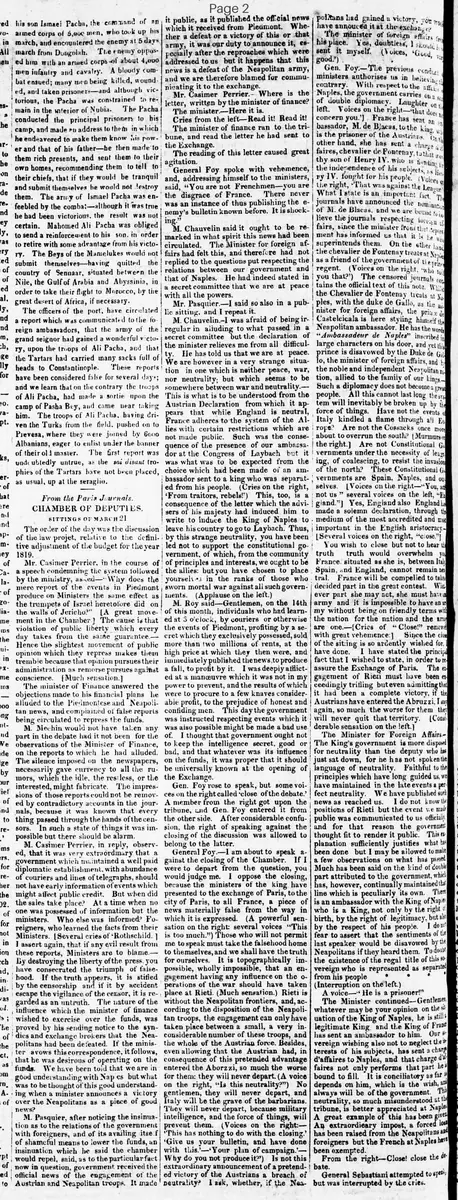
CHAMBER OF DEPUTIES
SITTINGS OF MARCH 21
The order of the day was the discussion of the law project, relative to the definitive adjustment of the budget for the year 1819.
Mr. Casimir Perrier, in the course of a speech condemning the system followed by the ministry, asked-"Why does the mere report of the events in Piedmont produce on Ministers the same effect as the trumpets of Israel heretofore did on the walls of Jericho?" [A great movement in the Chamber.] The cause is that violation of public liberty which every day takes from the same guarantee.-- Hence the slightest movement of public opinion which they repress makes them tremble because that opinion pursues their administration as remorse pursues against conscience. [Much sensation.]
The minister of Finance answered the objections made to his financial plans he alluded to the Piedmontese and Neapolitan news, and complained of false reports being circulated to repress the funds.
M. Mechin would not have taken any part in the debate had it not been for the observations of the Minister of Finance, on the reports to which he had alluded. The silence imposed on the newspapers, necessarily gave currency to all the rumors, which the idle, the restless, or the interested, might fabricate. The impressions of those reports could not be removed by contradictory accounts in the journals, because it was known that every thing passed through the hands of the censors. In such a state of things it was impossible but there should be alarm.
M. Casimir Perrier, in reply, observed, that it was very extraordinary that a government which maintained a well paid diplomatic establishment, with abundance of couriers and lines of telegraphs, should not have early information of events which might affect public credit. But when did the sales take place? At a time when no one was possessed of information but the ministers. Who else was informed? Foreigners, who learned the facts from their Ministers. [Several cries of 'Rothschild.'] I assert again, that if any evil result from these reports, Ministers are to blame.-- By destroying the liberty of the press, you have consecrated the triumph of falsehood. If the truth appears, it is stifled by the censorship and if it by accident escape the vigilance of the censor, it is regarded as an untruth. The nature of the influence which the minister of finance wished to exercise over the funds, was proved by his sending notice to the syndics and exchange brokers that the Neapolitans had been defeated. If the minister avows this correspondence, it follows, that he was desirous of operating on the funds. We have been told that we are in good understanding with Naples but what was to be thought of this good understanding when a minister announces a victory over the Neapolitans as a piece of good news?
M. Pasquier, after noticing the insinuation as to the relations of the government with foreigners, and of its availing itself of shameful means to lower the funds, an insinuation which he said the chamber would repel, said, as to the particular fact now in question, government received the official news of the engagement of the Austrian and Neapolitan troops. It made it public, as it published the official news which it received from Piedmont. Whether a defeat or a victory of this or that army, it was our duty to announce it, especially after the reproaches which were addressed to us but it happens that this news is a defeat of the Neapolitan army, and we are therefore blamed for communicating it to the exchange.
Mr. Casimir Perrier.- Where is the letter, written by the minister of finance?
The minister.--Here it is.
Cries from the left-Read it! Read it!
The minister of finance ran to the tribune, and read the letter he had sent to the Exchange.
The reading of this letter caused great agitation.
General Foy spoke with vehemence, and, addressing himself to the ministers, said, "You are not Frenchmen-you are the disgrace of France. There never was an instance of thus publishing the enemy's bulletin known before. It is shocking."
M. Chauvelin said it ought to be remarked in what spirit this news had been circulated. The Minister for foreign affairs had felt this, and therefore had not replied to the questions put respecting the relations between our government and that of Naples. He had indeed stated in a secret committee that we are at peace with all the powers.
Mr. Pasquier.--I said so also in a public sitting, and I repeat it.
M. Chauvelin.-I was afraid of being irregular in alluding to what passed in a secret committee but the declaration of the minister relieves me from all difficulty. He has told us that we are at peace. We are however in a very strange situation in one which is neither peace, war, nor neutrality: but which seems to be somewhere between war and neutrality.- 'This is what is to be understood from the Austrian Declaration from which it appears that while England is neutral, France adheres to the system of the Allies with certain restrictions which are not made public. Such was the consequence of the presence of our ambassador at the Congress of Laybach but it was what was to be expected from the choice which had been made of an ambassador sent to a king who was separated from his people. (Cries on the right, From traitors, rebels!) This, too, is a consequence of the letter which the advisers of his majesty had induced him to leave his country to go to Laybach. Thus, by this strange neutrality, you have been led not to support the constitutional government, of which, from the community of principles and interests, we ought to be the allies: but you have chosen to place yourselves in the ranks of those who have sworn mortal war against all such governments. (Applause on the left.)
M. Roy said--Gentlemen, on the 14th of this month, individuals who had learned at 3 o'clock, by couriers or otherwise the events of Piedmont, profiting by a secret which they exclusively possessed, sold more than two millions of rents, at the high price at which they then were, and immediately published the news, to produce a fall, to profit by it. I was deeply afflicted at a manoeuvre which it was not in my power to prevent, and the results of which were to procure to a few knaves considerable profit, to the prejudice of honest and confiding men. This day the government was instructed respecting events which it was also possible might be made a bad use of. I thought that government ought not to keep the intelligence secret, good or bad, and that whatever was its influence on the funds, it was proper that it should be universally known at the opening of the Exchange.
Gen. Foy rose to speak, but some voices on the right called 'close of the debate.' A member from the right got upon the tribune, and Gen. Foy entered it from the other side. After considerable confusion, the right of speaking against the closing of the discussion was allowed to belong to the latter.
General Foy.-I am about to speak against the closing of the Chamber. If I were to depart from the question, you would judge me. I oppose the closing, because the ministers of the king have presented to the exchange of Paris, to the city of Paris, to all France, a piece of news materially false from the way in which it is expressed. (A powerful sensation on the right: several voices "This is too much.") Those who will not permit me to speak must take the falsehood home to themselves, and we shall have the truth for ourselves. It is topographically impossible, wholly impossible, that an engagement having any influence on the operations of the war should have taken place at Rieti. (Much sensation.) Rieti is without the Neapolitan frontiers, and, according to the disposition of the Neapolitan troops, the engagement can only have taken place between a small, a very inconsiderable number of these troops, and the whole of the Austrian force. Besides even allowing that the Austrian had, in consequence of this pretended advantage entered the Abruzzi, so much the worse for them: they will never depart. (A voice on the right, "Is this neutrality?") No gentlemen, they will never depart, and Italy will be the grave of the barbarians. They will never depart, because military intelligence, and the force of things, will prevent them. (Voices on the right:-- This has nothing to do with the closing.' 'Give us your bulletin, and have done with this.'--'Your plan of campaign.' Why do you not produce it?)
Is not this extraordinary announcement of a pretended victory of the Austrians a breach of neutrality? I ask, whether, if the Neapolitans had gained a victory, you would have announced it at the exchange?
The minister of foreign affairs from his place. Yes, doubtless, I should. I sent it myself. (Voices, 'Good, good.')
Gen. Foy:-The previous conduct ministers authorises us in believing the contrary. With respect to the affairs Naples, the government carries on a sort of double diplomacy. Laughter on the left. Voices on the right--'that does not concern you.') . France has sent an ambassador, M. de Blacas, to-the king, who is the prisoner of the Austrians. On the other hand, she has sent a charge d'affaires, chevalier de Fontenay, to that worthy son of Henry IV. who is fighting for the independence of his subjects, as Henry IV. fought for his people. (Voices on the right, 'That was against the League') What I state is an important fact. The journals have announced the nomination of M. de Blacas, and we are bound to believe the journals respecting foreign affairs, since the minister from that department has informed us that it is he who superintends them. On the other hand the chevalier de Fontenay treats at Naples as a friend of the government of the prince regent. (Voices on the right, 'who told you that?') The censored journals contain the official text of this note. While the Chevalier de Fontenay treats at Naples, with the duke de Gallo, as the minister for foreign affairs, the prince de Castelcicala is here styling himself the Neapolitan ambassador. He has the words "Ambassadeur de Naples" inscribed in large characters on his door, and yet this prince is disavowed by the Duke de Gallo, the minister of foreign affairs, and by the noble and independent Neapolitan nation, allied to the family of our kings.- Such a diplomacy does not become a great people. All this cannot last long the system will inevitably be broken up by the force of things. Have not the events of Italy kindled a flame through all Europe? Are not the Cossacks once more about to overrun the south? [Murmurs on the right.] Are not Constitutional Governments under the necessity of leaguing, of coalescing, to resist the invasion of the north? 'These Constitutional Governments are Spain, Naples, and ourselves. [Voices on the right-"You, and not us " several voices on the left, "England."] Yes, England also England has made a solemn declaration, through the medium of the most accredited and most important in the English aristocracy.
I Several voices on the right, "close."] You wish to close but not to hear the truth truth would overwhelm you France. situated as she is, between Italy Spain, and England, cannot remain neutral. France will be compelled to take a decided part in the great contest. Whatever part she may act, she must have an army and it is impossible to have an army without being on friendly terms with the nation for the nation and the army are one.-[Cries of "Close!" renewed with great vehemence:] Since the close of the sitting is so ardently wished for, have done. I have stated the principal fact that I wished to state, in order to reassure the Exchange of Paris. The engagement of Rieti must have been exceedingly trifling but even admitting that it had been a complete victory, if the Austrians have entered the Abruzzi, I say again, so much the worse for them they will never quit that territory. [Considerable sensation on the left.]
The Minister for Foreign Affairs- The King's government is more disposed for neutrality than the deputy who has just sat down, for he has not spoken the language of neutrality. Faithful to the principles which have long guided us, we have maintained in the late events a perfect neutrality. We have published such news as reached us. I do not know the positions of Rieti but the event we made public was communicated to us officially and for that reason the government thought fit to render it public. This explanation sufficiently justifies what has been done but I may be allowed to make a few observations on what has passed Much has been said on the kind of double part attributed to the government, which has, however, continually maintained the line which is peculiarly its own. There is an ambassador with the King of Naples who is a King, not only by the right of birth, by the right of legitimacy, but also by the respect of his people. I do not fear to assert that the sentiments of the last speaker would be disavowed by the Neapolitans if they heard them. To doubt the existence of the regal title of this sovereign who is represented as separated from his people (Interruption on the left.) A voice-" He is a prisoner!" The Minister continued--Gentlemen whatever may be your opinion on the situation of the King of Naples. he is still a legitimate King. and the King of France has sent an ambassador to him. Our sovereign wishing also not to neglect the interests of his subjects, has sent a charge d'affaires to Naples, and that charge d'affaires not only performs that part he is bound to fill. It is conciliatory as far as depends on him, which is the wish, and always will be of the government. This neutrality, so much misunderstood at the tribune, is better appreciated at Naples A great example of this has been given An extraordinary impost, a forced loan has been raised from the Neapolitans and foreigners but the French at Naples have been exempted.
From the right -Close! close the debate.
General Sebastiani attempted to speak but was interrupted by the cries.
The President put the question, on closing the vote, which was carried.
General Sebastiani, on getting to the tribune, spoke a few words with great vehemence, which were not heard.
What sub-type of article is it?
What keywords are associated?
What entities or persons were involved?
Where did it happen?
Foreign News Details
Primary Location
Naples
Event Date
March 21, 1819
Key Persons
Outcome
debate closed by vote; government defends neutrality and publication of official news of austrian victory over neapolitans at rieti; no specific casualties reported from the engagement.
Event Details
During the Chamber of Deputies session on the 1819 budget, deputies criticized the ministry for announcing an Austrian defeat of Neapolitan troops at Rieti to influence financial markets, accusing breach of neutrality and double diplomacy with ambassadors to both the King of Naples and the Neapolitan provisional government. Ministers defended publishing official news impartially and maintaining neutrality amid Italian events.