Thank you for visiting SNEWPapers!
Sign up free
Phenix Gazette
Alexandria, Virginia
What is this article about?
Analysis of political divisions in France: liberals split into Constitutionalists (Orleanists), Bonapartists, and Republicans opposing the Bourbon monarchy; royalists weakened by persecution and age. Predicts liberal triumph and potential revolution if Bourbons persist.
Merged-components note: These two components form a single continuous article on the state of parties in France, split across columns.
Clipping
OCR Quality
Full Text
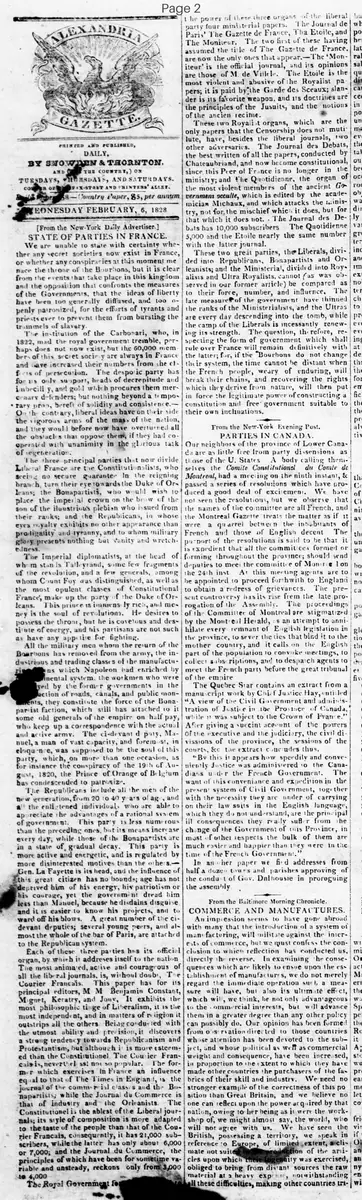
STATE OF PARTIES IN FRANCE.
We are unable to state with certainty whether any secret societies now exist in France, or whether any conspiracies at this moment menace the throne of the Bourbons, but it is clear from the events that take place in this kingdom and the opposition that confronts the measures of the Government's, that the ideas of liberty have been too generally diffused, and too openly patronized, for the efforts of tyrants and priests ever to prevent them from bursting the trammels of slavery.
The institution of the Carbonari, who, in 1822, made the royal government tremble, perhaps does not now exist, but the 60,000 members of this secret society are always in France and have increased their numbers from the acts of persecution. The despotic party has for its only support, heads of decrepitude and imbecility, and gold which procures them mercenary defenders; but nothing beyond a temporary prop, bereft of solidity and consistence.
On the contrary, liberal ideas have on their side the vigorous arms of the mass of the nation, and they would before now have overturned all the obstacles that oppose them, if they had co-operated with unanimity in the glorious task of regeneration.
The three principal parties that now divide Liberal France are the Constitutionalists, who seeing no secure guarantee in the reigning branch, turn their eyes towards the Duke of Orleans; the Bonapartists, who would wish to place the imperial crown on the brow of the son of the illustrious plebeian who issued from their ranks; and the Republicans, in whose eyes royalty exhibits no other appearance than prodigality and tyranny, and to whom military glory presents nothing but vanity and wretchedness.
The imperial diplomatists, at the head of whom stands Talleyrand, some few fragments of the revolution, and a few generals, among whom Count Foy was distinguished, as well as the most opulent classes of Constitutional France, make up the party of the Duke of Orleans. This prince is immensely rich, and money is the soul of revolutions. He desires to possess the throne, but he is covetous and destitute of energy, and his partisans are not such as have any appetite for fighting.
All the military men whom the return of the Bourbons has removed from the army, the industrious and trading classes of the manufacturers which Napoleon had enriched by his continental system, the workmen who were employed by the former governments in the construction of roads, canals, and public monuments, they constitute the force of the Bonapartist faction, which still has attached to it some old generals of the empire on half pay, who keep up a correspondence with the actual and active army. The ci-devant deputy, Manuel, a man of vast capacity, and foremost in eloquence, was supposed to be the soul of this party, which, on more than one occasion, as for instance the conspiracy of the 13th of August, 1820, the Prince of Orange of Belgium has condescended to patronize.
The Republicans include all the men of the new generation, from 20 to 40 years of age, and all the enlightened individuals, who are able to appreciate the advantages of a rational system of government. This party is less numerous than the preceding ones, but its means increase every day, while those of the Bonapartists are in a state of gradual decay. This party is more active and energetic, and is regulated by more disinterested motives than the others. Gen. La Fayette is its head, and the influence of this great citizen has no bounds; age has not deprived him of his energy, his patriotism or his courage, yet the government dreads him less than Manuel, because he disdains disguise and it is easier to know his projects, and to ward off his blows. A great number of the ci-devant deputies; several young peers, and almost the whole of the bar of Paris, are attached to the Republican system.
Each of these three parties has its official organ, by which it addresses itself to the nation. The most animated, active and courageous of all the liberal journals, is, without doubt, The Courier Francais. This paper has for its principal editors, MM. Benjamin Constant, Mignet, Keratry, and Jouy. It exhibits the most philosophic tinge of Liberalism, it is the most independent, and in matters of religion it outstrips all the others. Being conducted with the utmost ability and precision, it discovers a strong tendency towards Republicanism and Protestantism, but although it is more esteemed than the Constitutionnel The Courier Francais is, nevertheless, not so popular. The former which exercises in France an influence equal to that of The Times in England, is the journal of the commercial classes and the Bonapartists; while the Journal du Commerce is that of industry and the Orleanists. The Constitutionnel is the ablest of the Liberal journals; its style of composition is more adapted to the taste of the people than that of the Courier Francais, consequently, it has 21,000 subscribers, while the latter has only about 6,000 or 7,000; and the Journal du Commerce, the principles of which have been for sometime variable and unsteady, reckons only from 3,000 to 4,000.
The Royal Government
has but the power of these three organs of the liberal party four ministerial papers. The Journal de Paris, The Gazette de France, The Etoile, and The Moniteur. The two first of these having assumed the title of The Gazette de France, are now the only ones that appear. The Moniteur is the official journal, and its opinions are those of M. de Villele. The Etoile is the most violent and abusive of the Royalist papers; it is paid by the Garde des Sceaux; slander is its favorite weapon, and its doctrines are the principles of the Jesuits, and the notions of the ancien regime.
These two Royalist organs, which are the only papers that the Censorship does not mutilate, have, besides the liberal journals, two other adversaries. The Journal des Debats, the best written of all the papers, conducted by Chateaubriand, and now become constitutional, since this peer of France is no longer in the ministry; and The Quotidienne, the organ of the most violent members of the ancient Government occulte, which is edited by the academician Michaux, and which attacks the ministry, not for the mischief which it does, but for that which it does not. The Journal des Debats has 10,000 subscribers The Quotidienne 5,000 and the Etoile nearly the same number with the latter journal.
These two great parties, the Liberals, divided into Republicans, Bonapartists and Orleanists; and the Ministerial, divided into Royalists and Ultra Royalists, cannot (as was observed in our former article) be compared as to their force, number, and influence. The late measures of the government have thinned the ranks of the Ministerialists, and the Ultras are every day descending into the tomb, while the camp of the Liberals is incessantly renewing its strength. The question, therefore, respecting the form of government which shall rule over France will remain definitively with the latter; for, if the Bourbons do not change their system, the time cannot be distant when the French people, weary of enduring, will break their chains, and recovering the rights which they derive from nature, will then put in force the legitimate power of constructing a constitution and free government suitable to their own inclinations.
What sub-type of article is it?
What keywords are associated?
What entities or persons were involved?
Where did it happen?
Foreign News Details
Primary Location
France
Key Persons
Outcome
liberals gaining strength while royalists weaken; predicts potential revolution if bourbons do not reform.
Event Details
Detailed analysis of liberal opposition to Bourbon monarchy, divided into Constitutionalists favoring Duke of Orleans, Bonapartists supporting Napoleon's son, and Republicans led by La Fayette; contrasts with weakening royalist support; discusses party organs and subscriber numbers; foresees liberal victory and possible uprising.