Thank you for visiting SNEWPapers!
Sign up free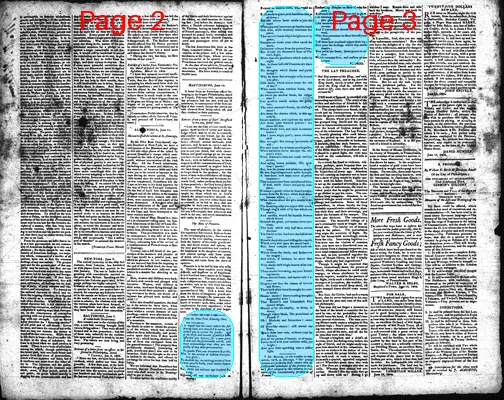
Poem
June 15, 1804
Berkeley And Jefferson Intelligencer
Martinsburg, Berkeley County, Virginia
What is this article about?
A moralistic poem submitted to the New-York Evening Post editor, critiquing immodest fashion among women as degrading and imitating French revolutionary prostitutes. It urges modesty and innocence, signed Florio, with a quote from Dr. Barror on education.
Merged-components note: Continuation of the poem addressed to Mr. Coleman about fashion and modesty, spanning pages 2 and 3, as the text is sequential and part of the same composition.
Clippings
1 of 2
OCR Quality
85%
Good
Full Text
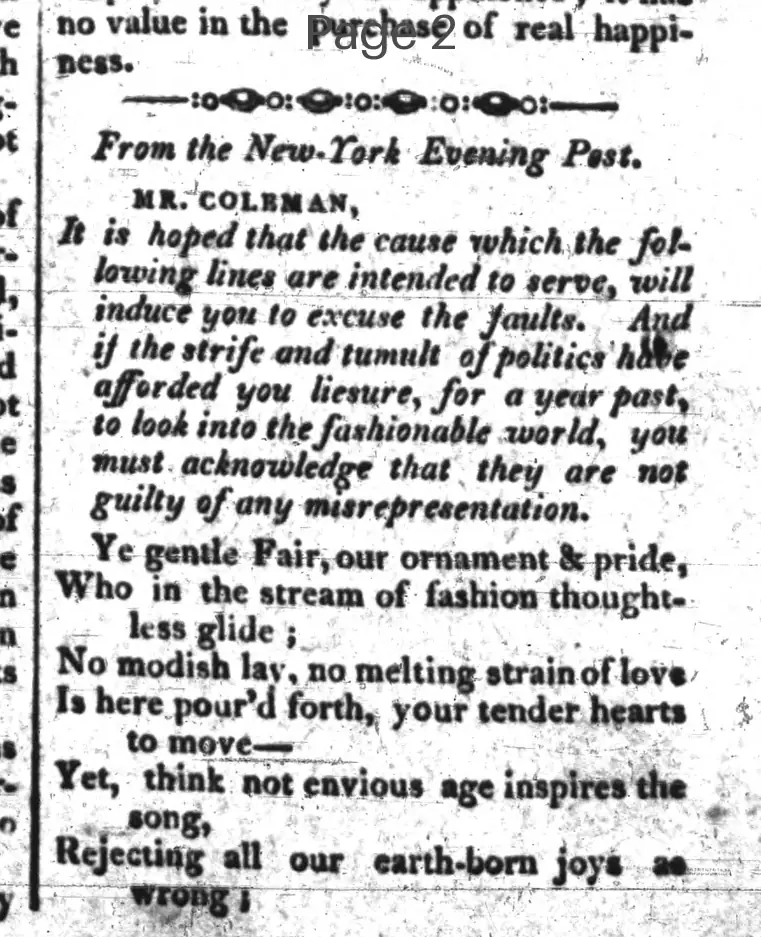
From the New-York Evening Post.
MR. COLEMAN,
It is hoped that the cause which the following lines are intended to serve, will induce you to excuse the faults. And if the strife and tumult of politics has been afforded you leisure, for a year past, to look into the fashionable world, you must acknowledge that they are not guilty of any misrepresentation.
Ye gentle Fair, our ornament & pride,
Who in the stream of fashion thoughtless glide;
No modish lay, no melting strain of love
Is here pour'd forth, your tender hearts to move—
Yet, think not envious age inspires the song,
Rejecting all our earth-born joys and
Suspect no matron stern, who would repress
Each modern grace, each harmless change of dress;
But one whose heart exults to join the band
Where joy and innocence go hand in hand,
One who, while modesty maintains her place,
That sacred charm which heightens ev'ry grace,
Complacent views your robes excell the snow,
Or borrow colours from the painted bow;
But dreads the threaten'd hour of Virtue's flight,
More than the pestilence which walks by night.
Say, in those half-rob'd bosoms are there hid
No thoughts which shame and purity forbid?
Why do these fine-wrought veils around you play,
Like mists, which scarce screen the orb of day
What mean those careless limbs, that conscious air,
At which the modest blush, the vulgar stare
Can spotless minds endure the guilty leer,
The sober matron's frown, the witling's sneer?
Are these the charms which, in this age refin'd,
Insure applause, and captivate the mind:
Are these your boasted powers! are these the arts
Which kindle love, and chain inconstant hearts?
Alas! some angry pow'r, some envious skill
Has wrought this strange perversity of will:
For sure some foe to innocence beguiles
When harmless doves attempt the serpent's wiles.
True, Fashion's laws her ready vot'ries screen
And ogling beaux exclaim, Oh, goddess! queen!
But, low the praise and adulation sought
By arts degrading to each noble thought,
A base-born love those dotes of praise inspires-
That incense rises from unhallowed fires.
If deaf, while shame and purity complain;
If reason's gentle voice be heard in vain;
Learn from the flowers which deck those bosoms white
What charms alone can give unmix'd delight—
The flaunting tulip you reject with scorn,
Though ting'd with ev'ry hue which can adorn;
And careful, search for humble flowers which bloom
Beneath the grass, yet scatter sweet perfume,
The buds which only half their sweets disclose
You fondly seize, but leave the full blown rose,
Humble the praise, and trifling the regard,
Which ever wait upon the moral bard:
But, there remains a hateful truth unsung,
Which burns the cheek, and faulters on the tongue;
And which, if modesty be more than sound,
With shame each virgin bosom must confound.
These modes becoming, say your flattering beaux,
From ancient times, and tastes refin'd arose.
Disgrace not thus the names of Greece and Rome,
Their birth place must be sought for nearer home,
Shame! shame! heart-rending thought! disgraceful stain!
That Britain's and Columbia's Fair should deign,
Should ev'ry art employ, to dress, to dance,
Though virtue blush, like prostitutes of France!
Oh! Modesty and Innocence! sweet pair
Of dove-like sisters! still attend our Fair,
Teach them how vain, without your influence,
Are all the charms of beauty, or of sense.
Invest them with your radiance mild, yet bright;
And give, their sparkling eyes a softer light.
Dr. Barror, in his treatise on education, vol 2, p. 304 says, "Our young women are probably little aware that the fashionable nakedness of the present day, was first adopted in this country in imitation of the revolutionary prostitutes of France."
Enchanting dimples on their cheeks bestow
And teach them with a purer red to glow.
Let winning smiles too, from those dimples gleam,
Like moon-beams sporting on the ruffled stream.
And if resentment should the Muse attend,
Who thus presumes to shew herself your friend;
Tell them how cruel and unjust their ire.
How pure the feelings which this strain inspire;
How pants her heart, those graces to secure
Which constant love, and endless praise, insure.
FLORIO.
MR. COLEMAN,
It is hoped that the cause which the following lines are intended to serve, will induce you to excuse the faults. And if the strife and tumult of politics has been afforded you leisure, for a year past, to look into the fashionable world, you must acknowledge that they are not guilty of any misrepresentation.
Ye gentle Fair, our ornament & pride,
Who in the stream of fashion thoughtless glide;
No modish lay, no melting strain of love
Is here pour'd forth, your tender hearts to move—
Yet, think not envious age inspires the song,
Rejecting all our earth-born joys and
Suspect no matron stern, who would repress
Each modern grace, each harmless change of dress;
But one whose heart exults to join the band
Where joy and innocence go hand in hand,
One who, while modesty maintains her place,
That sacred charm which heightens ev'ry grace,
Complacent views your robes excell the snow,
Or borrow colours from the painted bow;
But dreads the threaten'd hour of Virtue's flight,
More than the pestilence which walks by night.
Say, in those half-rob'd bosoms are there hid
No thoughts which shame and purity forbid?
Why do these fine-wrought veils around you play,
Like mists, which scarce screen the orb of day
What mean those careless limbs, that conscious air,
At which the modest blush, the vulgar stare
Can spotless minds endure the guilty leer,
The sober matron's frown, the witling's sneer?
Are these the charms which, in this age refin'd,
Insure applause, and captivate the mind:
Are these your boasted powers! are these the arts
Which kindle love, and chain inconstant hearts?
Alas! some angry pow'r, some envious skill
Has wrought this strange perversity of will:
For sure some foe to innocence beguiles
When harmless doves attempt the serpent's wiles.
True, Fashion's laws her ready vot'ries screen
And ogling beaux exclaim, Oh, goddess! queen!
But, low the praise and adulation sought
By arts degrading to each noble thought,
A base-born love those dotes of praise inspires-
That incense rises from unhallowed fires.
If deaf, while shame and purity complain;
If reason's gentle voice be heard in vain;
Learn from the flowers which deck those bosoms white
What charms alone can give unmix'd delight—
The flaunting tulip you reject with scorn,
Though ting'd with ev'ry hue which can adorn;
And careful, search for humble flowers which bloom
Beneath the grass, yet scatter sweet perfume,
The buds which only half their sweets disclose
You fondly seize, but leave the full blown rose,
Humble the praise, and trifling the regard,
Which ever wait upon the moral bard:
But, there remains a hateful truth unsung,
Which burns the cheek, and faulters on the tongue;
And which, if modesty be more than sound,
With shame each virgin bosom must confound.
These modes becoming, say your flattering beaux,
From ancient times, and tastes refin'd arose.
Disgrace not thus the names of Greece and Rome,
Their birth place must be sought for nearer home,
Shame! shame! heart-rending thought! disgraceful stain!
That Britain's and Columbia's Fair should deign,
Should ev'ry art employ, to dress, to dance,
Though virtue blush, like prostitutes of France!
Oh! Modesty and Innocence! sweet pair
Of dove-like sisters! still attend our Fair,
Teach them how vain, without your influence,
Are all the charms of beauty, or of sense.
Invest them with your radiance mild, yet bright;
And give, their sparkling eyes a softer light.
Dr. Barror, in his treatise on education, vol 2, p. 304 says, "Our young women are probably little aware that the fashionable nakedness of the present day, was first adopted in this country in imitation of the revolutionary prostitutes of France."
Enchanting dimples on their cheeks bestow
And teach them with a purer red to glow.
Let winning smiles too, from those dimples gleam,
Like moon-beams sporting on the ruffled stream.
And if resentment should the Muse attend,
Who thus presumes to shew herself your friend;
Tell them how cruel and unjust their ire.
How pure the feelings which this strain inspire;
How pants her heart, those graces to secure
Which constant love, and endless praise, insure.
FLORIO.
What sub-type of article is it?
Satire
Verse Letter
What themes does it cover?
Moral Virtue
Satire Society
What keywords are associated?
Modesty
Fashion Critique
Women's Dress
Moral Satire
French Influence
Virtue Innocence
What entities or persons were involved?
Florio
Poem Details
Author
Florio
Subject
Critique Of Fashionable Immodesty In Women
Form / Style
Rhymed Couplets
Key Lines
Shame! Shame! Heart Rending Thought! Disgraceful Stain!
That Britain's And Columbia's Fair Should Deign,
Should Ev'ry Art Employ, To Dress, To Dance,
Though Virtue Blush, Like Prostitutes Of France!
Oh! Modesty And Innocence! Sweet Pair
Of Dove Like Sisters! Still Attend Our Fair,