Thank you for visiting SNEWPapers!
Sign up free
Daily Richmond Whig
Richmond, Virginia
What is this article about?
Testimony in the trial of Lincoln's assassins reveals actor Samuel Chester's encounters with John Wilkes Booth, who tried to recruit him for a conspiracy to kidnap the President. Additional proceedings detail Booth's preparations, involvement of Dr. Mudd, Mrs. Surratt, Harrold, and Payne, with witness accounts of the capture.
Clipping
OCR Quality
Full Text
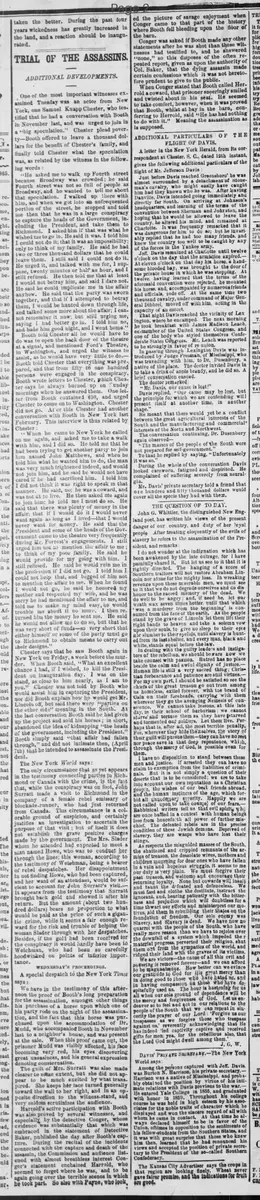
ADDITIONAL DEVELOPMENTS.
One of the most important witnesses examined Tuesday was an actor from New York, one Samuel Knapp Chester, who testified that he had a conversation with Booth in November last, and was urged to join in a "big speculation." Chester plead poverty-Booth offered to leave a thousand dollars for the benefit of Chester's family, and finally told Chester what the speculation was, as related by the witness in the following words:
"He asked me to walk up Fourth street because Broadway was crowded; he said Fourth street was not so full of people as Broadway, and he wanted to tell me about that speculation. I walked up there with him, and when we got into an unfrequented portion of the street, he stopped and told me then that he was in a large conspiracy to capture the heads of the Government, including the President, and take them to Richmond. I asked him if that was what he wished me to go in. He said it was. I told him I could not do it; that it was an impossibility; only to think of my family. He said he had two or three thousand dollars that he could leave them. I still said I could not do it. He urged it, and talked with me for, I suppose, twenty minutes or half an hour, and I still refused. He then told me that at least I would not betray him, and said I dare not. He said he could implicate me in the affair anyhow. He said that the party was sworn together, and that if I attempted to betray them, I would be hunted down through life, and talked some more about the affair; I cannot remember it now; but still urging me, saying I had better go in. I told him no, and bade him good night, and I went home."
Booth told Chester all he would have to do was to open the back door of the theatre at a signal, and mentioned Ford's Theatre, in Washington, and urged the witness to assist, as he would have very little to do.— Booth told Chester that everything was prepared, and that from fifty to one hundred persons were engaged in the conspiracy.
Booth wrote letters to Chester, which Chester says he always burned up on Sunday mornings when he answered them. One letter from Booth contained $50, and urged Chester to come on to Washington. Chester did not go. After this Chester had another conversation with Booth in New York last February. This interview is thus related by Chester:
" When he came to New York he called on me again, and asked me to take a walk with him, and I did so. He told me that he had been trying to get another party to join him named John Matthews, and when he told him what he wanted him to do, the man was very much frightened indeed, and would not join him, and he said he would not have cared if he had sacrificed him. I told him I did not think it was right to speak in that manner. He said, no; he was a coward, and was not fit to live. He then asked me again to join him; he told me I must do so. He said that there was plenty of money in the affair: that if I would do it I would never want again as long as I lived—that I would never want for money. He said that the President and some of the heads of the Government came to the theatre very frequently during Mr. Forrest's engagements. I still urged him not to mention the affair to me; to think of my poor family. He said he would provide for my going with him. I still refused. He said he would ruin me in the profession if I did not go. I told him I could not help that, and begged of him not to mention the affair to me. When he found I would not go, he said he honored my mother and respected my wife, and he was sorry he had mentioned the affair to me, and told me to make my mind easy, he would trouble me about it no more. I then returned him the money he sent me. He said he would not allow me to do so, but that he was very short of funds—so very short that either himself or some of the party must go to Richmond to obtain means to carry out their designs."
Chester says that he saw Booth again in New York on Friday, a week before the murder. When Booth said, "What an excellent chance I had, if I wished, to kill the President on inauguration day. I was on the stand, as close to him nearly, as I am to you." Chester was not told by Booth who would assist him in capturing the President, nor did Booth explain how he would get Mr. Lincoln off, but said there were "parties on the other side" meaning in the South. At the last conversation Booth said he had given up the project and sold his horses; in short, abandoned the idea of kidnapping "the heads of the government, including the President." Booth simply said that affair had fallen through," and did not intimate then, (April 7th) that he intended to assassinate the President.
The New York World says:
The only circumstance that as yet appears in the testimony connecting parties in Richmond or Canada with the crime, is the fact that, while the conspiracy was on foot, John Surratt made a visit to Richmond in the company of a female rebel emissary or blockade-runner, who had just returned from Canada. This circumstance is a colorable ground of suspicion, and certainly justifies an investigation to ascertain the purpose of that visit; but of itself it does not establish the grave positive charges made by the government. The Mrs. Slater whom he attended had expected to meet a man named Howe, who was to conduct her through the lines; this woman, according to the testimony of Weichman, being a bearer of rebel despatches. Her disappointment in not finding Howe, who had been captured, and her want of an attendant, would be sufficient to account for John Surratt's visit. It appears from the testimony that Surratt brought back gold and showed it after his return. But the amount (about two hundred dollars) bears no proportion to what would be paid as the price of such a gigantic crime, while it seems a fair enough reward for the risk and trouble of helping the woman Slater through with her despatches. Besides, if the gold had been received for the conspiracy it would hardly have been to Weichman, who had been so carefully hoodwinked on points of inferior importance.
WEDNESDAY'S PROCEEDINGS.
A special despatch to the New York Times says:
We have in the testimony of this afternoon the proof of Booth's long preparation for the assassination, amongst other things his purchase of a horse upon which one of his party rode on the night of the assassination, and the fact that this horse was purchased upon the accommodation of Dr. Mudd, who accompanied Booth in November last to a neighbor's house, and was present at the sale. When this proof came out, the prisoner Mudd was visibly affected, his face becoming very red, his eyes discovering great uneasiness, and his general expression denoting consternation.
The guilt of Mrs. Surratt was also made clearer to some extent, but she did not appear to be much excited by what transpired. She keeps her face turned generally toward the wall to her right, and in an opposite direction to the witness-stand, and very seldom scrutinizes the audience.
Harrold's active participation with Booth was also proved by several witnesses, and especially by the detective Conger, whose evidence was substantially that which was embraced in the statement of Detective Baker, published the day after Booth's capture. During the recital of the incidents connected with the capture and death of the assassin, the Commission and audience listened with almost breathless interest. Conger's statement enchained Harrold, who seemed to forget where he was, and to be again going over the terrible scenes in which he took part. So also with Payne, who looked the picture of savage enjoyment when Conger came to that part of the history where Booth fell bleeding upon the floor of the barn.
Conger was asked if Booth made any other statements after he was shot than those witnesses had testified to, and he answered "none," so this disposes of the often repeated report, given as upon the authority of Col. Baker, that the dying assassin made certain confessions which it was not heretofore prudent to give to the public.
When Conger stated that Booth called Herrold a coward, that prisoner sneeringly smiled and twisted about in his seat. He seemed to take comfort, however, when it was proved that Booth, whilst at bay in the barn, conferring to Herrold, said "He has had nothing to do with it." Meaning the assassination as is supposed.
What sub-type of article is it?
What themes does it cover?
What keywords are associated?
What entities or persons were involved?
Where did it happen?
Story Details
Key Persons
Location
New York, Washington, Richmond
Event Date
November 1864, February 1865, April 7 1865
Story Details
Actor Samuel Chester testifies about Booth's repeated attempts to recruit him for a conspiracy to kidnap President Lincoln and government heads to Richmond, involving opening a theater door and up to 100 conspirators. Booth later claims the plan is abandoned. Trial proceedings reveal Booth's preparations, including horse purchase with Dr. Mudd's aid, and accounts of Harrold and Payne's involvement, plus Surratt's suspicious Richmond visit.