Thank you for visiting SNEWPapers!
Sign up free
Richmond Enquirer
Richmond, Richmond County, Virginia
What is this article about?
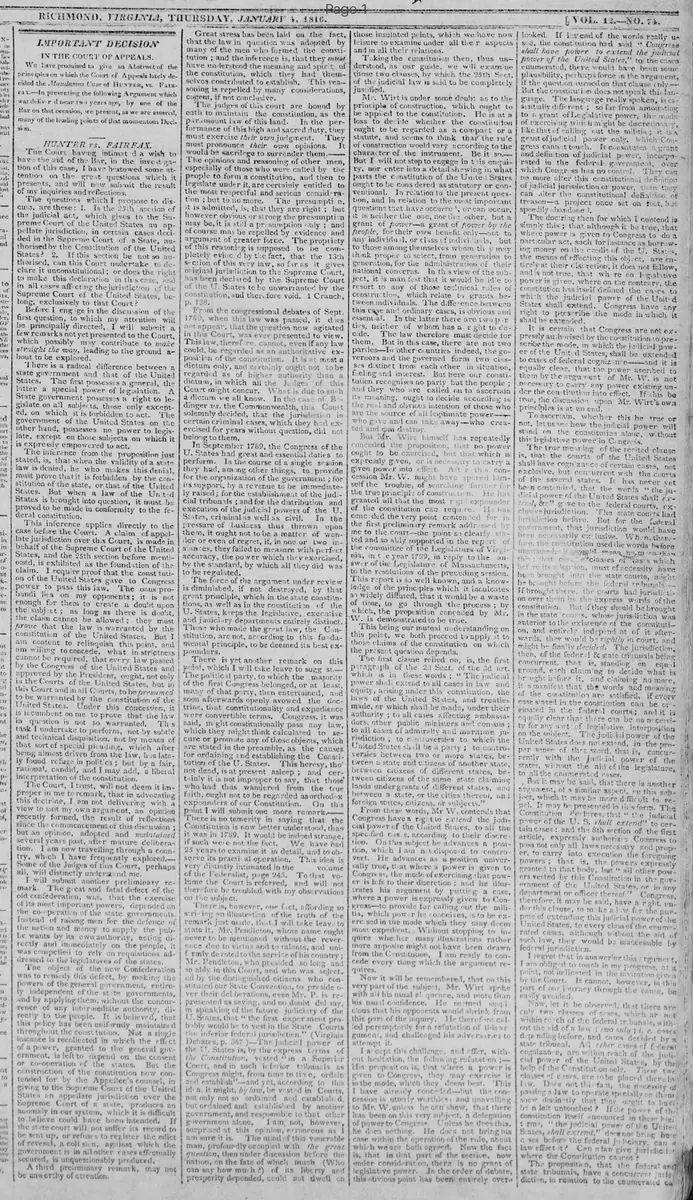
Argument in Hunter vs. Fairfax case before the Court of Appeals, challenging the constitutionality of the 25th section of the Judiciary Act of 1789, which grants the U.S. Supreme Court appellate jurisdiction over state supreme courts in certain cases. The speaker argues that the U.S. Constitution does not authorize Congress to pass such a law, emphasizing limited federal powers and concurrent jurisdiction.
Merged-components note: Continuation of the same legal story across pages, sequential reading order.
Clippings
1 of 2
OCR Quality
Full Text
IN THE COURT OF APPEALS.
We have promised to give an Abstract of the principles on which the Court of Appeals lately decided the important Case of Hunter, vs. Fairfax—in presenting the following Argument which was delivered near two years ago, by one of the Bar on that occasion, we present, as we are assured, many of the leading points of that momentous Decision.
HUNTER vs. FAIRFAX.
The Court having intimated a wish to have the aid of the Bar, in the investigation of this case, I have bestowed some attention on the great questions which it presents, and will now submit the result of my inquiries and reflections.
The questions which I propose to discuss, are these: 1. Is the 25th section of the judicial act, which gives to the Supreme Court of the United States an appellate jurisdiction, in certain cases decided in the Supreme Court of a State, authorised by the Constitution of the United States? 2. If this section be not so authorised, can this Court undertake to declare it unconstitutional; or does the right to make this declaration in this case, and in all cases affecting the jurisdiction of the Supreme Court of the United States, belong, exclusively to that Court?
Before I engage in the discussion of the first question, to which my attention will be principally directed, I will submit a few remarks not yet presented to the Court, which possibly may contribute to make straight the way, leading to the ground about to be explored.
There is a radical difference between a state government and that of the United States. The first possesses a general, the latter a special power of legislation. A State government possesses a right to legislate on all subjects, those only excepted, on which it is forbidden to act. The government of the United States on the other hand, possesses no power to legislate, except on those subjects on which it is expressly empowered to act.
The inference from the proposition just stated, is, that when the validity of a state law is denied, he who makes this denial, must prove that it is forbidden by the constitution of the state, or that of the United States. But when a law of the United States is brought into question, it must be proved to be made in conformity to the federal constitution.
This inference applies directly to the case before the Court. A claim of appellate jurisdiction over this Court, is made in behalf of the Supreme Court of the United States, and the 25th section before mentioned, is exhibited as the foundation of the claim. I require proof that the constitution of the United States gave to Congress power to pass this law. The onus probandi lies on my opponents; it is not enough for them to create a doubt upon the subject; as long as there is doubt, the claim cannot be allowed; they must prove that the law is warranted by the constitution of the United States. But I am content to relinquish this point, and am willing to concede, what in strictness cannot be required, that every law passed by the Congress of the United States and approved by the President, ought, not only in the Courts of the United States, but in this Court and in all Courts, to be presumed to be warranted by the constitution of the United States. Under this concession, it is incumbent on me to prove that the law in question is not so warranted. This task I undertake to perform, not by subtle and technical disquisition, not by means of that sort of special pleading, which after being almost driven from the law, has lately found refuge in politics; but by a fair, rational, candid, and I may add, liberal interpretation of the constitution.
The Court, I trust, will not deem it improper in me to remark, that in advocating this doctrine, I am not delivering with a view to suit my own argument, an opinion recently formed, the result of reflections since the commencement of this discussion: but an opinion, adopted and maintained several years past, after mature deliberation. I am now travelling through a country, which I have frequently explored.—Some of the Judges of this Court, perhaps all, will distinctly understand me.
I will submit another preliminary remark. The great and fatal defect of the old confederation, was, that the exercise of its most important powers, depended on the co-operation of the state governments. Instead of raising men for the defence of the nation and money to supply the public wants by its own authority, acting directly and immediately on the people, it was compelled to rely on requisitions addressed to the legislatures of the states.
The object of the new Confederation was to remedy this defect, by making the powers of the general government, entirely independent of the state governments, and by applying them, without the concurrence of any intermediate authority, directly to the people. It is believed, that this policy has been uniformly maintained throughout the constitution. Not a single instance is recollected in which the effect of a power, granted to the general government, is left to depend on the consent or co-operation of the states. But the construction of the constitution now contended for by the Appellee's counsel, in giving to the Supreme Court of the United States an appellate jurisdiction over the Supreme Court of a state, produces an anomaly in our system, which it is difficult to believe could have been intended. If the state court will not suffer its record to be sent up, or refuses to register the edict of reversal, a collision, against which the government is in all other cases effectually secured, is unquestionably produced.
A third preliminary remark, may not be unworthy of attention.
Great stress has been laid on the fact, that the law in question was adopted by many of the men who formed the constitution; and the inference is, that they must have understood the meaning and spirit of the constitution, which they had themselves contributed to establish. This reasoning is repelled by many considerations, cogent, if not conclusive.
The judges of this court are bound by oath to maintain the constitution, as the paramount law of this land. In the performance of this high and sacred duty, they must exercise their own judgment. They must pronounce their own opinions. It would be sacrilege to surrender them.—The opinions and reasoning of other men, especially of those who were called by the people to form a constitution, and then to legislate under it, are certainly entitled to the most respectful and serious consideration; but to no more. The presumption, it is admitted, is, that they are right; but however obvious or strong the presumption may be, it is still a presumption only; and of course may be repelled by evidence and argument of greater force. The propriety of this reasoning is supposed to be completely evinced by the fact, that the 13th section of this very law, so far as it gives original jurisdiction to the Supreme Court, has been declared by the Supreme Court of the U. States to be unwarranted by the constitution, and therefore void. 1 Cranch, p. 138.
From the congressional debates of Sept. 1789, when this law was passed, it does not appear, that the question now agitated in this Court, was ever presented to view. This law, therefore, cannot, even if any law could, be regarded as an authoritative exposition of the constitution. It is at most a dictum only, and certainly ought not to be regarded as of higher authority than a dictum, in which all the Judges of this Court might concur. What is due to such a dictum we all know. In the case of B-dinger vs. the Commonwealth, this Court solemnly decided, that the jurisdiction in certain criminal cases, which they had exercised for years without question, did not belong to them.
In September 1789, the Congress of the U. States had great and essential duties to perform. In the course of a single session they had, among other things, to provide for the organization of the government; for its support, by a revenue to be immediately raised; for the establishment of the judicial tribunals; and for the distribution and execution of the judicial powers of the U. States, criminal as well as civil. In the pressure of business thus thrown upon them, it ought not to be a matter of wonder or even of regret, if, in one or two instances, they failed to measure with perfect accuracy, the power which they exercised, by the standard, by which all they did was to be regulated.
The force of the argument under review is diminished, if not destroyed, by that great principle, which in the state constitutions, as well as in the constitution of the U. States, keeps the legislative, executive and judiciary departments entirely distinct. Those who made the great law, the Constitution, are not, according to this fundamental principle, to be deemed its best expounders.
There is yet another remark on this point, which I will take leave to suggest.—The political party, to which the majority of the first Congress belonged, or at least, many of that party, then entertained, and soon afterwards openly avowed the doctrine, that constitutionality and expedience were convertible terms. Congress, it was said, might constitutionally pass any law, which they might think calculated to secure or promote any of those objects, which are stated in the preamble, as the causes for ordaining and establishing the Constitution of the U. States. This heresy, tho' not dead, is at present asleep; and certainly it is not improper to say, that those who had thus wandered from the true faith, ought not to be regarded as orthodox expounders of our Constitution. On this point I will submit one more remark.—
There is no temerity in saying that the Constitution is now better understood, than it was in 1789. It would be indeed strange, if such were not the fact. We have had 25 years to examine it in detail, and to observe its practical operation. This idea is very distinctly intimated in the volume of the Federalist, page 243. To that volume the Court is referred, and will not therefore be troubled with my observations on the subject.
There is, however, one fact, affording so striking an illustration of the truth of the remark just made, that I will take leave to state it. Mr. Pendleton, whose name ought never to be mentioned without the reverence due to virtue and to talents, and uniformly devoted to the service of his country; Mr. Pendleton, who presided so long and so ably in this Court, and who was selected by the distinguished citizens who constituted our State Convention, to preside over their deliberations, even Mr. P. is represented as saying, and no doubt did say, in speaking of the future judiciary of the U. States, that "the first experiment probably would be to vest in the State Courts the inferior federal jurisdiction." (Virginia Debates, p. 367)—The judicial power of the U. States is, by the express terms of the Constitution, vested "in a Supreme Court, and in such inferior tribunals as Congress might, from time to time, ordain and establish"—and yet, according to this idea, it might, by law, be vested in Courts, not only not so ordained and established, but ordained and established by another government, and responsible to that other government alone. I am not, however, surprised at this opinion, erroneous as I am sure it is. The mind of this venerable man, profoundly occupied with the great question, then under discussion before the nation, on the fate of which much (Who can say how much?) of its liberty and prosperity depended, could not dwell on those insulated points, which we have now leisure to examine under all their aspects and in all their relations.
Taking the constitution then, thus understood, as our guide, we will examine those two clauses, by which the 25th Sect. of the judicial law is said to be completely justified.
Mr. Wirt is under some doubt as to the principle of construction, which ought to be applied to the constitution. He is at a loss to decide whether the constitution ought to be regarded as a compact or a statute, and seems to think that the rule of construction would vary according to the character of the instrument. Be it so.—But I will not stop to engage in this enquiry, nor enter into a detail shewing in what parts the Constitution of the United States ought to be considered as statutory or conventional. In relation to the present question, and in relation to the most important questions that have occurred, or can occur, it is neither the one, nor the other, but a grant of power—a grant of power by the people, for their own benefit only—not to any individual, or class of individuals, but to those among themselves whom they may think proper to select, from generation to generation, for the administration of their national concerns. In this view of the subject, it is manifest that it would be idle to resort to any of those technical rules of construction, which relate to grants between individuals. The difference between this case and ordinary cases, is obvious and essential. In the latter there are two parties, neither of whom has a right to decide. The law therefore must decide for them. But in this case, there are not two parties—In other Countries indeed, the governors and the governed form two classes distinct from each other in situation, feeling and interest. But here our constitution recognises no party but the people; and they who are called on to ascertain its meaning, ought to decide according to the real and obvious intention of those who are the source of all legitimate power—err who give and can take away—who created and can destroy.
But Mr. Wirt himself has repeatedly conceded the proposition, that no power ought to be exercised, but that which is expressly given, or is necessary to carry a given power into effect. After this concession Mr. W. might have spared himself the trouble, of searching further for the true principle of construction. He has granted all that the most rigid expounder of the constitution can require. He has conceded the very point contended for in the first preliminary remark addressed by me to the court—the point so clearly stated and so ably supported in the report of the committee of the Legislature of Virginia, in the year 1799, in reply to the answer of the Legislature of Massachusetts, to the resolutions of the preceding session. This report is so well known, and a knowledge of the principles which it inculcates so widely diffused, that it would be a waste of time, to go through the process; by which, the proposition conceded by Mr. W. is demonstrated to be true.
This being our mutual understanding on this point, we both proceed to apply it to those claims of the constitution on which the present question depends.
The first clause relied on, is, the first paragraph of the 2d Sect. of the 3d art. which is in these words; "The judicial power shall extend to all cases in law and equity, arising under this constitution, the laws of the United States, and treaties made, or which shall be made, under their authority; to all cases affecting ambassadors, other public ministers and consuls; to all cases of admiralty and maritime jurisdiction; to controversies to which the United States shall be a party; to controversies between two or more states; between a state and citizens of another state; between citizens of different states; between citizens of the same state claiming lands under grants of different states, and between a state, or the citizens thereof, and foreign states, citizens, or subjects."
From these words, Mr. W. contends that Congress have a right to extend the judicial power of the United States, to all the specified cases, according to their discretion. On this subject he advances a position, which I am not disposed to controvert. He advances as a position universally true, that where a power is given to Congress, the mode of exercising that power is left to their discretion: and he illustrates his argument by putting a case, where a power is expressly given to Congress—to provide for calling out the militia, which power he conceives, to be exercised in the mode which they may deem most expedient. Without stopping to inquire whether many illustrations rather more apposite might not have been drawn from the Constitution, I am ready to concede every thing which the argument requires.
Now it will be remembered, that on this very part of the subject, Mr. Wirt spoke with all his usual eloquence, and more than his usual confidence. He seemed suspicious that his opponents would shrink from this part of the inquiry. He therefore called peremptorily for a refutation of this argument, and challenged his adversaries to attempt it.
I accept this challenge, and offer, without hesitation, the following refutation;—His proposition is, that where a power is given to Congress, they may exercise it in the mode, which they deem best. This I have already conceded—but the concession is utterly worthless and unavailing to Mr. W. unless he can shew, that there has been on this very subject, a delegation of power to Congress. Unless he does this, he does nothing. He does not bring his case within the operation of the rule, about which we are both agreed. Now the fact is, that in that part of the section, now under consideration, there is no grant of legislative power. In the order of debate, this obvious point has been entirely over-looked. If instead of the words really used, the constitution had said "Congress shall have power to extend the judicial power of the United States," to the cases enumerated, there would have been some plausibility, perhaps force in the argument, if the question turned on that clause only—But the constitution does not speak this language. The language really spoken, is essentially different; so far from amounting to a grant of Legislative power, the mode of exercising which might be discretionary, like that of calling out the militia; it is a grant of judicial power only, which Congress cannot touch. It constitutes a grant and definition of judicial power, incorporated in the federal government, over which Congress has no control. They can no more alter this constitutional definition of judicial jurisdiction or power, than they can alter the constitutional definition of treason—a project once set on foot, but speedily abandoned.
The doctrine then for which I contend is simply this; that although it be true, that where power is given to Congress to do a particular act, such for instance as borrowing money on the credit of the U. States, the means of effecting this object, are entirely at their discretion, it does not follow, and is not true, that where no legislative power is given, where on the contrary, the constitution has itself defined the cases to which the judicial power of the United States shall extend, "Congress have any right to prescribe the mode in which it shall be extended."
It is certain that Congress are not expressly authorised by the constitution to prescribe the mode, in which the judicial power of the United States, shall be extended to cases of federal cognizance—and it is equally clear, that the power ascribed to them by the argument of Mr. W. is not necessary to carry any power existing under the constitution into effect. If this be true, the discussion upon Mr. Wirt's own principles is at an end.
To ascertain, whether this be true or not, let us see how the judicial power will stand on the constitution alone, without this legislative power in Congress.
The true meaning of the recited clause is, that the courts of the United States shall have cognizance of certain cases, not exclusive, but concurrent with the courts of the several states. It has never yet been contended, that the words "the judicial power of the United States shall extend, &c." give to the federal courts, exclusive jurisdiction. The state courts had jurisdiction before. But for the federal government, that jurisdiction would have been necessarily exclusive. When, therefore, the constitution used the words before mentioned it would mean no more than this: that classes of cases which before its adoption, must of necessity have been brought into the state courts, might be brought before the federal tribunals—If brought there, the courts had jurisdiction over them by the express words of the constitution. But if they should be brought in the state courts, whose jurisdiction was anterior to the existence of the constitution, and entirely independent of it afterwards, they would be rightly in court, and might be finally decided. The jurisdiction, then, of the federal & state tribunals being concurrent, that is, standing on equal ground, each claiming to decide what is brought before it, and claiming no more, it is manifest that the words and meaning of the constitution are satisfied, if every case stated in the constitution can be originated in the federal courts; and it is equally clear that there can be no necessity for any sort of legislative interposition on the subject. The judicial power of the United States does not extend, in the proper sense of that word, that is, concurrently with the judicial power of the states, without the aid of the legislature, to all the enumerated cases.
But it may be said, that there is another argument, of a similar aspect, on this subject, which it may be more difficult to repel. It may be presented in this form. The Constitution requires, that "the judicial power of the U. S. shall extend" to certain cases: and the 8th section of the first article, expressly authorises Congress to pass not only all laws necessary and proper, to carry into execution the foregoing powers; that is, the powers expressly granted to that body, but "all other powers vested by this Constitution in the government of the United States, or in any department or officer thereof." Congress, therefore, it may be said, have a right, under this clause, to make a law for the purpose of extending this judicial power of the United States, to every class of the enumerated cases, although without the aid of such law, they would be inaccessible by federal jurisdiction.
I regret that in answering this argument, I am obliged to touch in my progress, at a point, not indicated in the invitation given by the Court. It cannot, however, in this part of our journey through the case, be easily avoided.
Now, let it be observed, that there are only two classes of cases, which are not within reach of the federal tribunals, without the aid of a law; two only; i. e. cases depending before, and cases decided by a state tribunal. All other cases of federal cognizance, are within reach of the judicial power of the United States, by the help of the Constitution only. These two classes of cases, are to be placed there by law. Does not this fact, the necessity of passing a law to operate specially on them shew distinctly that they ought to have been left untouched? If the power of the constitution itself announced in these high terms, "the judicial power of the United States, shall extend," does not bring these cases before the federal judiciary, can a law effect it? Can a law give jurisdiction where the Constitution cannot?
The proposition, that the federal and state tribunals, have a concurrent jurisdiction, in relation to the enumerated cases arising under the laws of the United States, has been advanced. But it is believed, that this proposition will not be maintained. It is believed, that it will be conceded, that in cases arising under the laws of the United States, the jurisdiction of the federal courts is exclusive. If this be so, then the necessity of a law to bring cases depending in the state courts before the federal judiciary, is a necessity to take jurisdiction from the state courts, and to give it to the federal courts. But this is a necessity which the constitution has not created. The constitution has not said that the judicial power of the United States shall extend exclusively to cases arising under the laws of the United States. It has said only, that it shall extend to such cases; and this is satisfied, as has been shewn, by a concurrent jurisdiction. The necessity, then, of a law to make the jurisdiction exclusive, shews that the jurisdiction is not exclusive by the constitution; and that Congress have no right to make it so.
VOL. 12.—NO. 71.
sessions never having been denied, will be assumed to be true. Now, in my humble opinion, as already expressed, concurrence implies, on this subject, equality: that is, that each Court shall entertain jurisdiction of the cases originated before it, and this is its meaning in relation to the concurrent jurisdiction of the Federal Courts. Cases brought before them, are never removed into the State Courts. Cases decided by them, are finally decided. But, it seems that a little more is meant. In relation to the federal courts, it further means, that they may take cognizance of causes, removed from a state tribunal, before trial, or revise them afterwards by appeal. Is it not, moreover, apparent, that the same reasoning, which justifies the extension of the judicial power of the U. States, to these cases, in this way, would justify its extension in any way, and give to Congress a power to transfer by law, every case of federal cognizance, brought before a state tribunal, within the pale of the federal jurisdiction? According to the doctrine advanced by Mr. Wirt, as to the discretion of Congress in selecting the mode of effecting an object, such would inevitably be the result. But, let us examine this point more minutely. "The judicial power of the United States shall extend," &c. Now, admit that Congress have a right, under the 8th section, to make a law for the purpose of carrying into effect the judicial power of the United States. Let them have this power, and to what does it amount? The judicial power of the United States, is by the constitution, concurrent with that of the States, and so it must remain. But, this argument goes to shew, that it may be exclusive and supreme! A further remark on this point is submitted. The argument here controverted, supposes that Congress have a right to extend the judicial power of the United States to all cases in the enumerated classes, though depending before, or decided by a state tribunal. Thus, these words, "the judicial power of the U. States shall extend," &c. mean that Congress shall have power to pass laws for the removal into the tribunals of the United States, causes depending before a state tribunal, and to give to the former an appellate jurisdiction over the latter. That a power so delicate in its character, and so important in its effect, should have been intended to be conveyed in this covered, subterraneous way, it is impossible to believe. It may also, with propriety, be said that the Constitution of the United States, when speaking of the cases, to which the judicial power shall extend, must be considered as referring to existing cases. Now, cases decided, cannot be regarded as existing cases. The original case is merged in the decision. A bond, on which a judgment is obtained, is swallowed up by the judgment. It is, however, unnecessary to press this point more. According to my view of the subject, every argument founded on the clause of the constitution now reviewed, is irrelevant. The question before this court is, whether the Supreme Court of the United States, has Appellate power over this court, the Supreme Court of a State? Now this question is decided by a different clause of the Constitution, by which the original as well as Appellate jurisdiction of the Supreme Court is completely defined, and if, from a fair expression, it appears that the Supreme Court has not constitutionally Appellate jurisdiction over the state tribunals, manifestly, a waste of time to engage in a regular refutation of arguments, introduced to prove that Congress will bestow it. This brings us to the 2d ground taken by the Counsel, for the Appellee. They say that the 2d paragraph, of the 2d sec. art. 3, of the constitution of the United States in these words: "In all cases affecting ambassadors, other public ministers and consuls, and those in which a state shall be party, the supreme court, shall have original jurisdiction. In all the other cases, before mentioned, the supreme court shall have appellate jurisdiction, both as to law & fact, with such exceptions, & under such regulations, as the Congress shall make," gives to the Supreme Court of the U. S. an appellate jurisdiction over the tribunals of a state, as well as over the inferior tribunals of the United States. Various considerations present themselves at once, in opposition to this doctrine. They shall be briefly stated. 1. The object of the Constitution, in this clause, is obviously, to designate the cases in which, and not the courts over which the Supreme Court shall have appellate jurisdiction. There is not a word said about courts. 2. The power now claimed is of a character both delicate and peculiar: the first, because it is to be exercised by a department of one government over a department of another; and peculiar, because, as was before remarked, it introduces an anomaly into our system, which it was very easy to avoid. Now, is it to be believed, that a power of this kind, really intended to be given, would have been left to depend on conjecture or inference? This cannot be believed: on the contrary, the evidence to be collected from the constitution itself proves, that if this power had been intended to be conferred on the Supreme Court of the U. States, the terms used would have distinctly and expressly referred to it. The language would have been as clear as that of the following sentence: "In all the other cases before mentioned, whether decided by an inferior tribunal of the U. States, or by any Court of a State, the Supreme Court shall have appellate jurisdiction," &c. An example of the evidence here alluded to is furnished by the very section before us. Although it might be fairly inferred from this section, that Congress were to ordain and establish inferior tribunals; yet, a power for that purpose is expressly given, in so many words, by the 3d section of the 1st Art. Another example is furnished even by the clause itself. The Constitution meant to bestow on the Supreme Court a general appellate jurisdiction over its own inferior tribunals, both as to law and fact. It, therefore, says, that it shall have appellate jurisdiction, both as to law and fact. Other instances of this kind might be selected--but these are sufficient. They shew that where power was meant to be given, it was given in plain terms, and not left to be cunningly deduced from general terms actually applied to a different subject. Yet in defiance of all this, and in defiance too of the general character and policy of the Constitution, we are called on to say, that the Constitution, when speaking of the cases in which the Supreme Court should have appellate power, was thinking of federal and state courts, and by these words, meant to subject the latter to the jurisdiction of the former. 3. It has been conceded, that power must be expressly given. Now, in the present case, there is not a single word expressly applicable to state tribunals. But it may be said, that the terms of the Constitution though general are express, and that the general terms include this case.--In illustration of this idea, it may be further said, that there is no express delegation to the Supreme Court of appellate jurisdiction, over the inferior Courts of the United States; yet it has this jurisdiction over them. The general terms of the Constitution, therefore, embracing, as is admitted, an appellate jurisdiction over the inferior Courts of the U. States, may, on the same principle, be said to embrace the jurisdiction in question. This I conceive to be the strongest argument that can be urged, in support of the appellate pretensions of the Supreme Court of the U. States. The considerations already suggested, may be used with great force against the argument just stated. My own impression is, that they are conclusive. But there is an additional remark too important to be passed by. All words, oral or written, the construction of which is judicially or even rationally investigated, must be referred to the subject matter. Although it be true, that general terms are to be generally understood, still their generality must be restricted to the subject to which the speech or writing relates. Illustrations of this elementary and obvious principle would be superfluous in this Court, and in ordinary cases, perhaps improper--But this is no ordinary case: and the Court will therefore indulge me, while I mention two furnished, among many others, by the Constitution itself--one of them, by the section under consideration. "The trial of all crimes, except in cases of impeachment, shall be by jury." What crimes? The expression is general; there is no exception. Yet, that the Constitution meant "all crimes committed against the United States," it would be as idle to attempt to prove, as it would be absurd to deny. "In all criminal prosecutions, the accused shall enjoy the right to a speedy and public trial by an impartial jury of the state and district, &c." It is equally clear that the words "all criminal prosecutions" mean those only which are instituted on the part of the U. States. This plain reasoning at once detects and exposes the fallacy of the argument under consideration. The section on which it relies, speaks of the judicial power of the U. States only. The clause in question, speaks of the Courts of the U. States only--the Supreme Court of the U States, and such inferior tribunals as Congress might establish. The relation between these Courts, as Supreme and inferior, is distinctly announced. They and the distribution between them of the judicial power of the U. States, constituted the subject matter. When, therefore, appellate jurisdiction is given to the Supreme Court, that appellate jurisdiction must be considered as extended over the inferior federal tribunals, which had been mentioned, and not over state courts, about which not a word had been said. This construction of the constitution, limiting the appellate power of the Supreme Court, to federal tribunals, is irresistibly enforced, by an argument deduced from the power given to Congress, to make such exceptions and regulations concerning it, as they might deem proper. Is it not obvious that this appellate power was understood to be within the reach of Congressional regulation and control? And is it not so, provided the restriction for which I contend be adopted? But if the appellate power of the Supreme Court be extended to state tribunals, why then it follows that Congress must have the power of regulating the proceedings of state as well as federal courts; a power never yet exercised, nor even claimed, but on the contrary very distinctly disavowed. Congress, in relation to the appellate power of the Supreme Courts over their inferior Courts, have established several regulations. By the 19th section of the judicial act, they have directed, that the facts shall appear on the record. By the 30th section they have directed, that the evidence shall be recorded, and authorised a recourse to it, where the witnesses cannot be procured. These regulations, however, and indeed all prescribed by that act, relate exclusively to the federal courts. Not one word is said that has any relation to the state courts. The right of appeal from them is asserted, but no regulation is attempted. None; I mean, affecting the trial or previous proceedings. There is not only no regulation concerning appeals from the state courts, of the description just mentioned, but there is no attempt to provide a remedy, in case this appellate power should be controverted or opposed. Collision between the federal tribunals is fore seen, and the evil is corrected by mandamus or prohibition: but in case of collision between the federal and state tribunals, no remedy whatever is provided. The knowledge on the part of Congress, that no remedy could be provided, ought, it would seem, to have admonished them that they had gone too far. This remark, suggests another, not unworthy of notice. If the framers of the Constitution had really meant to confer this appellate power on the Supreme Court of the U. States, they would not only have said so in plain language, but they would have provided some means for upholding the authority of the general government, in case of disagreement. A case of such importance would have been provided for in the constitution itself. The foregoing arguments, if sound, establish the position, that by the constitution, the Supreme Court of the U. States has no appellate jurisdiction, whatever, over the tribunals of a state. The argument, now to be urged, is intended to shew, that even if an appellate power does exist, it cannot be exercised in the manner and for a purpose prescribed by this mandate. This proposition, however, not being of much importance except in this case, will not be extensively discussed. By the 1st section of the 3d article of the Constitution, "the judicial power of the U. States is vested in one Supreme Court, and in such inferior tribunals, as Congress may from time to time ordain and establish." Being vested in them by the constitution, it must remain in them exclusively and for ever. That the constitution has fixed, no law can change. What then is the character of the power which this court is required to assume and to exercise? It is emphatically a judicial power. It is a power to enter upon record a judgment, although the record of this court shews that a judgment, final & conclusive, as far as the judicial power of the state vested in this court is concerned, has already been entered. In entering then the judgment prescribed, this court would not act, by virtue of any judicial power derived from the state. That power has been exercised, and the judgment is beyond its reach. If then a new judgment is entered, the court must act, not by virtue of the judicial power of the state, but by virtue of the judicial power of the United States. But this is impossible: that power being by the constitution vested exclusively in the federal tribunals. The difficulty will not be obviated by proving the act required to be done, to be of a ministerial, and not of a judicial character, unless it can be also proved, that Congress have a right, to impose ministerial duties on the state judges. This will hardly be affirmed. Duties of this description cannot be imposed even on federal judges. This point has been settled by the judges of the Supreme Court. On this first question I shall add no more. Whatever the decision may be, the discussion will be useful. It is that sort of recurrence to fundamental principles, so forcibly recommended by our state bill of rights. On the 2d question, I have but little to offer. It was scarcely touched by Mr. Wirt, and I see no reason for departing far from his example. Mr. Leigh's leading position is, that the Supreme Court is alone competent to decide, concerning the extent of its own jurisdiction. His reasoning I understand to be this—Wherever there is a concurrent jurisdiction between the federal and state tribunals, they form so far one judiciary system--they constitute one whole. The Supreme Courts of the United States being at the head of the system, must like all other Supreme Courts, decide in the last resort--and that Court having decided this question, no inferior tribunal ought to controvert the decision. Every part of this proposition is pregnant with error. It is denied that the Federal and state judiciaries form one system, or constitute one whole on any ground whatever, and most especially on the ground of concurrent jurisdiction. The naked fact, of concurrent jurisdiction, implies no connection. The County and Corporation Courts have a concurrent jurisdiction, but no relation, no connection whatever. They are created by the same power, and amenable to the same government. Still there is no point of contact between them. But the federal and state tribunals derive their existence from different sources, and are amenable to different governments. Yet according to Mr. Leigh, the fact alone of their having a concurrent jurisdiction, implies not only relation, but pre-eminence on one side. Now in my estimation it implies equality--and I see no more reason, taking this fact solely into view, for making the State Courts parts of the Federal judiciary, so as to give the latter an appellate jurisdiction over them, than for making the Federal Courts parts of the state judiciary. Mr. Leigh appears to be mistaken also as to the fact, that this question has been decided by the Supreme Courts. The cases adduced by him, I have since examined.--They only prove that the jurisdiction now claimed, has been exercised, but not that the question now discussed has been decided. In truth, the point was never presented to the court. But if it had been decided after argument, this court would not be bound by the decision. The judges would approach it with great respect--examine it with great care--reflect upon it long & intensely--but after all they would decide as duty and conscience prescribed. It is true, that if this Court were to decide any question concerning its own jurisdiction, the decision would be admitted by all the state tribunals, however exceptionable it might be deemed. It would be admitted, and ought to be admitted, because this is the Supreme Court of the country; and this is the Supreme Court from no other circumstance than this: that it decides in the last resort, and has the power to enforce its decisions against all the inferior tribunals of the Commonwealth. But Mr. Leigh's argument gratuitously bestows a supremacy on the Supreme Court of the U. States in relation to this Court, although the essence of the question is, whether it has that supremacy, that is, whether it has that appellate power, which, it is conceded, would constitute a Superior Court. But, supreme as this court unquestionably is, in relation to all the courts of this state, it has never yet said, that it alone is competent to decide a question concerning the extent of its own jurisdiction. In fact, one court must often decide, concerning the jurisdiction of another. If the court which decides, happens to be an inferior court, its error, if it commit one, may be corrected. But, still it has decided. If, for instance, a defendant should pray an appeal from the county court to this court, his application would be rejected. He would be told that this court has no immediate appellate jurisdiction over a county court, and the justices, I presume, would hardly think the counsel serious, who should tell them, that they were undertaking to decide a question which this court alone was competent to decide. Illustrations of this doctrine might be furnished in great numbers; but, it is unnecessary to suggest them to this court. Before I conclude, I will notice a remark from Mr. Leigh, which ought to have been examined in a preceding part of this inquiry--He said, it had been "decided by this Court, that a cause depending in a state court against the citizen of another state might be transferred before a federal tribunal; and he asked, why this removal might not be effected after judgment." It would be useless to repeat what has been already said, concerning this power to remove before judgment. I will barely mention to the Court, that in the case of Brown vs. Cropper & Wise, I was of counsel for the Appellant, and in fact, the only counsel in the cause; and I am perfectly assured, that the case was argued and decided upon the law, and the law alone. No doubt of its validity was suggested. In this statement I am justified, not only by my own recollection, but by the printed report of the case. One more remark, and I have done.--It has been eloquently urged, that it is important that all questions involving the construction of a treaty, should be decided by the national judiciary. It may be so; but the proposition is not conceded. Whether true or false it is immaterial here. We are enquiring into the meaning of the Court; not what the Court ought to be. Those who formed the Court, were not of this opinion. If they had been, they would either have given an exclusive or an appellate jurisdiction to the Court of the U. nited States, in terms not to be misunderstood. They did not believe, as has been contended here, that violations of treaties by judicial decisions, constitute the most common source of wars. They knew better. They knew that wars spring from the ambition of princes, from an eagerness after wealth as well as fame, always indulged by the military of a powerful nation, and more especially from the monopolizing and rapacious spirit, which commerce never fails to inspire. In truth, no instance is recollected, in which a war has arisen from a decision supposed to be in contravention of a treaty. Judicial decisions are not between states and empires, but individuals. Their claims are too trivial, and themselves too obscure, to set in motion those strong feelings which impel nations into war. The people of this Country did not wage war against Great-Britain, because of the decisions of Sir William Scott, repugnant as they were, not to a treaty, but to the great law of nature and nations, the benefit of which may be rightfully claimed by all the people of the earth, but because of the orders of the British Government--The orders in Council, which established a new law of nations, as iniquitous as it was new, and which the judge thought proper to adopt and to enforce.
What sub-type of article is it?
What themes does it cover?
What keywords are associated?
What entities or persons were involved?
Where did it happen?
Story Details
Key Persons
Location
Court Of Appeals
Event Date
Near Two Years Ago
Story Details
Legal argument contending that the 25th section of the Judiciary Act is unconstitutional, as the U.S. Constitution does not grant Congress power to give the Supreme Court appellate jurisdiction over state courts; emphasizes concurrent jurisdiction and limited federal powers.