Thank you for visiting SNEWPapers!
Sign up free
Story
March 5, 1959
Peninsula Enterprise
Accomac, Accomack County, Virginia
What is this article about?
VPI study on lime requirements for Virginia soils, including on-farm tests since 1954 and alfalfa trials, reveals lime's enduring pH benefits, varying needs by soil type, and superiority of dolomitic lime.
Clipping
OCR Quality
100%
Excellent
Full Text
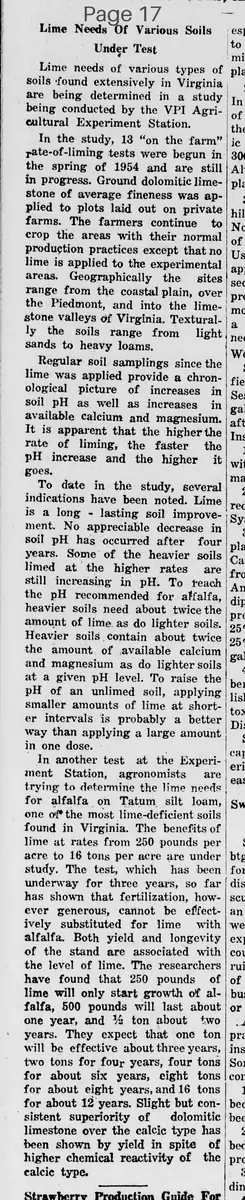
Lime Needs Of Various Soils Under Test
Lime needs of various types of soils found extensively in Virginia are being determined in a study being conducted by the VPI Agricultural Experiment Station.
In the study, 13 "on the farm" rate-of-liming tests were begun in the spring of 1954 and are still in progress. Ground dolomitic limestone of average fineness was applied to plots laid out on private farms. The farmers continue to crop the areas with their normal production practices except that no lime is applied to the experimental areas. Geographically the sites range from the coastal plain, over the Piedmont, and into the limestone valleys of Virginia. Texturally the soils range from light sands to heavy loams.
Regular soil samplings since the lime was applied provide a chronological picture of increases in soil pH as well as increases in available calcium and magnesium.
It is apparent that the higher the rate of liming, the faster the pH increase and the higher it goes.
To date in the study, several indications have been noted. Lime is a long-lasting soil improvement. No appreciable decrease in soil pH has occurred after four years. Some of the heavier soils limed at the higher rates are still increasing in pH. To reach the pH recommended for alfalfa, heavier soils need about twice the amount of lime as do lighter soils. Heavier soils contain about twice the amount of available calcium and magnesium as do lighter soils at a given pH level. To raise the pH of an unlimed soil, applying smaller amounts of lime at shorter intervals is probably a better way than applying a large amount in one dose.
In another test at the Experiment Station, agronomists are trying to determine the lime needs for alfalfa on Tatum silt loam, one of the most lime-deficient soils found in Virginia. The benefits of lime at rates from 250 pounds per acre to 16 tons per acre are under study. The test, which has been underway for three years, so far has shown that fertilization, however generous, cannot be effectively substituted for lime with alfalfa. Both yield and longevity of the stand are associated with the level of lime. The researchers have found that 250 pounds of lime will only start growth of alfalfa, 500 pounds will last about one year, and 1/2 ton about two years. They expect that one ton will be effective about three years, two tons for four years, four tons for about six years, eight tons for about eight years, and 16 tons for about 12 years. Slight but consistent superiority of dolomitic limestone over the calcic type has been shown by yield in spite of higher chemical reactivity of the calcic type.
Lime needs of various types of soils found extensively in Virginia are being determined in a study being conducted by the VPI Agricultural Experiment Station.
In the study, 13 "on the farm" rate-of-liming tests were begun in the spring of 1954 and are still in progress. Ground dolomitic limestone of average fineness was applied to plots laid out on private farms. The farmers continue to crop the areas with their normal production practices except that no lime is applied to the experimental areas. Geographically the sites range from the coastal plain, over the Piedmont, and into the limestone valleys of Virginia. Texturally the soils range from light sands to heavy loams.
Regular soil samplings since the lime was applied provide a chronological picture of increases in soil pH as well as increases in available calcium and magnesium.
It is apparent that the higher the rate of liming, the faster the pH increase and the higher it goes.
To date in the study, several indications have been noted. Lime is a long-lasting soil improvement. No appreciable decrease in soil pH has occurred after four years. Some of the heavier soils limed at the higher rates are still increasing in pH. To reach the pH recommended for alfalfa, heavier soils need about twice the amount of lime as do lighter soils. Heavier soils contain about twice the amount of available calcium and magnesium as do lighter soils at a given pH level. To raise the pH of an unlimed soil, applying smaller amounts of lime at shorter intervals is probably a better way than applying a large amount in one dose.
In another test at the Experiment Station, agronomists are trying to determine the lime needs for alfalfa on Tatum silt loam, one of the most lime-deficient soils found in Virginia. The benefits of lime at rates from 250 pounds per acre to 16 tons per acre are under study. The test, which has been underway for three years, so far has shown that fertilization, however generous, cannot be effectively substituted for lime with alfalfa. Both yield and longevity of the stand are associated with the level of lime. The researchers have found that 250 pounds of lime will only start growth of alfalfa, 500 pounds will last about one year, and 1/2 ton about two years. They expect that one ton will be effective about three years, two tons for four years, four tons for about six years, eight tons for about eight years, and 16 tons for about 12 years. Slight but consistent superiority of dolomitic limestone over the calcic type has been shown by yield in spite of higher chemical reactivity of the calcic type.
What sub-type of article is it?
Scientific Study
Agricultural Research
What keywords are associated?
Lime Needs
Soil Ph
Virginia Soils
Alfalfa Cultivation
Dolomitic Limestone
What entities or persons were involved?
Vpi Agricultural Experiment Station Agronomists
Where did it happen?
Virginia (Coastal Plain, Piedmont, Limestone Valleys)
Story Details
Key Persons
Vpi Agricultural Experiment Station Agronomists
Location
Virginia (Coastal Plain, Piedmont, Limestone Valleys)
Event Date
Spring Of 1954 (Ongoing)
Story Details
Study determines lime needs for Virginia soils through on-farm tests and alfalfa experiments, showing lime's long-lasting effects on pH, calcium, magnesium; heavier soils require more lime; dolomitic limestone slightly superior.