Thank you for visiting SNEWPapers!
Sign up free
Story
January 28, 1848
The Lancaster Gazette
Lancaster, Fairfield County, Ohio
What is this article about?
Satirical article depicts a mock trial of President James K. Polk before the American people for the unjust Mexican War. Foreign leaders ironically justify aggressive wars, while U.S. figures defend or criticize, highlighting debts and mismanagement. Jury deadlocks 11-1 for conviction.
Clipping
OCR Quality
95%
Excellent
Full Text
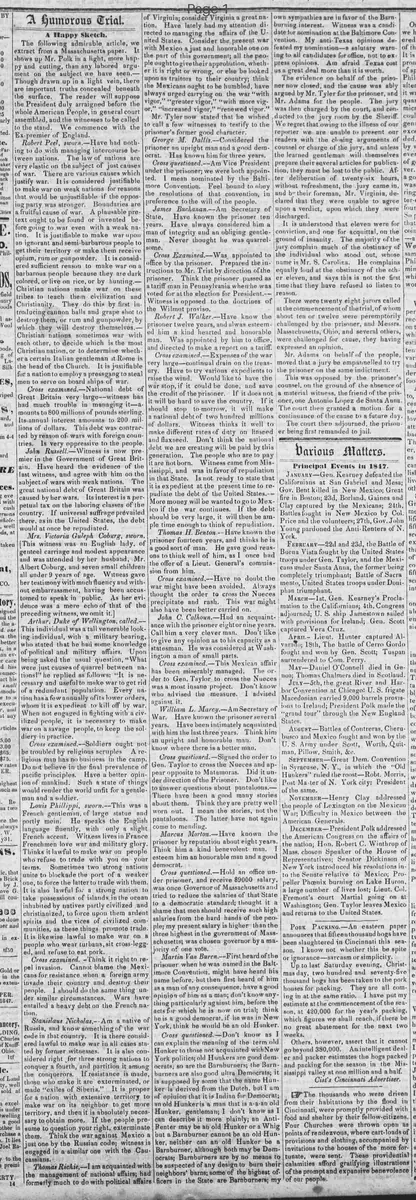
A humorous Trial. A Happy Sketch.
The following admirable article, we extract from a Massachusetts paper. It shows up Mr. Polk in a light, more happy and cutting, than any labored argument on the subject we have seen. Though drawn up in a light vein, there are important truths concealed beneath the surface. The reader will suppose the President duly arraigned before the whole American People, in general court assembled, and the witnesses to be called to the stand. We commence with the Ex-premier of England.
Robert Peel, sworn.--Have had nothing to do with managing intercourse between nations. The law of nations are very elastic on the subject of just causes of war. There are various causes which justify war. It is considered justifiable to make war on weak nations for reasons that would be unjustifiable if the opposing party was stronger. Boundaries are a fruitful cause of war. A plausible pretext ought to be found or invented before going to war even with a weak nation. It is justifiable to make war upon an ignorant and semi-barbarous people to get their territory or make them receive opium, rum or gunpowder. It is considered sufficient reason to make war on a barbarous people because they are dark colored, or live on rice, or by hunting. Christian nations make war on these tribes to teach them civilization and Christianity. They do this by first introducing cannon balls and grape shot to destroy them, or rum and gunpowder, by which they will destroy themselves. Christian nations sometimes war with each other, to decide which is the most Christian nation, or to determine whether a certain Italian gentleman at Rome is the head of the Church. It is justifiable for a nation to employ a pressgang to steal men to serve on board ships of war.
Cross examined.--National debt of Great Britain very large--witness has had much trouble in managing it-amounts to 800 millions of pounds sterling. Its annual interest amounts to 200 millions of dollars. This debt was contracted by reason of wars with foreign countries. Is very oppressive to the people
John Russell.--Witness is now premier in the Government of Great Britain. Have heard the evidence of the last witness, and agree with him on the subject of wars with weak nations. The great national debt of Great Britain was caused by her wars. Its interest is a perpetual tax on the laboring classes of the country. If universal suffrage prevailed there, as in the United States. the debt would at once be repudiated.
Mrs. Victoria Guelph Coburg. sworn. [This witness was an English lady. of genteel carriage and modest appearance and was attended by her husband, Mr. Albert Coburg, and seven small children all under 9 years of age. Witness gave her testimony with much fluency and without embarrassment, having been accustomed to speak in public. As her evidence was a mere echo of that of the preceding witness, we omit it.]
Arthur. Duke of Wellington, called.-- This individual was a tall venerable looking individual, with a military bearing, who stated that he had some knowledge of political and military affairs. Upon being asked the usual question, "What were just causes of quarrel between nations?"he replied as follows: "It is necessary and useful to make war to get rid of a redundant population. Every nation has a few annually of its lower orders, whom it is expedient to kill off by war. When not engaged in fighting with a civilized people, it is necessary to make war on a savage people, to keep the soldiery in practice."
Cross examined.--Soldiers ought not be troubled by religious scruples A religious man has no business in the camp. Do not believe in the final prevalence of pacific principles. Have a better opinion of mankind. Such a state of things would render the world unfit for a gentleman and a soldier.
Louis Phillippi, sworn.--This was a French gentleman, of large stature and portly mien: He speaks the English language fluently, with only a slight French accent. Witness lives in France Frenchmen love war and military glory. Thinks it lawful to make war on people who refuse to trade with you on your terms. Sometimes two strong nations unite to blockade the port of a weaker one, to force the latter to trade with them. It is also lawful for a strong nation to take possessions of islands in the ocean inhabited by natives partly civilized and christianized, to force upon them ardent spirits and the vices of civilized communities, as these things promote trade. It is likewise lawful to make war on a people who wear turbans, sit cross-legged, and refuse to eat pork.
Cross examined. -Think it right to repel invasion. Cannot blame the Mexicans for resistance when a foreign army invade their country and destroy their people. I should do the same thing under similar circumstances. Wars have entailed a heavy debt on the French nation.
Stanislaus Nicholas.--Am a native of Russia, and know something of the war code in that country. It is there considered lawful to make war in all cases stated by former witnesses. It is also considered right for three strong nations to conquer a fourth, and partition it among the conquerors. If resistance is made, those who make it are exterminated, or made "exiles of Siberia," It is proper for a nation with extensive territory to make war on its neighbor to get more territory, and then it is absolutely necessary to obtain more. If the people presume to question your right, exterminate them. Think the war against Mexico a just one by the Russian code; witness is engaged in a similar one with the Caucasians.
Thomas Richie,-I am acquainted with the management of national affairs; had formerly much to do with political affairs of Virginia; consider Virginia a great nation. Have lately had my attention directed to managing the affairs of the United States. Consider the present war with Mexico a just and honorable one on the part of this government; all the people ought to give their approbation. whether it is right or wrong. or else be looked upon as traitors to their country; think the Mexicans ought to be humbled, have always urged carrying on the war "with vigor," "greater vigor," "with more vigor," "increased vigor," "renewed vigor."
Mr. Tyler now stated that he wished to call a few witnesses to testify to the prisoner's former good character.
George M. Dallas.--Considered the prisoner an upright man and a good democrat. Has known him for three years.
Cross questioned,--Am Vice President under the prisoner; we were both appointed. I mean nominated by the Baltimore Convention. Feel bound to obey the resolutions of that convention, in preference to the will of the people.
James Buchanan.--Am Secretary of State, Have known the prisoner ten years. Have always considered him a man of integrity and an obliging gentleman. Never thought he was quarrelsome.
Cross Examined.--Was appointed to office by the prisoner. Prepared the instructions to Mr. Trist by direction of the prisoner. Think the prisoner passed as a tariff man in Pennsylvania when he was voted for at the election for President.-- Witness is opposed to the doctrines of the Wilmot proviso.
Robert J. Walker.--Have known the prisoner twelve years, and always esteemed him a kind hearted and honorable man. Was appointed by him to office, and directed to make a report on a tariff.
Cross examined.--Expenses of the war very large-continual drain on the treasury. Have to try various expedients to raise the wind. Would like to have the war stop,if it could be done, and save the credit of the prisoner. If it does not it will be hard to save the country. If it should stop to-morrow, it will make a national debt of two hundred millions of dollars. Witness thinks it well to make different rates of duty on linseed and flaxseed. Don't think the national debt we are creating will be paid by this generation. The people who are to pay it are not born. Witness came from Mississippi. and was in favor of repudiation in that State. Is not ready to state that it is expedient at the present time to repudiate the debt of the United States.-- More money will be wanted to go to Mexico if the war continues. If the debt should be very large. it will then be ample time enough to think of repudiation.
Thomas H. Benton.--Have known the prisoner fourteen years, and thinks he is a good sort of man. He gave good reasons to think well of him, as I once had the offer of a Lieut. General's commission from him.
Cross examined,--Have no doubt the war might have been avoided. Always thought the order to cross the Nueces precipitate and rash. This war might also have been better carried on.
John C. Calhoun.-Had an acquaintance with the prisoner eight or nine years Call him a very clever man. Don't like to give any opinion as to his capacity as a statesman. He was considered at Washington a man of small parts.
Cross examined.-This Mexican affair has been miserably managed. The order to Gen. Taylor to cross the Nueces was a most insane project. Don't know who advised the measure. I advised against it.
William L. Marcy.-Am Secretary of War, Have known the prisoner several years. Have been intimately acquainted with him the last three years. Think him an upright and honorable man. Don't know where there is a better man.
Cross questioned.-Signed the order to Gen. Taylor to cross the Nueces and appear opposite to Matamoras. Did it under direction of the Prisoner. Don't like to answer questions about pantaloons.- There have been a good many stories about them. Think they are pretty well worn out. I mean the stories, not the pantaloons. The latter have not again come to mending.
Marcus Morton.--Have known the prisoner by reputation about eight years. Think him a kind benevolent man. I esteem him an honorable man and a good democrat.
Cross questioned.-Hold an office under prisoner, and receive $9000 salary. was once Governor of Massachusetts and tried to reduce the salaries of that State to a democratic standard; thought it a shame that men should receive such high salaries from the hard hands of the people; my present salary is higher than the three highest in the government of Massachusetts; was chosen governor by a majority of one vote.
Martin Van Buren.--First heard of the prisoner when he was named in the Baltimore Convention, might have heard his name before. but then first heard of him as a man of any consequence, have a good opinion of him as a man; don't know anything particularly against him, before the acts for which he is now on trial; think he is a good democrat, if he was in New York, think he would be an old Hunker.
Cross questioned.-Don't know as I can explain the meaning of the term old Hunker to those not acquainted with New York politics; old Hunkers are good democrats: so are the Barnburners: the Barnburners are also good ultra Democrats; it is supposed by some that the name Hunker is derived from the Dutch, but I am of opinion that it is Indian for Democrat; an old Hunker is a man that is a-a-an old Hunker, gentleman; I don't know as I can describe it more plainly; an Anti-Renter may be an old Hunker or a Whig but a Barnburner cannot be an old Hunker. neither can an old Hunker be a Barnburner, although both may be Democrats; Barnburners are by no means to be suspected of any design to burn their neighbors'barns; some of the highest of ficers in the State are Barnburners; my own sympathies are in favor of the Barn. burning interest. Witness was a candidate tor nomination at the Baltimore Convention. My anti-Texas opinions defeated my nomination-a salutary warning to all candidates for office, not to express opinions. Am afraid Texas cost us a great deal more than it is worth.
The evidence on behalf of the prisoner now closed, and the cause was ably argued by Mr. Tyler for the prisoner, and Mr. Adams for the people. The jury was then charged by the court, and conducted to the jury room by the Sheriff. We regret that owing to the illness of our reporter we are unable to present our readers with the closing arguments of counsel or charge of the jury, and unless the learned gentleman will themselves prepare their several articles for publication, they must be lost to the public. After deliberation of twenty-six hours, without refreshment, the jury came in, and by their foreman. Mr. Virginia, declared that they were unable to agree upon a verdict, upon which they were discharged.
It is understood that eleven were for conviction, and one for acquittal, on the ground of insanity. The majority of the jury complain much of the obstinacy of the individual who stood out. whose name is Mr. S. Carolina. He complains equally loud at the obstinacy of the other eleven, and says this is not the first time that they have refused to listen to reason,
There were twenty eight jurors called at the commencement of the trial, of whom about ten or twelve were peremptorily challenged by the prisoner, and Messrs. Massachusetts, Ohio, and several others, were challenged for cause, they having expressed an opinion.
Mr. Adams on behalf of the people, moved that a jury be empannelled to try the prisoner on the same indictment. This was opposed by the prisoner's counsel, on the ground of the absence of a material witness. the friend of the prisoner, one Antonio Lopez de Santa Anna. The court then granted a motion for a continuance of the cause to a future day The court then adjourned, the prisoner being first remanded to jail.
The following admirable article, we extract from a Massachusetts paper. It shows up Mr. Polk in a light, more happy and cutting, than any labored argument on the subject we have seen. Though drawn up in a light vein, there are important truths concealed beneath the surface. The reader will suppose the President duly arraigned before the whole American People, in general court assembled, and the witnesses to be called to the stand. We commence with the Ex-premier of England.
Robert Peel, sworn.--Have had nothing to do with managing intercourse between nations. The law of nations are very elastic on the subject of just causes of war. There are various causes which justify war. It is considered justifiable to make war on weak nations for reasons that would be unjustifiable if the opposing party was stronger. Boundaries are a fruitful cause of war. A plausible pretext ought to be found or invented before going to war even with a weak nation. It is justifiable to make war upon an ignorant and semi-barbarous people to get their territory or make them receive opium, rum or gunpowder. It is considered sufficient reason to make war on a barbarous people because they are dark colored, or live on rice, or by hunting. Christian nations make war on these tribes to teach them civilization and Christianity. They do this by first introducing cannon balls and grape shot to destroy them, or rum and gunpowder, by which they will destroy themselves. Christian nations sometimes war with each other, to decide which is the most Christian nation, or to determine whether a certain Italian gentleman at Rome is the head of the Church. It is justifiable for a nation to employ a pressgang to steal men to serve on board ships of war.
Cross examined.--National debt of Great Britain very large--witness has had much trouble in managing it-amounts to 800 millions of pounds sterling. Its annual interest amounts to 200 millions of dollars. This debt was contracted by reason of wars with foreign countries. Is very oppressive to the people
John Russell.--Witness is now premier in the Government of Great Britain. Have heard the evidence of the last witness, and agree with him on the subject of wars with weak nations. The great national debt of Great Britain was caused by her wars. Its interest is a perpetual tax on the laboring classes of the country. If universal suffrage prevailed there, as in the United States. the debt would at once be repudiated.
Mrs. Victoria Guelph Coburg. sworn. [This witness was an English lady. of genteel carriage and modest appearance and was attended by her husband, Mr. Albert Coburg, and seven small children all under 9 years of age. Witness gave her testimony with much fluency and without embarrassment, having been accustomed to speak in public. As her evidence was a mere echo of that of the preceding witness, we omit it.]
Arthur. Duke of Wellington, called.-- This individual was a tall venerable looking individual, with a military bearing, who stated that he had some knowledge of political and military affairs. Upon being asked the usual question, "What were just causes of quarrel between nations?"he replied as follows: "It is necessary and useful to make war to get rid of a redundant population. Every nation has a few annually of its lower orders, whom it is expedient to kill off by war. When not engaged in fighting with a civilized people, it is necessary to make war on a savage people, to keep the soldiery in practice."
Cross examined.--Soldiers ought not be troubled by religious scruples A religious man has no business in the camp. Do not believe in the final prevalence of pacific principles. Have a better opinion of mankind. Such a state of things would render the world unfit for a gentleman and a soldier.
Louis Phillippi, sworn.--This was a French gentleman, of large stature and portly mien: He speaks the English language fluently, with only a slight French accent. Witness lives in France Frenchmen love war and military glory. Thinks it lawful to make war on people who refuse to trade with you on your terms. Sometimes two strong nations unite to blockade the port of a weaker one, to force the latter to trade with them. It is also lawful for a strong nation to take possessions of islands in the ocean inhabited by natives partly civilized and christianized, to force upon them ardent spirits and the vices of civilized communities, as these things promote trade. It is likewise lawful to make war on a people who wear turbans, sit cross-legged, and refuse to eat pork.
Cross examined. -Think it right to repel invasion. Cannot blame the Mexicans for resistance when a foreign army invade their country and destroy their people. I should do the same thing under similar circumstances. Wars have entailed a heavy debt on the French nation.
Stanislaus Nicholas.--Am a native of Russia, and know something of the war code in that country. It is there considered lawful to make war in all cases stated by former witnesses. It is also considered right for three strong nations to conquer a fourth, and partition it among the conquerors. If resistance is made, those who make it are exterminated, or made "exiles of Siberia," It is proper for a nation with extensive territory to make war on its neighbor to get more territory, and then it is absolutely necessary to obtain more. If the people presume to question your right, exterminate them. Think the war against Mexico a just one by the Russian code; witness is engaged in a similar one with the Caucasians.
Thomas Richie,-I am acquainted with the management of national affairs; had formerly much to do with political affairs of Virginia; consider Virginia a great nation. Have lately had my attention directed to managing the affairs of the United States. Consider the present war with Mexico a just and honorable one on the part of this government; all the people ought to give their approbation. whether it is right or wrong. or else be looked upon as traitors to their country; think the Mexicans ought to be humbled, have always urged carrying on the war "with vigor," "greater vigor," "with more vigor," "increased vigor," "renewed vigor."
Mr. Tyler now stated that he wished to call a few witnesses to testify to the prisoner's former good character.
George M. Dallas.--Considered the prisoner an upright man and a good democrat. Has known him for three years.
Cross questioned,--Am Vice President under the prisoner; we were both appointed. I mean nominated by the Baltimore Convention. Feel bound to obey the resolutions of that convention, in preference to the will of the people.
James Buchanan.--Am Secretary of State, Have known the prisoner ten years. Have always considered him a man of integrity and an obliging gentleman. Never thought he was quarrelsome.
Cross Examined.--Was appointed to office by the prisoner. Prepared the instructions to Mr. Trist by direction of the prisoner. Think the prisoner passed as a tariff man in Pennsylvania when he was voted for at the election for President.-- Witness is opposed to the doctrines of the Wilmot proviso.
Robert J. Walker.--Have known the prisoner twelve years, and always esteemed him a kind hearted and honorable man. Was appointed by him to office, and directed to make a report on a tariff.
Cross examined.--Expenses of the war very large-continual drain on the treasury. Have to try various expedients to raise the wind. Would like to have the war stop,if it could be done, and save the credit of the prisoner. If it does not it will be hard to save the country. If it should stop to-morrow, it will make a national debt of two hundred millions of dollars. Witness thinks it well to make different rates of duty on linseed and flaxseed. Don't think the national debt we are creating will be paid by this generation. The people who are to pay it are not born. Witness came from Mississippi. and was in favor of repudiation in that State. Is not ready to state that it is expedient at the present time to repudiate the debt of the United States.-- More money will be wanted to go to Mexico if the war continues. If the debt should be very large. it will then be ample time enough to think of repudiation.
Thomas H. Benton.--Have known the prisoner fourteen years, and thinks he is a good sort of man. He gave good reasons to think well of him, as I once had the offer of a Lieut. General's commission from him.
Cross examined,--Have no doubt the war might have been avoided. Always thought the order to cross the Nueces precipitate and rash. This war might also have been better carried on.
John C. Calhoun.-Had an acquaintance with the prisoner eight or nine years Call him a very clever man. Don't like to give any opinion as to his capacity as a statesman. He was considered at Washington a man of small parts.
Cross examined.-This Mexican affair has been miserably managed. The order to Gen. Taylor to cross the Nueces was a most insane project. Don't know who advised the measure. I advised against it.
William L. Marcy.-Am Secretary of War, Have known the prisoner several years. Have been intimately acquainted with him the last three years. Think him an upright and honorable man. Don't know where there is a better man.
Cross questioned.-Signed the order to Gen. Taylor to cross the Nueces and appear opposite to Matamoras. Did it under direction of the Prisoner. Don't like to answer questions about pantaloons.- There have been a good many stories about them. Think they are pretty well worn out. I mean the stories, not the pantaloons. The latter have not again come to mending.
Marcus Morton.--Have known the prisoner by reputation about eight years. Think him a kind benevolent man. I esteem him an honorable man and a good democrat.
Cross questioned.-Hold an office under prisoner, and receive $9000 salary. was once Governor of Massachusetts and tried to reduce the salaries of that State to a democratic standard; thought it a shame that men should receive such high salaries from the hard hands of the people; my present salary is higher than the three highest in the government of Massachusetts; was chosen governor by a majority of one vote.
Martin Van Buren.--First heard of the prisoner when he was named in the Baltimore Convention, might have heard his name before. but then first heard of him as a man of any consequence, have a good opinion of him as a man; don't know anything particularly against him, before the acts for which he is now on trial; think he is a good democrat, if he was in New York, think he would be an old Hunker.
Cross questioned.-Don't know as I can explain the meaning of the term old Hunker to those not acquainted with New York politics; old Hunkers are good democrats: so are the Barnburners: the Barnburners are also good ultra Democrats; it is supposed by some that the name Hunker is derived from the Dutch, but I am of opinion that it is Indian for Democrat; an old Hunker is a man that is a-a-an old Hunker, gentleman; I don't know as I can describe it more plainly; an Anti-Renter may be an old Hunker or a Whig but a Barnburner cannot be an old Hunker. neither can an old Hunker be a Barnburner, although both may be Democrats; Barnburners are by no means to be suspected of any design to burn their neighbors'barns; some of the highest of ficers in the State are Barnburners; my own sympathies are in favor of the Barn. burning interest. Witness was a candidate tor nomination at the Baltimore Convention. My anti-Texas opinions defeated my nomination-a salutary warning to all candidates for office, not to express opinions. Am afraid Texas cost us a great deal more than it is worth.
The evidence on behalf of the prisoner now closed, and the cause was ably argued by Mr. Tyler for the prisoner, and Mr. Adams for the people. The jury was then charged by the court, and conducted to the jury room by the Sheriff. We regret that owing to the illness of our reporter we are unable to present our readers with the closing arguments of counsel or charge of the jury, and unless the learned gentleman will themselves prepare their several articles for publication, they must be lost to the public. After deliberation of twenty-six hours, without refreshment, the jury came in, and by their foreman. Mr. Virginia, declared that they were unable to agree upon a verdict, upon which they were discharged.
It is understood that eleven were for conviction, and one for acquittal, on the ground of insanity. The majority of the jury complain much of the obstinacy of the individual who stood out. whose name is Mr. S. Carolina. He complains equally loud at the obstinacy of the other eleven, and says this is not the first time that they have refused to listen to reason,
There were twenty eight jurors called at the commencement of the trial, of whom about ten or twelve were peremptorily challenged by the prisoner, and Messrs. Massachusetts, Ohio, and several others, were challenged for cause, they having expressed an opinion.
Mr. Adams on behalf of the people, moved that a jury be empannelled to try the prisoner on the same indictment. This was opposed by the prisoner's counsel, on the ground of the absence of a material witness. the friend of the prisoner, one Antonio Lopez de Santa Anna. The court then granted a motion for a continuance of the cause to a future day The court then adjourned, the prisoner being first remanded to jail.
What sub-type of article is it?
Crime Story
Historical Event
Deception Fraud
What themes does it cover?
Deception
Justice
Misfortune
What keywords are associated?
Mock Trial
Mexican War
President Polk
War Justification
National Debt
Satire
International Hypocrisy
What entities or persons were involved?
James K. Polk
Robert Peel
John Russell
Victoria Guelph Coburg
Arthur Duke Of Wellington
Louis Philippe
Stanislaus Nicholas
Thomas Ritchie
John Tyler
George M. Dallas
James Buchanan
Robert J. Walker
Thomas H. Benton
John C. Calhoun
William L. Marcy
Marcus Morton
Martin Van Buren
John Quincy Adams
Where did it happen?
Before The Whole American People
Story Details
Key Persons
James K. Polk
Robert Peel
John Russell
Victoria Guelph Coburg
Arthur Duke Of Wellington
Louis Philippe
Stanislaus Nicholas
Thomas Ritchie
John Tyler
George M. Dallas
James Buchanan
Robert J. Walker
Thomas H. Benton
John C. Calhoun
William L. Marcy
Marcus Morton
Martin Van Buren
John Quincy Adams
Location
Before The Whole American People
Story Details
A satirical mock trial of President Polk for instigating an unjust war with Mexico. Witnesses from Britain, France, Russia, and U.S. officials provide ironic justifications for wars, highlight national debts, and critique or defend the administration's actions. The jury deadlocks, and the trial is continued.