Thank you for visiting SNEWPapers!
Sign up free
Gazette Of The United States, & Philadelphia Daily Advertiser
Philadelphia, Philadelphia County, Pennsylvania
What is this article about?
On September 4-5, 1795, Paris's Council of Five Hundred debated removing names from a transportation list for conspirators. Normand, Thibaudeau, Doulcet, and Bailly were erased after speeches praising their patriotism and services; others were ordered transported.
Clipping
OCR Quality
Full Text
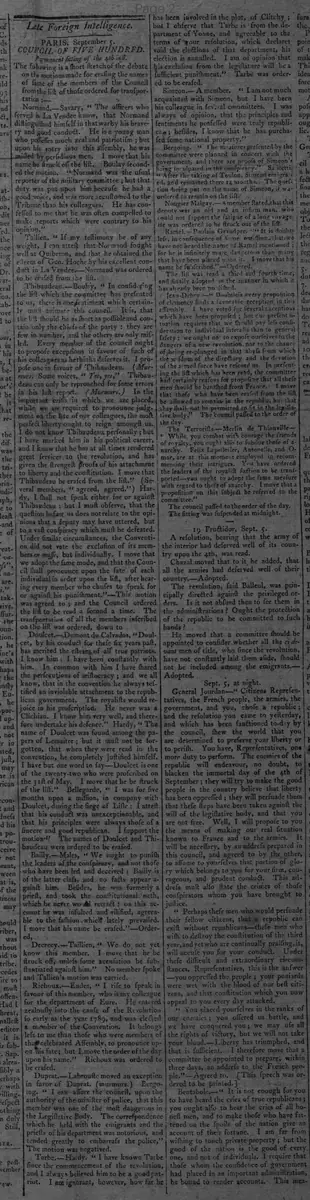
COUNCIL OF FIVE HUNDRED.
Permanent sitting of the 4th inst.
The following is a short sketch of the debate on the motions made for erasing the names of some of the members of the Council from the list of those ordered for transportation:-
Normand. Savary, "The officers who served in La Vendee know, that Normand distinguished himself in that war by his bravery and good conduct. He is a young man who possesses much zeal and patriotism; but upon his entry into this assembly, he was misled by perfidious men. I move that his name be struck off the list." Boissy d'Anglas seconded the motion. "Normand was the usual reporter of the military committee; but that duty was put upon him because he had a good voice, and was more accustomed to the Tribune than his colleagues. He has confessed to me that he was often compelled to make reports which were contrary to his opinion."
Tallien, "If my testimony be of any weight, I can attest that Normand fought well at Quiberon, and that he obtained the esteem of Gen. Hoche by his excellent conduct in La Vendee."—Normand was ordered to be erased from the list.
Thibaudeau.—Boissy d'Anglas, "In considering the list which the committee has presented to us, there is one sentiment which certainly must animate this council. It is, that the list should be as short as possible and contain only the chiefs of the party: they are few in number, and the others are only misled. Every member of the council ought to propose exceptions in favour of such of his colleagues as he thinks deserves it. I propose one in favour of Thibaudeau." (Murmurs. Some voices, "Yes, yes," Thibaudeau can only be reproached for some errors in his last report. (Murmurs.) In the important crisis in which we are placed, while we are required to pronounce judgment on the fate of our colleagues, the most perfect liberty ought to reign amongst us. I do not know Thibaudeau personally; but I have marked him in his political career, and I know that he has at all times rendered great services to the revolution, and has given the strongest proofs of his attachment to liberty and the constitution. I move that Thibaudeau be erased from the list." (Several members, "agreed, agreed.") Hardy, I shall not speak either for or against Thibaudeau: but I must observe, that the question before us does not relate to the opinions that a deputy may have uttered, but to a vast conspiracy which must be defeated. Under similar circumstances, the Convention did not vote the exclusion of its members en masse, but individually. I move that we adopt the same mode, and that the Council shall pronounce upon the fate of each individual in order upon the list, after hearing every member who chooses to speak for or against his punishment."+This motion was agreed to; and the Council ordered the list to be read a second time. The transportation of all the members inscribed on the list was ordered, down to
Doulcet.—Dumont du Calvados, "Doulcet, by his conduct for these six years past, has merited the esteem of all true patriots. I know him: I have been constantly with him. In common with him I have shared the persecutions of aristocracy: and we all know, that in the convention he always testified an inviolable attachment to the republican government. The royalists would rejoice in his proscription. He never was a Clichian. I know him very well, and therefore undertake his defence." Hardy, "The name of Doulcet was found among the papers of Lemaitre; but it must not be forgotten, that when they were read in the convention, he completely justified himself. I have but one word to say—Doulcet is one of the twenty-two who were proscribed on the 31st of May. I move that he be struck off the list." Bellegarde, "I was for five months upon a mission, in company with Doulcet, during the siege of Lille: I attest that his conduct was unexceptionable, and that his principles were always those of a sincere and good republican. I support the motion"—The names of Doulcet and Thibaudeau were ordered to be erased.
Bailly.—Malesherbes, "We ought to punish the leaders of the conspiracy, and not those who have been led and deceived: Bailly is of the latter class, and no facts appear against him. Besides, he was formerly a priest, and took the constitutional oath, which he never would retract: on this account he was insulted and vilified, agreeable to the fashion which lately prevailed. I move that his name be erased."—Ordered.
What sub-type of article is it?
What keywords are associated?
What entities or persons were involved?
Where did it happen?
Foreign News Details
Primary Location
Paris
Event Date
Permanent Sitting Of The 4th Inst.
Key Persons
Outcome
normand, thibaudeau, doulcet, and bailly were ordered to be erased from the transportation list; the transportation of all other members inscribed on the list was ordered.
Event Details
The Council of Five Hundred held a permanent sitting on the 4th inst., debating motions to erase names from a list of members ordered for transportation due to a conspiracy. Defenses were made for Normand, highlighting his bravery in La Vendee and Quiberon; for Thibaudeau, noting his services to the revolution; for Doulcet, citing his republican attachment and prior proscription; and for Bailly, as a deceived former priest. Hardy's motion to vote on each individual was agreed to, and the list was read again.