Thank you for visiting SNEWPapers!
Sign up free
Letter to Editor
October 31, 1815
Daily National Intelligencer
Washington, District Of Columbia
What is this article about?
Morris Birkbeck writes to Henry Grattan, criticizing his support for the war against Napoleon following the Battle of Waterloo. He argues that the victory, restoring Louis XVIII, will ultimately advance freedom despite the devastation, taxation, and loss of life it causes, drawing on historical precedents of liberty prevailing over tyranny.
Clipping
OCR Quality
95%
Excellent
Full Text
FROM COBBETT'S WEEKLY REGISTER JULY 29.
TO THE RIGHT HON. H. GRATTAN.
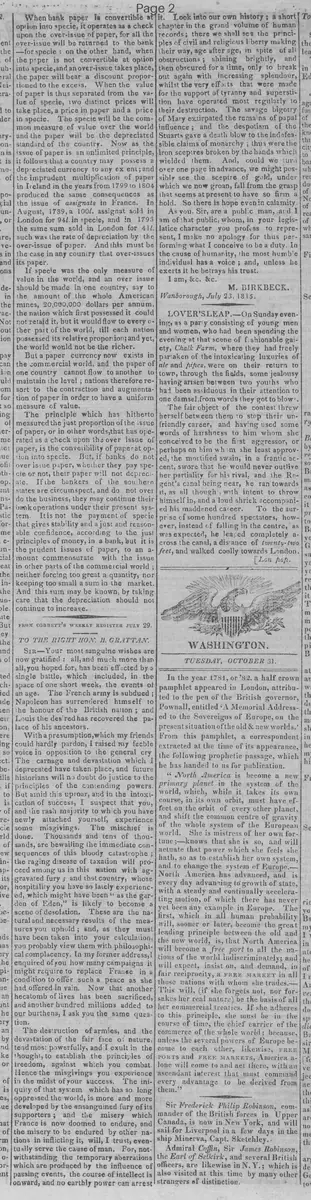
SIR—Your most sanguine wishes are now gratified: all, and much more than all, you hoped for, has been effected by a single battle, which included, in the space of one short week, the events of an age. The French army is subdued; Napoleon has surrendered himself to the honour of the British nation; and Louis the desired has recovered the palace of his ancestors.
With a presumption, which my friends could hardly pardon, I raised my feeble voice in opposition to the general cry. The carnage and devastation which I deprecated have taken place, and future historians will no doubt do justice to the principles of the contending powers.
But amid this uproar, and in the intoxication of success, I suspect that you, and the rash majority to which you have newly attached yourself, experience some misgivings. The mischief is done. Thousands and tens of thousands, are bewailing the immediate consequences of this bloody catastrophe; the raging disease of taxation will proceed among us in this nation with aggravated fury; and that country, whose hospitality you have so lately experienced, which might have been "as the garden of Eden," is likely to become a scene of desolation. These are the natural and necessary results of the measures you uphold; and, as they must have been taken into your calculation, you probably view them with philosophical complacency. In my former address, I enquired of you how many campaigns it might require to replace France in a condition to offer such a peace as she had offered in vain. Now that another hecatomb of lives has been sacrificed, and another hundred millions added to our burthens, I ask you the same question.
The destruction of armies, and the devastation of the fair face of nature, tend most powerfully, and I exult in the thought, to establish the principles of freedom, against which you combat. Hence the misgivings you experience in the midst of your success. The iniquity of that system which has so long oppressed the world, is more and more developed by the ensanguined fury of its supporters; and the misery which France is now doomed to endure, and the misery to be endured by other nations in inflicting it, will, I trust, eventually serve the cause of man. For, notwithstanding the temporary aberrations which are produced by the influence of passing events, the course of intellect is onward, and no earthly power can arrest it. Look into our own history; a short chapter in the grand volume of human records; there we shall see the principles of civil and religious liberty making their way, age after age, in spite of all obstructions; shining brightly, and then obscured for a time, only to break out again with increasing splendour, whilst the very efforts that were made for the support of tyranny and superstition have operated most regularly to their destruction. The savage bigotry of Mary extirpated the remains of papal influence; and the despotism of the Stuarts gave a death blow to the indefeasible claims of monarchy; thus were the iron sceptres broken by the hands which wielded them. And, could we turn over one page in advance, we might possibly see the sceptre of gold, under which we now groan, fall from the grasp that seems at present to have so firm a hold. So there is hope even in calamity.
As you, Sir, are a public man, and I am of that public, whom, in your legislative character you profess to represent, I make no apology for thus performing what I conceive to be a duty. In the cause of humanity, the most humble individual has a voice: and, unless he exerts it he betrays his trust.
I am, &c. &c.
M. BIRKBECK.
Wanborough, July 23, 1815.
TO THE RIGHT HON. H. GRATTAN.
SIR—Your most sanguine wishes are now gratified: all, and much more than all, you hoped for, has been effected by a single battle, which included, in the space of one short week, the events of an age. The French army is subdued; Napoleon has surrendered himself to the honour of the British nation; and Louis the desired has recovered the palace of his ancestors.
With a presumption, which my friends could hardly pardon, I raised my feeble voice in opposition to the general cry. The carnage and devastation which I deprecated have taken place, and future historians will no doubt do justice to the principles of the contending powers.
But amid this uproar, and in the intoxication of success, I suspect that you, and the rash majority to which you have newly attached yourself, experience some misgivings. The mischief is done. Thousands and tens of thousands, are bewailing the immediate consequences of this bloody catastrophe; the raging disease of taxation will proceed among us in this nation with aggravated fury; and that country, whose hospitality you have so lately experienced, which might have been "as the garden of Eden," is likely to become a scene of desolation. These are the natural and necessary results of the measures you uphold; and, as they must have been taken into your calculation, you probably view them with philosophical complacency. In my former address, I enquired of you how many campaigns it might require to replace France in a condition to offer such a peace as she had offered in vain. Now that another hecatomb of lives has been sacrificed, and another hundred millions added to our burthens, I ask you the same question.
The destruction of armies, and the devastation of the fair face of nature, tend most powerfully, and I exult in the thought, to establish the principles of freedom, against which you combat. Hence the misgivings you experience in the midst of your success. The iniquity of that system which has so long oppressed the world, is more and more developed by the ensanguined fury of its supporters; and the misery which France is now doomed to endure, and the misery to be endured by other nations in inflicting it, will, I trust, eventually serve the cause of man. For, notwithstanding the temporary aberrations which are produced by the influence of passing events, the course of intellect is onward, and no earthly power can arrest it. Look into our own history; a short chapter in the grand volume of human records; there we shall see the principles of civil and religious liberty making their way, age after age, in spite of all obstructions; shining brightly, and then obscured for a time, only to break out again with increasing splendour, whilst the very efforts that were made for the support of tyranny and superstition have operated most regularly to their destruction. The savage bigotry of Mary extirpated the remains of papal influence; and the despotism of the Stuarts gave a death blow to the indefeasible claims of monarchy; thus were the iron sceptres broken by the hands which wielded them. And, could we turn over one page in advance, we might possibly see the sceptre of gold, under which we now groan, fall from the grasp that seems at present to have so firm a hold. So there is hope even in calamity.
As you, Sir, are a public man, and I am of that public, whom, in your legislative character you profess to represent, I make no apology for thus performing what I conceive to be a duty. In the cause of humanity, the most humble individual has a voice: and, unless he exerts it he betrays his trust.
I am, &c. &c.
M. BIRKBECK.
Wanborough, July 23, 1815.
What sub-type of article is it?
Persuasive
Political
Reflective
What themes does it cover?
Politics
Military War
Constitutional Rights
What keywords are associated?
Napoleon Surrender
Waterloo Victory
Bourbon Restoration
War Devastation
Taxation Burdens
Principles Of Freedom
British History
Political Opposition
What entities or persons were involved?
M. Birkbeck
The Right Hon. H. Grattan
Letter to Editor Details
Author
M. Birkbeck
Recipient
The Right Hon. H. Grattan
Main Argument
the recent victory over napoleon fulfills grattan's wishes but at great cost in lives and taxation; however, the destruction will ultimately advance principles of freedom against tyranny, as history shows liberty prevailing despite oppression.
Notable Details
Napoleon Has Surrendered To The British
Louis The Desired Has Recovered The Palace Of His Ancestors
Reference To France As 'The Garden Of Eden' Now To Become Desolation
Historical Examples: Mary's Bigotry, Stuarts' Despotism
Hope That Current 'Sceptre Of Gold' Will Fall