Thank you for visiting SNEWPapers!
Sign up free
Editorial
September 15, 1815
Daily National Intelligencer
Washington, District Of Columbia
What is this article about?
An editorial republishes a Vermont address urging voters to elect representatives based on their patriotic conduct during the recent war, contrasting them with the opposition's disloyal actions, to aid Maryland's upcoming state election.
Clipping
OCR Quality
98%
Excellent
Full Text
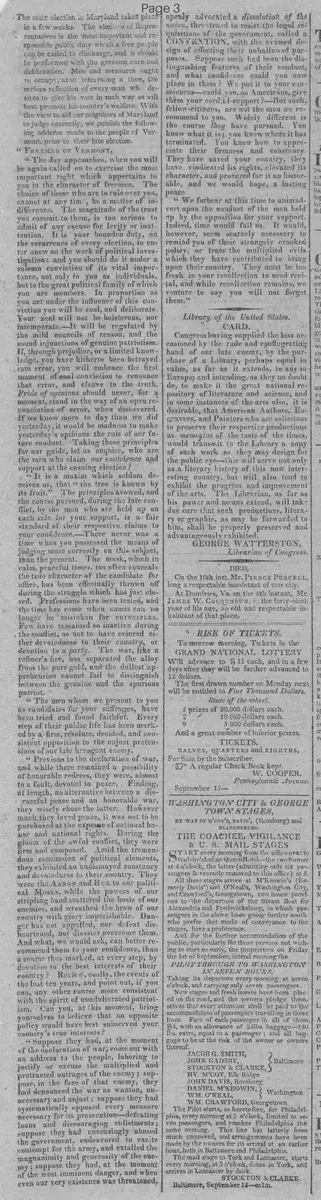
The state election in Maryland takes place in a few weeks. The election of Representatives is the most important and responsible public duty which a free people can be called to discharge, and it should be performed with the greatest care and deliberation. Men and measures ought to occupy, at so interesting a time, the serious reflection of every man who desires to give his vote in such way as will best promote his country's welfare. With the view to aid our neighbors of Maryland to judge correctly, we publish the following address made to the people of Vermont, prior to their late election.
"FREEMEN OF VERMONT,
The day approaches, when you will be again called on to exercise the most important right which appertains to you in the character of freemen. The choice of those who are to rule over you, cannot at any time, be a matter of indifference. The magnitude of the trust you commit to them, is too serious to admit of any excuse for levity or inattention. It is your bounden duty, on the recurrence of every election, to enter anew on the work of political investigation: and you should do it under a solemn conviction of its vital importance, not only to you as individuals, but to the great political family of which you are members. In proportion as you act under the influence of this conviction you will be cool, and deliberate. Your zeal will not be boisterous, nor intemperate. It will be regulated by the mild councils of reason, and the sound injunctions of genuine patriotism. If, through prejudice, or a limited knowledge, you have hitherto been betrayed into error, you will embrace the first moment of cool conviction to renounce that error, and cleave to the truth. Pride of opinions should never, for a moment, stand in the way of an open renunciation of error, when discovered. If we know more today than we did yesterday, it would be madness to make yesterday's opinions the rule of our future conduct." Taking these principles for our guide, let us enquire, who are the men who claim our confidence and support at the ensuing election?
It is a maxim which seldom deceives us, that "the tree is known by its fruit." The principles avowed, and the course pursued, during the late conflict, by the men who are held up on each side for your support, is a fair standard of their respective claims to your confidence. There never was a time when you possessed the means of judging more correctly on this subject than the present. The mask, which in calm, peaceful times, too often conceals the true character of the candidate for office, has been effectually thrown off during the struggle which has just closed. Professions have been tested, and the time has come when names can no longer be mistaken for principles. Few have remained so inactive during the conflict, as not to have evinced either devotedness to their country, or devotion to a party. The war, like a refiner's fire, has separated the alloy from the pure gold, and the dullest apprehension cannot fail to distinguish between the genuine and the spurious patriot.
"The men whom we present to you as candidates for your suffrages, have been tried and found faithful. Every step of their public life has been marked by a firm, resolute, decided, and consistent opposition to the unjust pretensions of our late arrogant enemy.
"Previous to the declaration of war, and while there remained a possibility of honorable redress, they were, almost to a fault, devoted to peace. Finding, at length, no alternative between a disgraceful peace and an honorable war, they wisely chose the latter. However much they loved peace, it was not to be purchased at the expense of national honor and national rights. During the gloom of the awful conflict, they were firm and composed. Amid the tremendous concussion of political elements, they exhibited an undismayed constancy and devotedness to their country. They were the Aaron and Hur to our political Moses, while the powers of our stripling band scattered the hosts of our enemies, and wreathed the brow of our country with glory imperishable. Danger has not appalled, nor defeat disheartened, nor disaster overcome them. And what, we would ask, can better recommend them to your confidence, than a course thus marked, at every step, by devotion to the best interests of their country? Review, coolly, the events of the last ten years, and point out, if you can, any other course more consistent with the spirit of unadulterated patriotism. Can you, at this moment, bring yourselves to believe that an opposite policy would have best subserved your country's true interests?
Suppose they had, at the moment of the declaration of war, come out with an address to the people, laboring to justify or excuse the multiplied and protracted outrages of the enemy; suppose, in the face of that enemy, they had denounced the war as wanton, unnecessary and unjust; suppose they had systematically opposed every measure necessary for its prosecution—defeating loans and discouraging enlistments; suppose they had unceasingly abused the government, endeavored to excite contempt for the army, and extolled the magnanimity and generosity of the enemy; suppose they had, at the moment of the most imminent danger, and when even our very existence was threatened, openly advocated a dissolution of the union, threatened to resist the legal requisitions of the government, called a CONVENTION, with the avowed design of effecting their unallowed purposes. Suppose such had been the distinguishing features of their conduct, and what confidence could you now place in them? We put it to your consciences—could you, as Americans, give them your cordial support? But such, fellow-citizens, are not the men we recommend to you. Widely different is the course they have pursued. You know what it is; you know where it has terminated. You know how to appreciate their firmness and constancy. They have saved your country, they have vindicated its rights, elevated its character, and procured for it an honorable, and we would hope, a lasting peace.
"We forbear at this time to animadvert upon the conduct of the men held up by the opposition for your support. Indeed, time would fail us. It would, however, seem scarcely necessary to remind you of their strangely crooked policy, or trace the multiplied evils which they have contributed to bring upon their country. They must be too fresh in your recollection to need recital, and while recollection remains, we venture to say you will not forget them."
"FREEMEN OF VERMONT,
The day approaches, when you will be again called on to exercise the most important right which appertains to you in the character of freemen. The choice of those who are to rule over you, cannot at any time, be a matter of indifference. The magnitude of the trust you commit to them, is too serious to admit of any excuse for levity or inattention. It is your bounden duty, on the recurrence of every election, to enter anew on the work of political investigation: and you should do it under a solemn conviction of its vital importance, not only to you as individuals, but to the great political family of which you are members. In proportion as you act under the influence of this conviction you will be cool, and deliberate. Your zeal will not be boisterous, nor intemperate. It will be regulated by the mild councils of reason, and the sound injunctions of genuine patriotism. If, through prejudice, or a limited knowledge, you have hitherto been betrayed into error, you will embrace the first moment of cool conviction to renounce that error, and cleave to the truth. Pride of opinions should never, for a moment, stand in the way of an open renunciation of error, when discovered. If we know more today than we did yesterday, it would be madness to make yesterday's opinions the rule of our future conduct." Taking these principles for our guide, let us enquire, who are the men who claim our confidence and support at the ensuing election?
It is a maxim which seldom deceives us, that "the tree is known by its fruit." The principles avowed, and the course pursued, during the late conflict, by the men who are held up on each side for your support, is a fair standard of their respective claims to your confidence. There never was a time when you possessed the means of judging more correctly on this subject than the present. The mask, which in calm, peaceful times, too often conceals the true character of the candidate for office, has been effectually thrown off during the struggle which has just closed. Professions have been tested, and the time has come when names can no longer be mistaken for principles. Few have remained so inactive during the conflict, as not to have evinced either devotedness to their country, or devotion to a party. The war, like a refiner's fire, has separated the alloy from the pure gold, and the dullest apprehension cannot fail to distinguish between the genuine and the spurious patriot.
"The men whom we present to you as candidates for your suffrages, have been tried and found faithful. Every step of their public life has been marked by a firm, resolute, decided, and consistent opposition to the unjust pretensions of our late arrogant enemy.
"Previous to the declaration of war, and while there remained a possibility of honorable redress, they were, almost to a fault, devoted to peace. Finding, at length, no alternative between a disgraceful peace and an honorable war, they wisely chose the latter. However much they loved peace, it was not to be purchased at the expense of national honor and national rights. During the gloom of the awful conflict, they were firm and composed. Amid the tremendous concussion of political elements, they exhibited an undismayed constancy and devotedness to their country. They were the Aaron and Hur to our political Moses, while the powers of our stripling band scattered the hosts of our enemies, and wreathed the brow of our country with glory imperishable. Danger has not appalled, nor defeat disheartened, nor disaster overcome them. And what, we would ask, can better recommend them to your confidence, than a course thus marked, at every step, by devotion to the best interests of their country? Review, coolly, the events of the last ten years, and point out, if you can, any other course more consistent with the spirit of unadulterated patriotism. Can you, at this moment, bring yourselves to believe that an opposite policy would have best subserved your country's true interests?
Suppose they had, at the moment of the declaration of war, come out with an address to the people, laboring to justify or excuse the multiplied and protracted outrages of the enemy; suppose, in the face of that enemy, they had denounced the war as wanton, unnecessary and unjust; suppose they had systematically opposed every measure necessary for its prosecution—defeating loans and discouraging enlistments; suppose they had unceasingly abused the government, endeavored to excite contempt for the army, and extolled the magnanimity and generosity of the enemy; suppose they had, at the moment of the most imminent danger, and when even our very existence was threatened, openly advocated a dissolution of the union, threatened to resist the legal requisitions of the government, called a CONVENTION, with the avowed design of effecting their unallowed purposes. Suppose such had been the distinguishing features of their conduct, and what confidence could you now place in them? We put it to your consciences—could you, as Americans, give them your cordial support? But such, fellow-citizens, are not the men we recommend to you. Widely different is the course they have pursued. You know what it is; you know where it has terminated. You know how to appreciate their firmness and constancy. They have saved your country, they have vindicated its rights, elevated its character, and procured for it an honorable, and we would hope, a lasting peace.
"We forbear at this time to animadvert upon the conduct of the men held up by the opposition for your support. Indeed, time would fail us. It would, however, seem scarcely necessary to remind you of their strangely crooked policy, or trace the multiplied evils which they have contributed to bring upon their country. They must be too fresh in your recollection to need recital, and while recollection remains, we venture to say you will not forget them."
What sub-type of article is it?
Partisan Politics
War Or Peace
What keywords are associated?
State Election
Maryland
Vermont
Representatives
War Conduct
Patriotism
Opposition
Honorable Peace
What entities or persons were involved?
Freemen Of Vermont
Candidates For Suffrages
Opposition
Our Late Arrogant Enemy
The Government
The Army
Editorial Details
Primary Topic
Urging Election Of Patriotic Candidates Based On War Conduct
Stance / Tone
Strongly Supportive Of Pro War Candidates, Critical Of Opposition
Key Figures
Freemen Of Vermont
Candidates For Suffrages
Opposition
Our Late Arrogant Enemy
The Government
The Army
Key Arguments
Election Of Representatives Is A Vital Duty Requiring Careful Deliberation
Judge Candidates By Their Conduct During The Recent War
Recommended Candidates Showed Firm Opposition To The Enemy And Devotion To Country
They Supported Honorable War Over Disgraceful Peace
Opposition Justified Enemy Outrages, Opposed War Measures, And Threatened Union Dissolution
Recommended Candidates Saved The Country And Secured Honorable Peace