Thank you for visiting SNEWPapers!
Sign up free
Editorial
August 28, 1900
The Saint Paul Globe
Saint Paul, Ramsey County, Minnesota
What is this article about?
Editorial discusses debate in North American Review between Prof. J. R. Straton and Booker T. Washington on whether education, especially industrial, will solve the U.S. race question for Southern negroes post-slavery. The piece leans skeptical, highlighting Straton's arguments on limited progress and Washington's pleas for charity.
Clipping
OCR Quality
95%
Excellent
Full Text
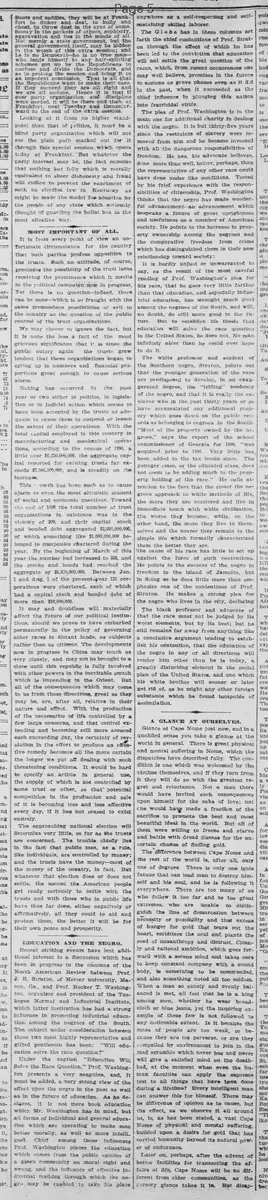
EDUCATION AND THE NEGRO,
Recent striking events have lent additional interest to a discussion which has been in progress in the columns of the North American Review between Prof. J. R. Straton, of Mercer university, Macon, Ga., and Prof. Booker T. Washington, organizer and president of the Tuskegee Normal and Industrial Institute, which latter institution has had a strong influence in promoting industrial education among the negroes of the South. The subject under consideration between these two most highly representative and gifted gentlemen has been: "Will education solve the race question?"
Under the caption "Education Will Solve the Race Question," Prof. Washington presents a very sanguine, and, it must be added, a very strong view of the effect upon the negro in the past as well as in the future of education. As he declares, it is not mere book education which Mr. Washington has in mind, but all forms of individual and general education which are operating to make men better morally, as well as more intelligent. Chief among those influences Prof. Washington places the education which comes from the public opinion of a given community on moral right and wrong, and the influence of effective industrial training through which the negro may be enabled to take his place anywhere as a self-respecting and self-sustaining skilled laborer.
The Globe has in these columns set forth the chief contentions of Prof. Straton through the effect of which he has been led to the conviction that education will not settle the great question of the races, which, from recent occurrences one may well believe, promises in the future to assume as grave phases even as it did in the past, when it succeeded as the chief influence in plunging this nation into fratricidal strife.
The plea of Prof. Washington is in the main one for additional charity in dealing with the negro. It is but thirty-five years since the restraints of slavery were removed from him and he became invested with all the dangerous responsibilities of freedom. He has, his advocate believes, done more than well, better, perhaps, than the representative of any other race could have done under like conditions. Tested by his brief experience with the responsibilities of citizenship, Prof. Washington thinks that the negro has made wonderful advancement-an advancement which bespeaks a future of great uprightness and usefulness as a member of American society. He points to the increase in property ownership among the negroes and the comparative freedom from crime which has distinguished them in their new relationship toward society:
It is hardly unjust or unwarranted to say, as the result of the most careful reading of Prof. Washington's plea for his race, that he goes very little farther than that education, and especially industrial education, has wrought much good among the negroes of the South, and will, no doubt, do still more good in the future. But to establish his thesis that education will solve the race question in the United States, he does not. No man infinitely abler than he could ever hope to do it.
The white professor and student of the Southern negro, Straton, points out that the younger generation of the race are predisposed to develop, in an exaggerated degree, the trifling tendency of the negro, and that it is really the ex-slaves who in the past thirty years or so have accumulated any additional property which goes down on the public records as belonging to negroes in the South. "Most of the property owned by the negroes," says the report of the school commissioner of Georgia for 1898, was acquired prior to 1880. Very little has been added to the tax books since. The younger class, or the educated class, does not seem to be adding much to the property holding of the race." He calls attention to the fact that the closer the negroes approach to white methods of life the more they are scattered and live in immediate touch with white civilization, the worse they become; while, on the other hand, the more they live to themselves and the nearer they remain to the simple life which formerly characterized them the better they are.
The black professor and advocate of the cause of his race has little to set up against the force of such contentions. He points to the success of the negro in freedom in the island of Jamaica, but in doing so he does little more than emphasize one of the contentions of Prof. Straton. He makes a strong plea for the negro who lives in the city, declaring that the race must not be judged by its worst elements, but by its best; but he still remains far away from anything like a conclusive argument tending to establish his contention, that the education of the negro in any or all directions will render him other than he is today, a greatly disturbing element in the social plan of the United States, and one which his white brother will sooner or later get rid of, as he might any other foreign substance which he found incapable of assimilation.
Recent striking events have lent additional interest to a discussion which has been in progress in the columns of the North American Review between Prof. J. R. Straton, of Mercer university, Macon, Ga., and Prof. Booker T. Washington, organizer and president of the Tuskegee Normal and Industrial Institute, which latter institution has had a strong influence in promoting industrial education among the negroes of the South. The subject under consideration between these two most highly representative and gifted gentlemen has been: "Will education solve the race question?"
Under the caption "Education Will Solve the Race Question," Prof. Washington presents a very sanguine, and, it must be added, a very strong view of the effect upon the negro in the past as well as in the future of education. As he declares, it is not mere book education which Mr. Washington has in mind, but all forms of individual and general education which are operating to make men better morally, as well as more intelligent. Chief among those influences Prof. Washington places the education which comes from the public opinion of a given community on moral right and wrong, and the influence of effective industrial training through which the negro may be enabled to take his place anywhere as a self-respecting and self-sustaining skilled laborer.
The Globe has in these columns set forth the chief contentions of Prof. Straton through the effect of which he has been led to the conviction that education will not settle the great question of the races, which, from recent occurrences one may well believe, promises in the future to assume as grave phases even as it did in the past, when it succeeded as the chief influence in plunging this nation into fratricidal strife.
The plea of Prof. Washington is in the main one for additional charity in dealing with the negro. It is but thirty-five years since the restraints of slavery were removed from him and he became invested with all the dangerous responsibilities of freedom. He has, his advocate believes, done more than well, better, perhaps, than the representative of any other race could have done under like conditions. Tested by his brief experience with the responsibilities of citizenship, Prof. Washington thinks that the negro has made wonderful advancement-an advancement which bespeaks a future of great uprightness and usefulness as a member of American society. He points to the increase in property ownership among the negroes and the comparative freedom from crime which has distinguished them in their new relationship toward society:
It is hardly unjust or unwarranted to say, as the result of the most careful reading of Prof. Washington's plea for his race, that he goes very little farther than that education, and especially industrial education, has wrought much good among the negroes of the South, and will, no doubt, do still more good in the future. But to establish his thesis that education will solve the race question in the United States, he does not. No man infinitely abler than he could ever hope to do it.
The white professor and student of the Southern negro, Straton, points out that the younger generation of the race are predisposed to develop, in an exaggerated degree, the trifling tendency of the negro, and that it is really the ex-slaves who in the past thirty years or so have accumulated any additional property which goes down on the public records as belonging to negroes in the South. "Most of the property owned by the negroes," says the report of the school commissioner of Georgia for 1898, was acquired prior to 1880. Very little has been added to the tax books since. The younger class, or the educated class, does not seem to be adding much to the property holding of the race." He calls attention to the fact that the closer the negroes approach to white methods of life the more they are scattered and live in immediate touch with white civilization, the worse they become; while, on the other hand, the more they live to themselves and the nearer they remain to the simple life which formerly characterized them the better they are.
The black professor and advocate of the cause of his race has little to set up against the force of such contentions. He points to the success of the negro in freedom in the island of Jamaica, but in doing so he does little more than emphasize one of the contentions of Prof. Straton. He makes a strong plea for the negro who lives in the city, declaring that the race must not be judged by its worst elements, but by its best; but he still remains far away from anything like a conclusive argument tending to establish his contention, that the education of the negro in any or all directions will render him other than he is today, a greatly disturbing element in the social plan of the United States, and one which his white brother will sooner or later get rid of, as he might any other foreign substance which he found incapable of assimilation.
What sub-type of article is it?
Education
Social Reform
Slavery Abolition
What keywords are associated?
Education
Negro
Race Question
Industrial Training
Booker T Washington
Straton
Slavery Aftermath
Southern Negroes
What entities or persons were involved?
Prof. J. R. Straton
Prof. Booker T. Washington
Tuskegee Normal And Industrial Institute
Mercer University
Negroes Of The South
Editorial Details
Primary Topic
Debate On Whether Education Solves The Race Question
Stance / Tone
Skeptical Of Education Solving Race Issues, Supportive Of Charity But Critical Of Washington's Thesis
Key Figures
Prof. J. R. Straton
Prof. Booker T. Washington
Tuskegee Normal And Industrial Institute
Mercer University
Negroes Of The South
Key Arguments
Education, Especially Industrial, Has Improved Negroes Morally And Economically
Negroes Have Advanced Remarkably In 35 Years Post Slavery
Property Ownership And Low Crime Rates Show Progress
Younger Educated Negroes Not Adding To Property Holdings
Negroes Closer To White Life Become Worse, Better In Isolation
Education Cannot Fully Solve The Race Question
Judge Race By Best Elements, Not Worst