Thank you for visiting SNEWPapers!
Sign up free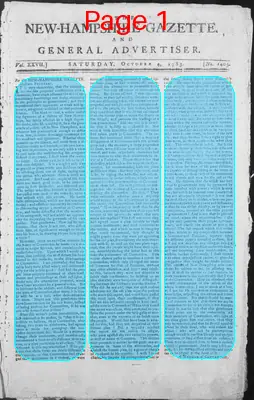
The New Hampshire Gazette And General Advertiser
Portsmouth, Exeter, Rockingham County, New Hampshire
What is this article about?
A member of the New Hampshire Convention defends its decision to recommend an alternative constitutional plan with a President instead of a Governor, refuting accusations of inconsistency by 'A Citizen of New Hampshire' and highlighting public returns and changes in membership as reasons for the shift, while criticizing the opponent's arrogance and misrepresentations.
Clipping
OCR Quality
Full Text
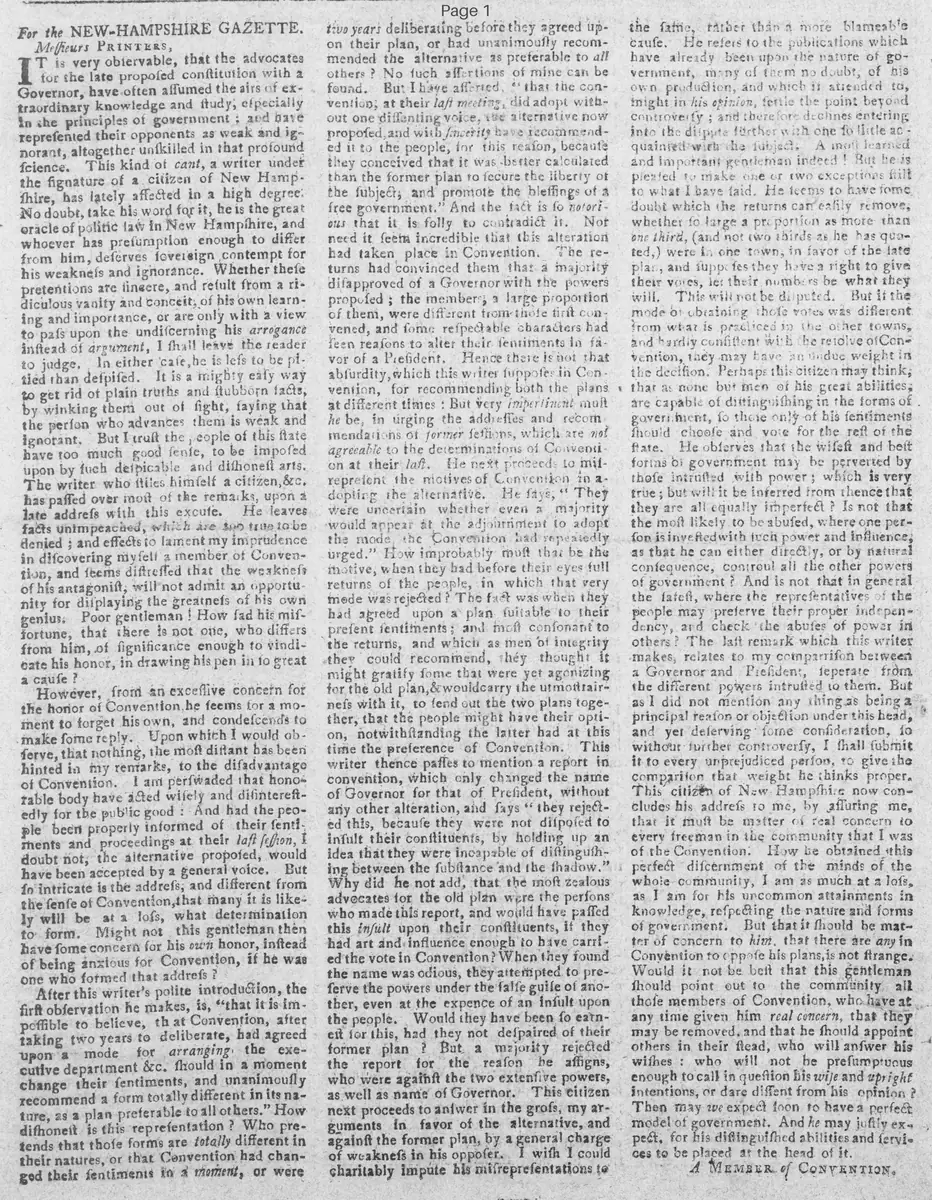
Messrs. Printers,
It is very observable, that the advocates for the late proposed constitution with a Governor, have often assumed the airs of extraordinary knowledge and study, especially in the principles of government: and have represented their opponents as weak and ignorant, altogether unskilled in that profound science. This kind of cant, a writer under the signature of a citizen of New Hampshire, has lately affected in a high degree: No doubt, take his word for it, he is the great oracle of politic law in New Hampshire, and whoever has presumption enough to differ from him, deserves sovereign contempt for his weakness and ignorance. Whether these pretensions are sincere, and result from a ridiculous vanity and conceit, of his own learning and importance, or are only with a view to pass upon the undiscern ing his arrogance instead of argument. I shall leave the reader to judge. In either case, he is less to be pitied than despised. It is a mighty easy way to get rid of plain truths and stubborn facts, by winking them out of sight, saying that the person who advances them is weak and ignorant. But I trust the people of this state have too much good sense, to be imposed upon by such despicable and dishonest arts.
The writer who styles himself a citizen, &c. has passed over most of the remarks, upon a late address with this excuse. He leaves facts unimpeached, which are too true to be denied: and affects to lament my imprudence in discovering myself a member of Convention. and seems distressed that the weakness of his antagonist; will not admit an opportunity for displaying the greatness of his own genius. Poor gentleman! How sad his misfortune, that there is not one, who differs from him. of significance enough to vindicate his honor, in drawing his pen in so great a cause?
However, from an excessive concern for the honor of Convention, he seems for a moment to forget his own, and condescends to make some reply. Upon which I would observe, that nothing, the most distant has been hinted in my remarks, to the disadvantage of Convention. I am persuaded that honorable body have acted wisely and disinterestedly for the public good: And had the people been properly informed of their sentiments and proceedings at their last session. I doubt not; the alternative proposed, would have been accepted by a general voice. But so intricate is the address; and different from the sense of Convention, that many it is likely will be at a loss, what determination to form. Might not this gentleman then have some concern for his own honor, instead of being anxious for Convention, if he was one who formed that address?
After this writer's polite introduction, the first observation he makes, is, "that it is impossible to believe, that Convention, after taking two years to deliberate, had agreed upon a mode for arranging the executive department &c. should in a moment change their sentiments, and unanimously recommend a form totally different in its nature, as a plan preferable to all others." How dishonest is this representation? Who pretends that those forms are totally different in their natures, or that Convention had changed their sentiments in a moment, or were two years deliberating before they agreed upon their plan, or had unanimously recommended the alternative as preferable to all others? No such assertions of mine can be found. But I have asserted, "that the convention, at their last meeting, did adopt without one dissenting voice, the alternative now proposed, and with sincerity have recommended it to the people, for this reason, because they conceived that it was better calculated than the former plan to secure the liberty of the subject: and promote the blessings of a free government." And the fact is so notorious that it is folly to contradict it. Nor need it seem incredible that this alteration had taken place in Convention. The returns had convinced them that a majority disapproved of a Governor with the powers proposed; the members, a large proportion of them, were different from those first convened, and some respectable characters had seen reasons to alter their sentiments in favor of a President. Hence there is not that absurdity, which this writer supposes in Convention, for recommending both the plans at different times: But very impertinent must he be, in urging the address and recommendations of former sessions, which are not agreeable to the determinations of Convention at their last. He next proceeds to misrepresent the motives of Convention in adopting the alternative. He says, "They were uncertain whether even a majority would appear at the adjournment to adopt the mode, the Convention had repeatedly urged." How improbably must that be the motive, when they had before their eyes full returns of the people, in which that very mode was rejected? The fact was when they had agreed upon a plan suitable to their present sentiments; and most consonant to the returns, and which as men of integrity they could recommend, they thought it might gratify some that were yet agonizing for the old plan, & would carry the utmost fairness with it, to send out the two plans together, that the people might have their option, notwithstanding the latter had at this time the preference of Convention. This writer thence passes to mention a report in convention, which only changed the name of Governor for that of President, without any other alteration, and says "they rejected this, because they were not disposed to insult their constituents, by holding up an idea that they were incapable of distinguishing between the substance and the shadow." Why did he not add, that the most zealous advocates for the old plan were the persons who made this report, and would have passed this insult upon their constituents, if they had art and influence enough to have carried the vote in Convention? When they found the name was odious, they attempted to preserve the powers under the false guise of another, even at the expense of an insult upon the people. Would they have been so earnest for this, had they not despaired of their former plan? But a majority rejected the report for the reason he assigns, who were against the two extensive powers, as well as name of Governor. This citizen next proceeds to answer in the gross, my arguments in favor of the alternative, and against the former plan, by a general charge of weakness in his opposer. I wish I could charitably impute his misrepresentations to the absence, rather than a more blameable cause. He refers to the publications which have already been upon the nature of government, many of them no doubt, of his own production, and which if attended to, might in his opinion, settle the point beyond controversy; and therefore declines entering into the dispute further with one so little acquainted with the subject. A most learned and important gentleman indeed! But he is pleased to make one or two exceptions still to what I have said. He seems to have some doubt which the returns can easily remove: whether so large a proportion as more than one third, (and not two thirds as he has suggested,) were in one town, in favor of the late plan, and supposes they have a right to give their votes, let their numbers be what they will. This will not be disputed. But if the mode of obtaining those votes was different from what is practiced in the other towns, and hardly consistent with the resolve of Convention, they may have an undue weight in the decision. Perhaps this citizen may think, that at none but men of his great abilities, are capable of distinguishing in the forms of government, so those only of his sentiments should choose and vote for the rest of the state. He observes that the wisest and best forms of government may be perverted by those intrusted with power; which is very true: but will it be inferred from thence that they are all equally imperfect? Is not that the most likely to be abused, where one person is invested with such power and influence, as that he can either directly, or by natural consequence, controul all the other powers of government? And is not that in general the safest, where the representatives of the people may preserve their proper independency, and check the abuses of power in others? The last remark which this writer makes, relates to my comparison between a Governor and President, separate from the different powers intrusted to them. But as I did not mention any thing, as being a principal reason or objection under this head, and yet deserving some consideration, so without further controversy, I shall submit it to every unprejudiced person, to give the comparison that weight he thinks proper.
This citizen of New Hampshire now concludes his address to me, by assuring me, that it must be matter of real concern to every freeman in the community that I was of the Convention. How he obtained this perfect discernment of the minds of the whole community, I am as much at a loss, as I am for his uncommon attainments in knowledge, respecting the nature and forms of government. But that it should be matter of concern to him, that there are any in Convention to oppose his plans, is not strange. Would it not be best that this gentleman should point out to the community, all those members of Convention, who have at any time given him real concern, that they may be removed, and that he should appoint others in their stead, who will answer his wishes: who will not be presumptuous enough to call in question his wise and upright intentions, or dare dissent from his opinion? Then may we expect soon to have a perfect model of government. And he may justly expect, for his distinguished abilities and services to be placed at the head of it.
A MEMBER OF CONVENTION.
What sub-type of article is it?
What themes does it cover?
What keywords are associated?
What entities or persons were involved?
Letter to Editor Details
Author
A Member Of Convention
Recipient
Messrs. Printers
Main Argument
the convention wisely adopted and recommended an alternative constitutional plan with a president over a governor based on public returns disapproving the original, acting with integrity for liberty and free government; the critic 'a citizen of new hampshire' misrepresents facts, motives, and displays arrogance unfit for discourse.
Notable Details