Thank you for visiting SNEWPapers!
Sign up free
Story
March 27, 1844
The Rhode Islander
Newport, Newport County, Rhode Island
What is this article about?
Agricultural calendar for April advising on farm planning, plowing techniques, manuring, planting crops like wheat, oats, corn, potatoes, and vegetables, garden care, animal management, and fruit orchard tasks from the American Agriculturists' Almanac.
Clipping
OCR Quality
98%
Excellent
Full Text
Agricultural.
CALENDAR FOR APRIL.
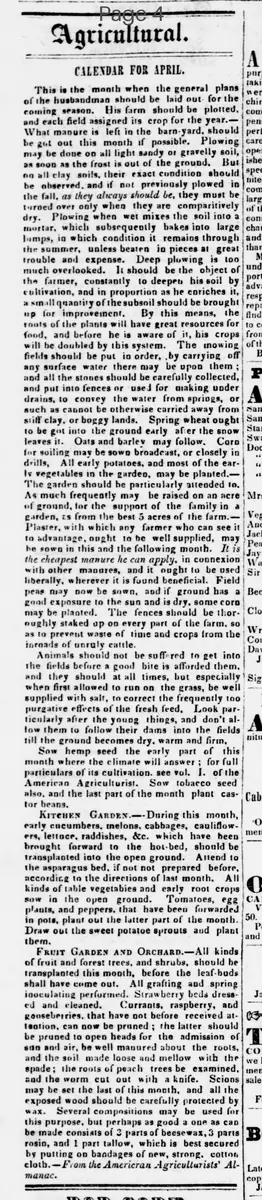
This is the month when the general plans of the husbandman should be laid out for the coming season. His farm should be plotted, and each field assigned its crop for the year. What manure is left in the barn-yard, should be got out this month if possible. Plowing may be done on all light sandy or gravelly soil, as soon as the frost is out of the ground. But on all clay soils, their exact condition should be observed, and if not previously plowed in the fall, as they always should be, they must be turned over only when they are comparatively dry. Plowing when wet mixes the soil into a mortar, which subsequently bakes into large lumps, in which condition it remains through the summer, unless beaten in pieces at great trouble and expense. Deep plowing is too much overlooked. It should be the object of the farmer, constantly to deepen his soil by cultivation, and in proportion as he enriches it, a small quantity of the subsoil should be brought up for improvement. By this means, the roots of the plants will have great resources for food, and before he is aware of it, his crops will be doubled by this system. The snowing fields should be put in order, by carrying off any surface water there may be upon them; and all the stones should be carefully collected, and put into fences or used for making under drains, to convey the water from springs, or such as cannot be otherwise carried away from stiff clay, or boggy lands. Spring wheat ought to be got into the ground early after the snow leaves it. Oats and barley may follow. Corn for soiling may be sown broadcast, or closely in drills. All early potatoes, and most of the early vegetables in the garden, may be planted. The garden should be particularly attended to. As much frequently may be raised on an acre of ground, for the support of the family in a garden, as from the best 5 acres of the farm. Plaster, with which any farmer who can see it to advantage, ought to be well supplied, may be sown in this and the following month. It is the cheapest manure he can apply, in connexion with other manures, and it ought to be used liberally, wherever it is found beneficial. Field peas may now be sown, and if ground has a good exposure to the sun and is dry, some corn may be planted. The fences should be thoroughly staked up on every part of the farm, so as to prevent waste of time and crops from the inroads of unruly cattle. Animals should not be suffered to get into the fields before a good bite is afforded them, and they should at all times, but especially when first allowed to run on the grass, be well supplied with salt, to correct the frequently too purgative effects of the fresh feed. Look particularly after the young things, and don't allow them to follow their dams into the fields till the ground becomes dry, warm and firm. Sow hemp seed the early part of this month where the climate will answer; for full particulars of its cultivation, see vol. I. of the American Agriculturist. Sow tobacco seed also, and the last part of the month plant castor beans.
KITCHEN Garden.--During this month, early cucumbers, melons, cabbages, cauliflowers, lettuce, radishes, &c. which have been brought forward to the hot-bed, should be transplanted into the open ground. Attend to the asparagus bed, if not prepared before, according to the directions of last month. All kinds of table vegetables and early root crops sow in the open ground. Tomatoes, egg plants, and peppers, that have been forwarded in pots, plant out the latter part of the month. Draw out the sweet potato sprouts and plant them.
FRUIT Garden And Orchard,--All kinds of fruit and forest trees, and shrubs, should be transplanted this month, before the leaf-buds shall have come out. All grafting and spring inoculating performed. Strawberry beds dressed and cleaned. Currants, raspberry, and gooseberries, that have not before received attention, can now be pruned: the latter should be pruned to open heads for the admission of sun and air, be well manured about the roots, and the soil made loose and mellow with the spade: the roots of peach trees be examined, and the worm cut out with a knife. Scions may be set the last of this month, and all the exposed wood should be carefully protected by wax. Several compositions may be used for this purpose, but perhaps as good a one as can be made consists of 3 parts of beeswax, 3 parts rosin, and 1 part tallow, which is best secured by putting on bandages of new, strong, cotton cloth.--From the American Agriculturists' Almanac.
CALENDAR FOR APRIL.
This is the month when the general plans of the husbandman should be laid out for the coming season. His farm should be plotted, and each field assigned its crop for the year. What manure is left in the barn-yard, should be got out this month if possible. Plowing may be done on all light sandy or gravelly soil, as soon as the frost is out of the ground. But on all clay soils, their exact condition should be observed, and if not previously plowed in the fall, as they always should be, they must be turned over only when they are comparatively dry. Plowing when wet mixes the soil into a mortar, which subsequently bakes into large lumps, in which condition it remains through the summer, unless beaten in pieces at great trouble and expense. Deep plowing is too much overlooked. It should be the object of the farmer, constantly to deepen his soil by cultivation, and in proportion as he enriches it, a small quantity of the subsoil should be brought up for improvement. By this means, the roots of the plants will have great resources for food, and before he is aware of it, his crops will be doubled by this system. The snowing fields should be put in order, by carrying off any surface water there may be upon them; and all the stones should be carefully collected, and put into fences or used for making under drains, to convey the water from springs, or such as cannot be otherwise carried away from stiff clay, or boggy lands. Spring wheat ought to be got into the ground early after the snow leaves it. Oats and barley may follow. Corn for soiling may be sown broadcast, or closely in drills. All early potatoes, and most of the early vegetables in the garden, may be planted. The garden should be particularly attended to. As much frequently may be raised on an acre of ground, for the support of the family in a garden, as from the best 5 acres of the farm. Plaster, with which any farmer who can see it to advantage, ought to be well supplied, may be sown in this and the following month. It is the cheapest manure he can apply, in connexion with other manures, and it ought to be used liberally, wherever it is found beneficial. Field peas may now be sown, and if ground has a good exposure to the sun and is dry, some corn may be planted. The fences should be thoroughly staked up on every part of the farm, so as to prevent waste of time and crops from the inroads of unruly cattle. Animals should not be suffered to get into the fields before a good bite is afforded them, and they should at all times, but especially when first allowed to run on the grass, be well supplied with salt, to correct the frequently too purgative effects of the fresh feed. Look particularly after the young things, and don't allow them to follow their dams into the fields till the ground becomes dry, warm and firm. Sow hemp seed the early part of this month where the climate will answer; for full particulars of its cultivation, see vol. I. of the American Agriculturist. Sow tobacco seed also, and the last part of the month plant castor beans.
KITCHEN Garden.--During this month, early cucumbers, melons, cabbages, cauliflowers, lettuce, radishes, &c. which have been brought forward to the hot-bed, should be transplanted into the open ground. Attend to the asparagus bed, if not prepared before, according to the directions of last month. All kinds of table vegetables and early root crops sow in the open ground. Tomatoes, egg plants, and peppers, that have been forwarded in pots, plant out the latter part of the month. Draw out the sweet potato sprouts and plant them.
FRUIT Garden And Orchard,--All kinds of fruit and forest trees, and shrubs, should be transplanted this month, before the leaf-buds shall have come out. All grafting and spring inoculating performed. Strawberry beds dressed and cleaned. Currants, raspberry, and gooseberries, that have not before received attention, can now be pruned: the latter should be pruned to open heads for the admission of sun and air, be well manured about the roots, and the soil made loose and mellow with the spade: the roots of peach trees be examined, and the worm cut out with a knife. Scions may be set the last of this month, and all the exposed wood should be carefully protected by wax. Several compositions may be used for this purpose, but perhaps as good a one as can be made consists of 3 parts of beeswax, 3 parts rosin, and 1 part tallow, which is best secured by putting on bandages of new, strong, cotton cloth.--From the American Agriculturists' Almanac.
What sub-type of article is it?
Agricultural Calendar
Farming Guide
What keywords are associated?
Plowing
Planting
Manure
Garden
Orchard
Livestock
Crops
Farming
Story Details
Event Date
April
Story Details
Monthly guide for farmers on planning fields, plowing soils appropriately, applying manure and plaster, planting spring crops, vegetables, and fruits, maintaining gardens and orchards, and caring for livestock.