Thank you for visiting SNEWPapers!
Sign up free
The Dallas Daily Herald
Dallas, Dallas County, Texas
What is this article about?
In New Orleans, Sheriff Houston attempted to arrest Louisiana returning board members hiding in the Custom House, guarded by U.S. Marines. He and deputies were arrested by federal marshal for forcing entry, but later released. Crisis to be resolved by Washington.
Clipping
OCR Quality
Full Text
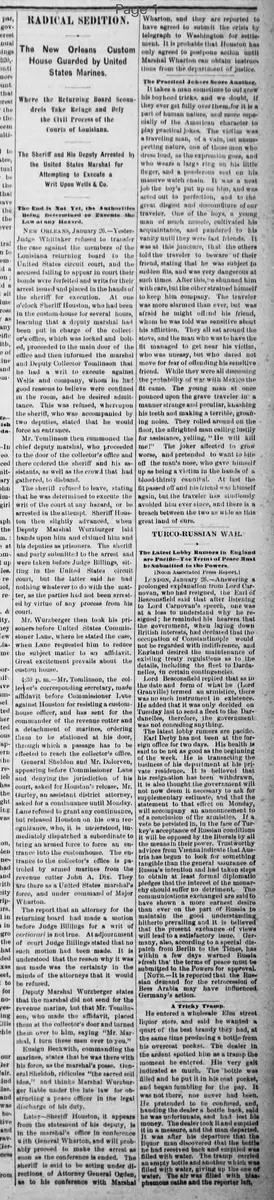
The New Orleans Custom
House Guarded by United
States Marines.
Where the Returning Board Scoundrels Take Refuge and Defy
the Civil Process of the
Courts of Louisiana.
The Sheriff and His Deputy Arrested by
the United States Marshal for
Attempting to Execute a
Writ Upon Wells & Co.
The End Is Not Yet, the Authorities
Being Determined to Execute the
Law at any Hazard.
NEW ORLEANS, January 26.—Yesterday Judge Whittaker refused to transfer the case against the members of the Louisiana returning board to the United States circuit court, and the accused failing to appear in court their bonds were forfeited and writs for their arrest issued and placed in the hands of the sheriff for execution. At one o'clock Sheriff Houston, who had been in the custom-house for several hours, learning that a deputy marshal had been put in charge of the collector's office, which was locked and bolted, proceeded to the main door of the office and then informed the marshal and Deputy Collector Tomlinson that he had a writ to execute against Wells and company, whom he had good reasons to believe were confined in the room, and he desired admittance. This was refused, whereupon the sheriff, who was accompanied by two deputies, stated that he would force an entrance.
Mr. Tomlinson then summoned the chief deputy marshal, who proceeded to the door of the collector's office and there ordered the sheriff and his assistants, as well as the crowd that had gathered, to disband.
The sheriff refused to leave, stating that he was determined to execute the writ of the court at any hazard, or be arrested in the attempt. Sheriff Houston then slightly advanced, when Deputy Marshal Wurzburger laid hands upon him and claimed him and his deputies as prisoners. The sheriff and party submitted to the arrest and were taken before Judge Billings, sitting in the United States circuit court, but the latter said he had nothing whatever to do with the matter, as the parties had not been arrested by virtue of any process from his court.
Mr. Wurzberger then took his prisoners before United States Commissioner Lane, where he stated the case, when Lane requested him to reduce the subject matter to an affidavit.
Great excitement prevails about the custom house.
4:30 p. m.—Mr. Tomlinson, the collector's corresponding secretary, made affidavit before Commissioner Lane against Houston for resisting a custom-house officer, and has sent for the commander of the revenue cutter and a detachment of marines, ordering them to be stationed at his door, through which a passage has to be effected to reach the collector's office.
General Sheldon and Mr. Dolphven, appearing before Commissioner Lane and denying the jurisdiction of his court, asked for Houston's release. Mr. Gurley, an assistant district attorney asked for a continuance until Monday. Lane refused to grant any continuance, but released Houston on his own recognizance, who, it is understood, immediately dispatched a subordinate to bring an armed force to force an entrance into the customhouse. The entrance to the collector's office is patrolled by armed marines from the revenue cutter John A. Dix. They are there as a United States marshal's force, and under command of Major Wharton.
The report that an attorney for the returning board had made a motion before Judge Billings for a writ of certiorari is not true. At adjournment of court Judge Billings stated that no such motion had been made. It is understood that the reason why it was not made was the certainty in the minds of the attorneys that it would be refused.
Deputy Marshal Wurzberger states that the marshal did not send for the revenue marine, but that Mr. Tomlinson, who made the affidavit, placed them at the collector's door and turned them over to him, saying "Mr. Marshal, I turn these men over to you."
Ensign Beckwith, commanding the marines, states that he was there with his force, as the marshal's posse. General Sheldon ridicules the sacred soil idea, and thinks Marshal Wurzberger liable under the late law for obstructing a peace officer in the legal discharge of his duty.
Later—Sheriff Houston, it appears from the statement of his deputy, is in the marshal's office in conference with General Wharton, and will probably proceed to make the arrest as soon as the conference is ended. The sheriff is said to be acting under directions of Attorney General Ogden, as to his conference with Marshal Wharton, and they are reported to have agreed to submit the crisis by telegraph to Washington for settlement. It is probable that Houston has only agreed to postpone action until Marshal Wharton can obtain instructions from the department of justice.
What sub-type of article is it?
What keywords are associated?
What entities or persons were involved?
Where did it happen?
Domestic News Details
Primary Location
New Orleans
Event Date
January 26
Key Persons
Outcome
sheriff houston and deputies arrested by federal marshal but released on recognizance; marines stationed to guard custom house; crisis submitted to washington for resolution; no violence or injuries reported.
Event Details
Judge Whittaker refused to transfer case against Louisiana returning board members to federal court; their bonds forfeited, arrest writs issued to Sheriff Houston. Houston attempted to enter locked collector's office in Custom House where board members were believed hiding; entry refused, leading to confrontation. Federal deputy marshal arrested Houston and deputies for resisting; they were brought before judges and commissioner, then released. Tomlinson summoned marines from revenue cutter to guard the door. Parties agreed to seek instructions from Washington.