Thank you for visiting SNEWPapers!
Sign up free
Editorial
February 20, 1869
Springfield Weekly Republican
Springfield, Hampden County, Massachusetts
What is this article about?
The editorial criticizes the unjust imprisonment of poor, friendless witnesses in criminal trials, highlighting hardships from the New York Prison Association report. It calls for reforms like taking testimony without bonds, providing compensation, better quarters, and notes benefits to justice administration.
Clipping
OCR Quality
98%
Excellent
Full Text
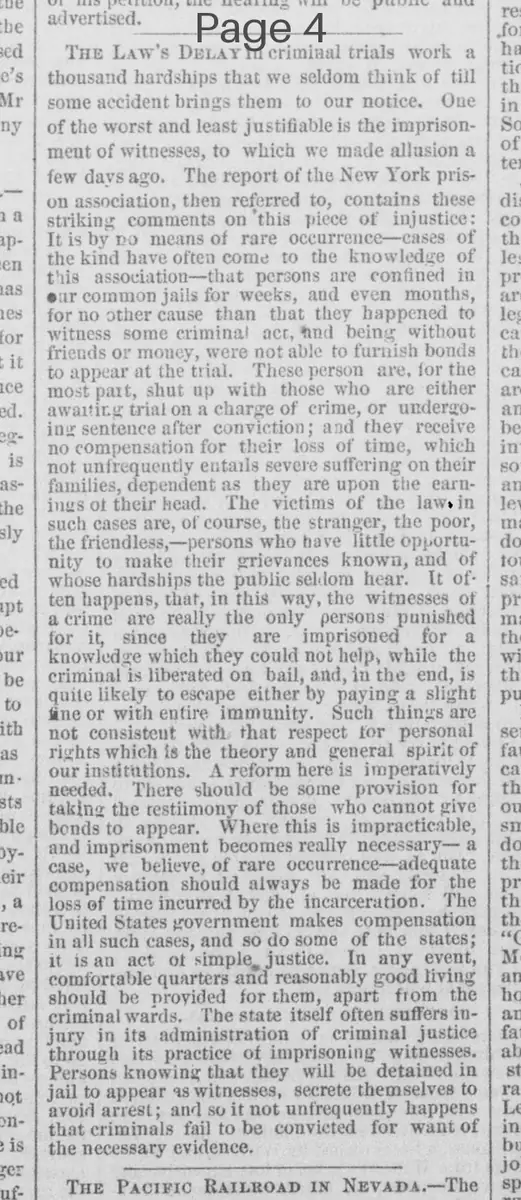
The Law's Delay in criminal trials work a thousand hardships that we seldom think of till some accident brings them to our notice. One of the worst and least justifiable is the imprisonment of witnesses, to which we made allusion a few days ago.
The report of the New York prison association, then referred to, contains these striking comments on this piece of injustice: It is by no means of rare occurrence—cases of the kind have often come to the knowledge of this association—that persons are confined in our common jails for weeks, and even months, for no other cause than that they happened to witness some criminal act, and being without friends or money, were not able to furnish bonds to appear at the trial. These persons are, for the most part, shut up with those who are either awaiting trial on a charge of crime, or undergoing sentence after conviction; and they receive no compensation for their loss of time, which not unfrequently entails severe suffering on their families, dependent as they are upon the earnings of their head.
The victims of the law in such cases are, of course, the stranger, the poor, the friendless,—persons who have little opportunity to make their grievances known, and of whose hardships the public seldom hear. It often happens, that, in this way, the witnesses of a crime are really the only persons punished for it, since they are imprisoned for a knowledge which they could not help, while the criminal is liberated on bail, and, in the end, is quite likely to escape either by paying a slight fine or with entire immunity.
Such things are not consistent with that respect for personal rights which is the theory and general spirit of our institutions. A reform here is imperatively needed. There should be some provision for taking the testimony of those who cannot give bonds to appear. Where this is impracticable, and imprisonment becomes really necessary—a case, we believe, of rare occurrence—adequate compensation should always be made for the loss of time incurred by the incarceration. The United States government makes compensation in all such cases, and so do some of the states; it is an act of simple justice. In any event comfortable quarters and reasonably good living should be provided for them, apart from the criminal wards.
The state itself often suffers injury in its administration of criminal justice through its practice of imprisoning witnesses. Persons knowing that they will be detained in jail to appear as witnesses, secrete themselves to avoid arrest; and so it not unfrequently happens that criminals fail to be convicted for want of the necessary evidence.
The report of the New York prison association, then referred to, contains these striking comments on this piece of injustice: It is by no means of rare occurrence—cases of the kind have often come to the knowledge of this association—that persons are confined in our common jails for weeks, and even months, for no other cause than that they happened to witness some criminal act, and being without friends or money, were not able to furnish bonds to appear at the trial. These persons are, for the most part, shut up with those who are either awaiting trial on a charge of crime, or undergoing sentence after conviction; and they receive no compensation for their loss of time, which not unfrequently entails severe suffering on their families, dependent as they are upon the earnings of their head.
The victims of the law in such cases are, of course, the stranger, the poor, the friendless,—persons who have little opportunity to make their grievances known, and of whose hardships the public seldom hear. It often happens, that, in this way, the witnesses of a crime are really the only persons punished for it, since they are imprisoned for a knowledge which they could not help, while the criminal is liberated on bail, and, in the end, is quite likely to escape either by paying a slight fine or with entire immunity.
Such things are not consistent with that respect for personal rights which is the theory and general spirit of our institutions. A reform here is imperatively needed. There should be some provision for taking the testimony of those who cannot give bonds to appear. Where this is impracticable, and imprisonment becomes really necessary—a case, we believe, of rare occurrence—adequate compensation should always be made for the loss of time incurred by the incarceration. The United States government makes compensation in all such cases, and so do some of the states; it is an act of simple justice. In any event comfortable quarters and reasonably good living should be provided for them, apart from the criminal wards.
The state itself often suffers injury in its administration of criminal justice through its practice of imprisoning witnesses. Persons knowing that they will be detained in jail to appear as witnesses, secrete themselves to avoid arrest; and so it not unfrequently happens that criminals fail to be convicted for want of the necessary evidence.
What sub-type of article is it?
Legal Reform
Crime Or Punishment
What keywords are associated?
Witness Imprisonment
Legal Injustice
Criminal Trials
Prison Reform
Compensation For Witnesses
Judicial Reform
What entities or persons were involved?
New York Prison Association
United States Government
Editorial Details
Primary Topic
Imprisonment Of Witnesses In Criminal Trials
Stance / Tone
Critique Of Injustice And Call For Reform
Key Figures
New York Prison Association
United States Government
Key Arguments
Imprisonment Of Witnesses Without Bonds Causes Undue Hardship To The Poor And Friendless
Witnesses Are Often Confined With Criminals Without Compensation, Affecting Their Families
Witnesses May Be The Only Ones Punished While Criminals Escape
Reform Needed: Provision For Taking Testimony Without Bonds Or Adequate Compensation
Provide Comfortable Quarters Separate From Criminals
Imprisoning Witnesses Leads To Evasion Of Testimony And Failure To Convict Criminals