Thank you for visiting SNEWPapers!
Sign up free
Editorial
November 27, 1937
United Automobile Worker
Detroit, Wayne County, Michigan
What is this article about?
This editorial critiques arguments that balancing the federal budget and reducing taxes would revive business, crediting Roosevelt's deficit spending for recovery instead. It accuses private capital of weakness without government aid and urges a major housing program to boost purchasing power and aid labor amid economic recession fears.
Clipping
OCR Quality
99%
Excellent
Full Text
Balanced Budget and Business
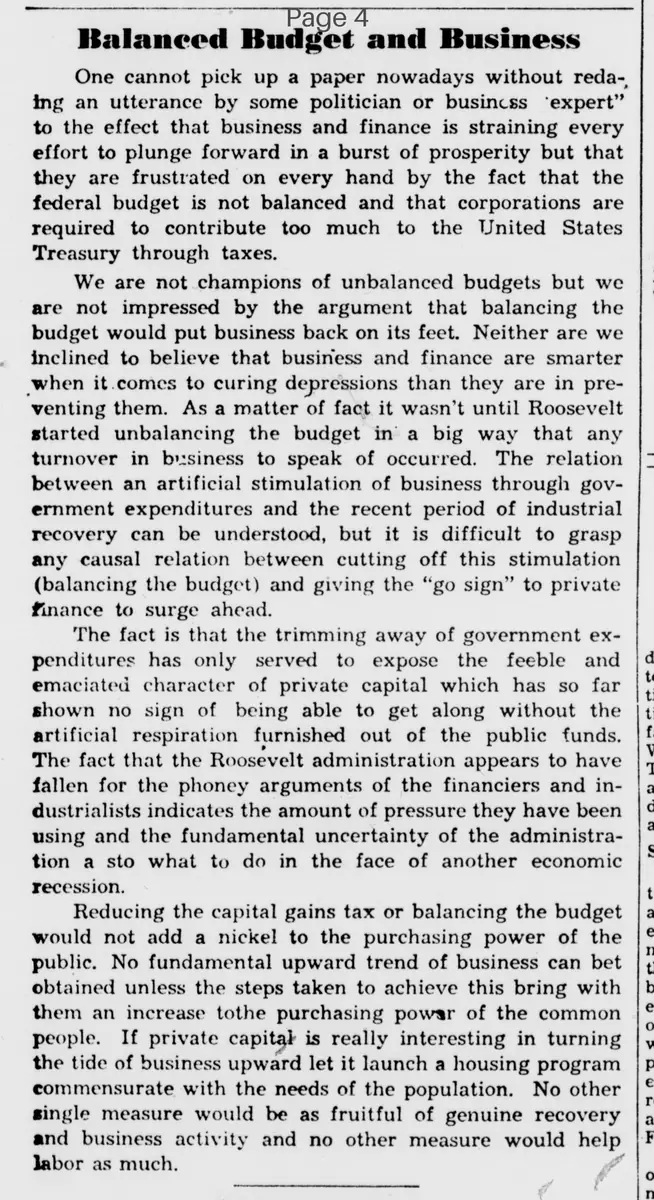
One cannot pick up a paper nowadays without reading an utterance by some politician or business expert to the effect that business and finance is straining every effort to plunge forward in a burst of prosperity but that they are frustrated on every hand by the fact that the federal budget is not balanced and that corporations are required to contribute too much to the United States Treasury through taxes.
We are not champions of unbalanced budgets but we are not impressed by the argument that balancing the budget would put business back on its feet. Neither are we inclined to believe that business and finance are smarter when it comes to curing depressions than they are in preventing them. As a matter of fact it wasn't until Roosevelt started unbalancing the budget in a big way that any turnover in business to speak of occurred. The relation between an artificial stimulation of business through government expenditures and the recent period of industrial recovery can be understood, but it is difficult to grasp any causal relation between cutting off this stimulation (balancing the budget) and giving the "go sign" to private finance to surge ahead.
The fact is that the trimming away of government expenditures has only served to expose the feeble and emaciated character of private capital which has so far shown no sign of being able to get along without the artificial respiration furnished out of the public funds.
The fact that the Roosevelt administration appears to have fallen for the phoney arguments of the financiers and industrialists indicates the amount of pressure they have been using and the fundamental uncertainty of the administration as to what to do in the face of another economic recession.
Reducing the capital gains tax or balancing the budget would not add a nickel to the purchasing power of the public. No fundamental upward trend of business can be obtained unless the steps taken to achieve this bring with them an increase to the purchasing power of the common people. If private capital is really interested in turning the tide of business upward let it launch a housing program commensurate with the needs of the population. No other single measure would be as fruitful of genuine recovery and business activity and no other measure would help labor as much.
One cannot pick up a paper nowadays without reading an utterance by some politician or business expert to the effect that business and finance is straining every effort to plunge forward in a burst of prosperity but that they are frustrated on every hand by the fact that the federal budget is not balanced and that corporations are required to contribute too much to the United States Treasury through taxes.
We are not champions of unbalanced budgets but we are not impressed by the argument that balancing the budget would put business back on its feet. Neither are we inclined to believe that business and finance are smarter when it comes to curing depressions than they are in preventing them. As a matter of fact it wasn't until Roosevelt started unbalancing the budget in a big way that any turnover in business to speak of occurred. The relation between an artificial stimulation of business through government expenditures and the recent period of industrial recovery can be understood, but it is difficult to grasp any causal relation between cutting off this stimulation (balancing the budget) and giving the "go sign" to private finance to surge ahead.
The fact is that the trimming away of government expenditures has only served to expose the feeble and emaciated character of private capital which has so far shown no sign of being able to get along without the artificial respiration furnished out of the public funds.
The fact that the Roosevelt administration appears to have fallen for the phoney arguments of the financiers and industrialists indicates the amount of pressure they have been using and the fundamental uncertainty of the administration as to what to do in the face of another economic recession.
Reducing the capital gains tax or balancing the budget would not add a nickel to the purchasing power of the public. No fundamental upward trend of business can be obtained unless the steps taken to achieve this bring with them an increase to the purchasing power of the common people. If private capital is really interested in turning the tide of business upward let it launch a housing program commensurate with the needs of the population. No other single measure would be as fruitful of genuine recovery and business activity and no other measure would help labor as much.
What sub-type of article is it?
Economic Policy
Labor
What keywords are associated?
Balanced Budget
Economic Recovery
Government Spending
Roosevelt Administration
Housing Program
Private Capital
Purchasing Power
Labor Aid
What entities or persons were involved?
Roosevelt Administration
Politicians
Business Experts
Financiers
Industrialists
Private Capital
Labor
Common People
Editorial Details
Primary Topic
Critique Of Balanced Budget For Economic Recovery And Advocacy For Housing Program
Stance / Tone
Supportive Of Government Spending And Critical Of Private Finance
Key Figures
Roosevelt Administration
Politicians
Business Experts
Financiers
Industrialists
Private Capital
Labor
Common People
Key Arguments
Balancing The Budget Won't Revive Business
Roosevelt's Deficit Spending Initiated Recovery
Private Capital Is Weak Without Government Aid
Administration Yielding To Pressure From Financiers
Reducing Taxes Doesn't Increase Public Purchasing Power
Housing Program Needed For Genuine Recovery And To Help Labor