Thank you for visiting SNEWPapers!
Sign up free
The Morning Star And Catholic Messenger
New Orleans, Orleans County, Louisiana
What is this article about?
In 1849, devout Catholics in English town B, led by Mr. Bichester, initiate a mission by renting a schoolroom for worship amid local prejudice. They convert a former ale store into a chapel, overcome disruptions, attract converts, and build a permanent St. Ignatius church by the 1850s.
Clipping
OCR Quality
Full Text
NEW ORLEANS, SUNDAY, SEPTEMBER 12, 1869.
The Growth of a Mission.
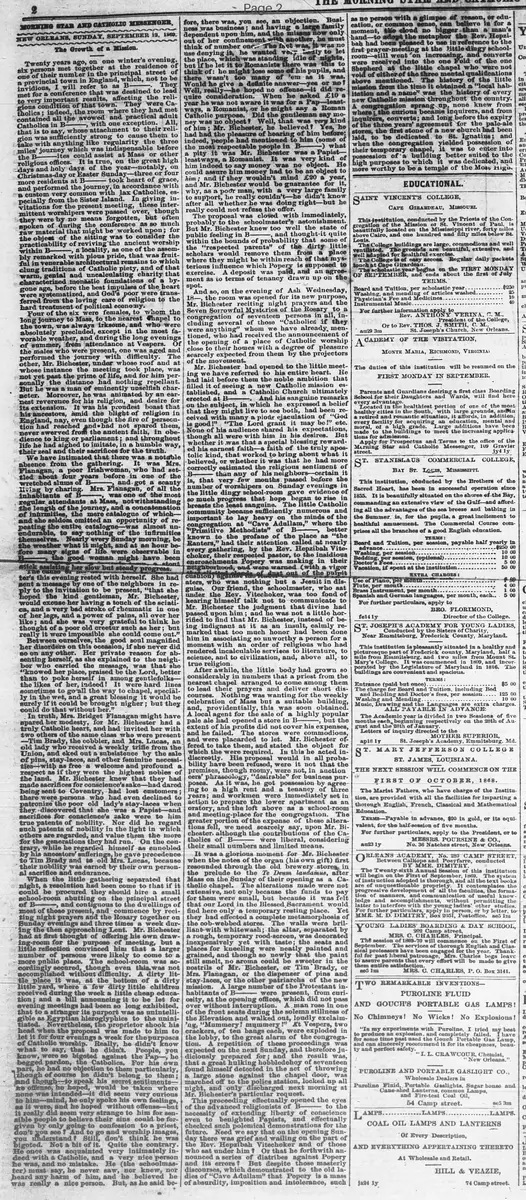
Twenty years ago, on one winter's evening, six persons met together at the residence of one of their number in the principal street of a provincial town in England, which, not to be invidious, I will refer to as B. They met for a conference that was destined to lead to very important results, affecting the religious condition of that town. They comprised all the avowed and practical adult Catholics in B; indeed, the room where they had met with one exception. All, that is to say, whose attachment to their religion was sufficiently strong to cause them to take with anything like regularity the three miles' journey which was indispensable before the B-ites could assist at Mass or other religious offices. It is true, on the great high days and holy days of the year--notably, on Christmas-day or Easter Sunday--three or four more residents at B. took heart of grace, and performed the journey, in accordance with a custom very common with lax Catholics, especially from the Sister Island. In giving invitations for the present meeting, these intermittent worshipers were passed over, though they were by no means forgotten, but often spoken of during the conference as so much raw material that might be worked upon; for the object of the sitting was to consider the practicability of reviving the ancient worship within B., a locality, as one of the assembly remarked with pious pride, that was fruitful in venerable architectural remains to which clung traditions of Catholic piety, and of that warm, genial and uncalculating charity that characterized monastic foundations of a bygone age, before the best impulses of the heart were systematized, and God's poor were transferred from the loving care of religion to the hard treatment of political economy. Four of the six were females, to whom the long journey to Mass, to the nearest Chapel to the town, was always irksome, and who were absolutely precluded, except in the most favorable weather, and during the long evenings of summer, from attendance at Vespers. Of the males who were present, one was aged and performed the journey with difficulty. The other, Mr. Bichester, under whose roof and at whose instance the meeting took place, was not yet past the prime of life, and for him personally the distance had nothing repellant. But he was a man of eminently unselfish character. Moreover, he was animated by an earnest reverence for his religion, and desire for its extension. It was his proudest boast that his ancestors, amid the blight of religion in England, nay, even though the fire of persecution had reached and had not spared them, never swerved from the ancient faith, in obedience to king or parliament; and throughout life he had sighed to imitate, in a humble way, their zeal and their sacrifices for the truth. We have intimated that there was a notable absence from the gathering. It was Mrs. Flanagan, a poor Irishwoman, who had settled about four years before--in one of the wretched slums of B. and got a scanty living by charing. Mrs. Flanagan, of all the inhabitants of B, was one of the most regular attendants at Mass, notwithstanding the length of the journey, and a concatenation of infirmities, the mere catalogue of which--and she seldom omitted an opportunity of repeating the entire catalogue--was almost unendurable, to say nothing of the infirmities themselves. Nearly every Sunday morning, be the weather what it might, and at an hour before many signs of life were observable in B., this good woman might have been seen wending her slow but steady progress. The cause of her absence this evening rested with herself. She had sent a message by one of the neighbors in reply to the invitation to be present, "that she hoped the kind gentleman, Mr. Bichester would excuse her having a touch of the sciatica, and a very bad stroke of rheumatiz in one of her legs, and a power of pains, all over her like: and she was very grateful to think he thought of a poor old creature such as her; but really it were impossible she could come out." Between ourselves, the good soul magnified her disorders on this occasion, if she never did so on any other. Her private reason for absenting herself, as she explained to the neighbor who carried the message, was that she "Knowed her place, praised be the Lord, better than to poke herself in among gentlefolks--the likes of her, indeed! It were hard lines sometimes to go all the way to chapel, especially in the wet, and a great blessing it would be surely if it could be brought nigher; but they could do that without her." In truth, Mrs. Bridget Flanagan might have spared her modesty, for Mr. Bichester had a truly Catholic heart, and had invited her with two others of the same class who were present --Tim Brady, the cobbler, and Mrs. Lucas, an old lady who received a weekly trifle from the Union, and eked out a subsistence by the sale of pins, stay-laces, and other feminine necessities--with as free a welcome and profound a respect as if they were the highest nobles of the land. Mr. Bichester knew that they had made sacrifices for conscience's sake--had dared being sent to Coventry,--had lost customers; there were persons who had even declined to patronize the poor old lady's stay-laces when they discovered that she was a Papist--and sacrifices for conscience's sake were to him true patents of nobility. Nor did he regard such patents of nobility in the light in which others are regarded, and value them the more for the generations they had run. On the contrary, while he regarded himself as ennobled by his ancestors' sufferings, he gave precedence to Tim Brady and to old Mrs. Lucas, because their nobility was earned by their own personal sacrifice and endurance. When the little gathering separated that night, a resolution had been come to that if it could be procured they should hire a small school-room abutting on the principal street of B., and contiguous to the dwellings of most of those present, and commence by reciting night prayers and the Rosary together on Sunday evenings and three times a week during the then approaching Lent. Mr. Bichester had at first thought of offering his own drawing-room for the purpose of meeting, but a little reflection convinced him that a larger number of persons were likely to come to a more public place. The school-room was accordingly secured, though even this was not accomplished without difficulty. A dirty little place it was, at the bottom of a dirty little yard, where a few dirty little children received during the week a little cheap education; and a bill announcing it to be let for evening meetings had been so long exhibited, that to a stranger its purport was as unintelligible as Egyptian hieroglyphics to the uninitiated. Nevertheless, the proprietor shook his head when the proposal was made to him to let it for four evenings a week for the purposes of Catholic worship. Really, he didn't know what to say, that he didn't. People, you know, were so bigoted against the Pap--, he begged pardon, the Catholics. For his own part, he had no objection to them particularly, though of course he didn't belong to them; and though--to speak his secret sentiments--no offense, he hoped, would be taken where none was intended--it did seem very curious to him--mind, he only spoke his own feelings, as it were, and he hoped without offense--but it really did seem very strange to him for sensible people to believe their sins could be forgiven by only going to confession to a priest, don't you see! And to go and worship images, you understand! Still, don't think he was bigoted. Not a bit of it. Quite the contrary. He once was acquainted very intimately indeed with a Catholic, and a very nice person he was, and no mistake. He (the schoolmaster) must say, he never saw, nor knew, nor heard any harm of him, and he believed he was really a nice person. But, as he said before, there was, you see, an objection. Business was business; and having a large family dependent upon him, and the missus now only out of her confinement with another, he must think of number one. The fact was, it was no use denying it, he wanted very badly to let the place, which was standing idle of nights, but if he let it to Romanists there was this to think of: he might lose some of his pupils, and there wasn't too many of 'em--as it was. Would he give a definite answer--yes or no? Well, really--he hoped no offense--it did require consideration. When he asked £10 a year he was not aware it was for a Pap--leastways, a Roman Catholic purpose. Did the gentleman say money was no object? Well, that was very kind of him; Mr. Bichester, he believed? Yes, he had had the pleasure of hearing of him before; indeed, people had mentioned to him (some of the most respectable people in B.) what a pity it was Mr. Bichester was a Papist leastways, a Romanist. It was very kind of him indeed to say money was no object. He could assure him money had to be an object to him; and if they wouldn't mind £20 a year, and Mr. Bichester would be guarantee for it, why, as a poor man, with a very large family to support, he really couldn't--he didn't know after all whether he was doing right--but he really could not refuse the offer. The proposal was closed with immediately, probably to the schoolmaster's astonishment. But Mr. Bichester knew too well the state of public feeling in B. and thought it quite within the bounds of probability that some of the "respected parents" of the dirty little scholars would remove them from a place where they might be within reach of that mysterious influence which Popery is supposed to exercise. A deposit was paid, and an agreement as to terms of tenancy drawn up on the spot. And so, on the evening of Ash Wednesday, 18-, the room was opened for its new purpose, Mr. Bichester reciting night prayers and the Seven Sorrowful Mysteries of the Rosary to a congregation of seventeen persons in all, including several of those "Catholics if they were anything" whom we have already mentioned, who had received the announcement of the opening of a place of Catholic worship close to their homes with a degree of pleasure scarcely expected from them by the projectors of the movement. Mr. Bichester had opened to the little meeting we have referred to his entire heart. He had laid before them the noble ambition that filled it of seeing a new Catholic mission established, and a Catholic Church ultimately erected at B. And his sanguine remarks on the subject, in which he expressed a belief that they might live to see both, had been received with many a pious ejaculation of "God is good!" "The Lord grant it may be!" etc. None of his audience shared his expectations, though all were with him in his desires. But whether it was that a special blessing rewarded his earnest faith--a faith of the truly apostolic kind, that worked to bring about what it believed, or whether it was that he had more correctly estimated the religious sentiment of B. than any of his neighbors--certain it is, that very few months passed before the number of worshipers on Sunday evenings in the little dingy school-room gave evidence of so much progress that hope began to rise in breasts the least sanguine. The little Catholic community became sufficiently numerous and important to lay heavy on the minds of the congregation at "Cave Adullam," where the "Primitive Methodists" of B., better known to the profane of the place as "the Ranters," had their attention called at nearly every gathering, by the Rev. Hepzibah Vitechoker, their respected pastor, to the insidious encroachments Popery was making in their neighborhood, and were warned (with a vigor that shook the cushions) against one out of the pulpit, Mr. Bichester, who was nothing but a Jesuit in disguise. Our friend, the schoolmaster, who sat under the Rev. Vitechoker, was too fond of hearing himself talk not to communicate to Mr. Bichester the judgment that divine had passed upon him; and he was not a little horrified to find that Mr. Bichester, instead of being indignant at it as an insult, calmly remarked that too much honor had been done him in associating so unworthy a person for a moment with an order of religious who had rendered incalculable services to literature, to science, and to civilization, and, above all,--to true religion. After awhile, the little body had grown so considerably in numbers that a priest from the nearest chapel arranged to come among them to lead their prayers and deliver short discourses. Nothing was wanting for the weekly celebration of Mass but a suitable building. and, providentially, this was soon obtained. A local agent for the sale of a highly popular pale ale had opened a store in B., but the extent of his profits did not cover his expenses, and he failed. The stores were commodious, and were placarded to let. Mr. Bichester offered to take them, and stated the object for which they were required. In this he acted indiscreetly. His proposal would in all probability have been refused, were it not that the premises, though roomy, were not, in auctioneers' phraseology, "desirable" for business purposes. As it was, he got possession by agreeing to a high rent and a tenancy of three years; and workmen were immediately set in action to prepare the lower apartment as an oratory, and the loft above as a school-room and meeting-place for the congregation. The greater portion of the expense of these alterations fell, we need scarcely say, upon Mr. Bichester, although the contributions of the Catholics of B. were liberal, considering their small numbers and limited means. It was a glorious moment for Mr. Bichester when the notes of the organ (his own gift) first resounded through the old brewery stores in the prelude to the Te Deum laudamus, after Mass on the Sunday of their opening as a Catholic chapel. The alterations made were not extensive, not only because the funds to pay for them were small, but because it was felt that our Lord in the Blessed Sacrament would find here only a temporary resting place. Yet they had effected a complete metamorphosis of the cob-webbed stores. The walls were brilliant with whitewash; the altar, separated by a rough, temporary rood-screen, was decorated inexpensively yet with taste; the seats and places for kneeling were neatly painted and grained, and though so newly that the paint still smelt, no aroma could be sweeter in the nostrils of Mr. Bichester, or Tim Brady, or Mrs. Flanagan, or the dispenser of pins and stay-laces, or the other patriarchs of the new mission. A large number of the Protestant inhabitants of B. were present, from curiosity, at the opening offices, which did not pass over without interruption. A man rose in one of the front seats during the solemn stillness of the Elevation and walked out, loudly exclaiming, "Mummery! mummery!" At Vespers, two crackers, of ten bangs each, were exploded in the lobby, to the great alarm of the congregation. A repetition of these proceedings was expected on the next Sunday, and therefore judiciously prepared for; and the result was, that a great hulking hobbledehoy of seventeen found himself detected in the act of throwing a large stone against the chapel door, was marched off to the police station, locked up all night, and only discharged next morning at Mr. Bichester's particular request. This proceeding effectually opened the eyes of the advanced religionists of B- to the necessity of extending liberty of conscience even to benighted Papists, and effectually checked such polemical demonstrations for the future. Need we say that on the opening Sunday there was grief and wailing on the part of the Rev. Hepzibah Vitechoker and of those who sat under him? Or that he forthwith announced a series of diatribes against Popery and its errors? But despite those masterly discourses, which demonstrated to the old ladies of "Cave Adullam" that Popery is a mass of absurdity, imposition and intolerance, such as no person with a glimpse of reason, or education, or common sense, can believe in for a moment, the cloud no bigger than a man's hand--to adopt the metaphor the Rev. Hepzibah had been pleased to use in reference to the first prayer-meeting at the little dingy school-room--still went on increasing, and converts were received into the one Fold of the one Shepherd at the little chapel who were not void of either of the three mental qualifications above mentioned. The history of the little mission from the time it obtained a "local habitation and a name" was the history of every new Catholic mission throughout the country. A congregation sprang up, none knew from where; the curious became inquirers, and from inquirers, converts; and long before the expiry of the three years' agreement for the pale-ale stores, the first stone of a new church had been laid, to be dedicated to St. Ignatius; and when the congregation yielded possession of their temporary chapel, it was to enter into possession of a building better suited to the high purposes to which it was dedicated, and more worthy to be a temple of the Most High.
What sub-type of article is it?
What themes does it cover?
What keywords are associated?
What entities or persons were involved?
Where did it happen?
Story Details
Key Persons
Location
Provincial Town B, England
Event Date
Twenty Years Ago From 1869, Starting Winter Evening Circa 1849; Ash Wednesday 18
Story Details
Six Catholics meet in town B to discuss reviving local worship due to the long journey to Mass. Led by Mr. Bichester, they rent a schoolroom for prayers despite prejudice and higher rent. Attendance grows; they convert a failed ale store into a temporary chapel, facing disruptions but gaining converts. The mission expands, leading to a permanent church dedicated to St. Ignatius.