Thank you for visiting SNEWPapers!
Sign up free
Daily National Intelligencer
Washington, District Of Columbia
What is this article about?
A letter to the National Intelligencer editors urges deepening the Tiber channel in Washington to enable larger vessels, reduce transportation costs for wood, coal, and goods, prevent urban decline north of the Tiber, and foster commerce rivaling Georgetown and Alexandria. Signed 'A Friend to the District.'
Clipping
OCR Quality
Full Text
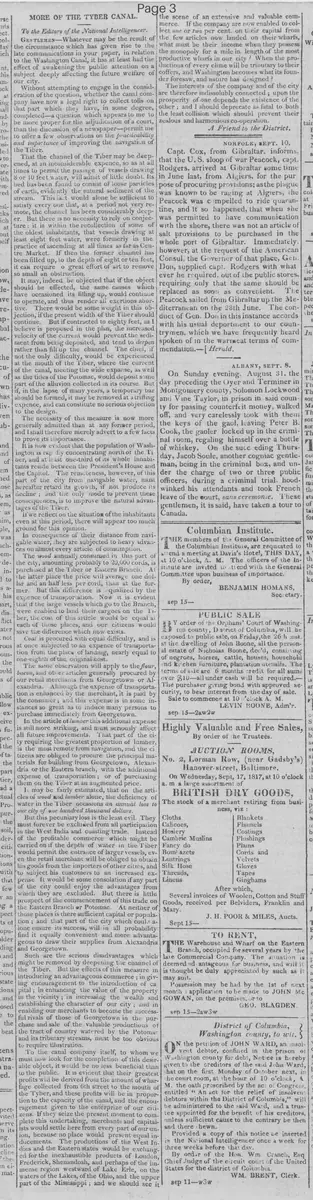
To the Editors of the National Intelligencer
GENTLEMEN—Whatever may be the result of the circumstance which has given rise to the late communications in your paper, in relation to the Washington Canal, it has at least had the effect of awakening the public attention on a subject deeply affecting the future welfare of our city.
Without attempting to engage in the consideration of the question, whether the canal company have now a legal right to collect tolls on that part which they have, in some degree, completed—a question which appears to me to be more proper for the adjudication of a court, than the discussion of a newspaper—permit me to offer a few observations on the practicability and importance of improving the navigation of the Tiber.
That the channel of the Tiber may be deepened, at an inconsiderable expense, so as at all times to permit the passage of vessels drawing 8 or 10 feet water, will admit of little doubt. Its bed has been found to consist of loose particles of earth, evidently the natural sediment of the stream. This fact would alone be sufficient to satisfy every one that, at a period not very remote, the channel has been considerably deeper. But there is no necessity to rely on conjecture: it is within the recollection of some of the oldest inhabitants, that vessels drawing at least eight feet water, were formerly in the practice of ascending at all times as far as Centre Market. If then the former channel has been filled up, to the depth of eight or ten feet, it can require no great effort of art to remove so small an obstruction.
It may, indeed be objected that if the object should be effected, the same causes which have occasioned its filling up, would continue to operate, and thus render all exertions abortive. There would be some weight in this objection, if the present width of the Tiber should continue. But if contracted to eighty feet, as I believe is proposed in the plan, the increased velocity of the current would prevent the sediment from being deposited, and tend to deepen rather than fill up the channel. The chief, if not the only difficulty, would be experienced at the mouth of the Tiber, where the current of the canal, meeting the wide expanse, as well as the tides of the Potomac, would deposit some part of the alluvion collected in its course. But if, in the lapse of many years, a temporary bar should be formed, it may be removed at a trifling expense, and can constitute no serious objection to the design.
The necessity of this measure is now more generally admitted than at any former period, and I shall therefore merely advert to a few facts to prove its importance.
It is now evident that the population of Washington is rapidly concentrating north of the Tiber, and at least one-third of its whole inhabitants reside between the President's House and the Capitol. The remoteness, however, of this part of the city from navigable water, must hereafter retard its growth, if not produce its decline; and the only mode to prevent these consequences, is to improve the natural advantages of the Tiber.
If we reflect on the situation of the inhabitants even at this period, there will appear too much ground for this opinion.
In consequence of their distance from navigable water, they are subjected to heavy advances on almost every article of consumption.
The wood annually consumed in this part of the city, amounting probably to 20,000 cords, is purchased at the Tiber or Eastern Branch. At the latter place the price will average one dollar and a half less per cord, than at the former. But this difference is equalized by the expense of transportation. Now it is evident that if the large vessels which go to the Branch, were enabled to land their cargoes on the Tiber, the cost of this article would be equal at each of those places, and our citizens would save the difference which now exists.
Coal is procured with equal difficulty, and is at once subjected to an expense of transportation from the places of landing, nearly equal to one-eighth of the original cost.
The same observation will apply to the flour, bacon, and other articles generally procured by our retail merchants from Georgetown or Alexandria. Although the expense of transportation is enhanced by the merchant, it is paid by the consumer; and this expense is in some instances so great as to induce many persons to purchase immediately from Georgetown.
In the article of lumber this additional expense is still more striking, and must seriously affect all future improvements. That part of the city requiring the greatest proportion of lumber, is the most remote from navigation, and the citizens are obliged to procure the principal materials for building from Georgetown, Alexandria or the Eastern branch, with the additional expense of transportation; or of purchasing them on the Tiber at an augmented price.
It may be fairly estimated, that on the articles of wood and lumber alone, the deficiency of water in the Tiber occasions an annual loss to our city of one hundred thousand dollars.
But this pecuniary loss is the least evil. They must forever be excluded from all participation in the West India and coasting trade. Instead of the profitable commerce which might be carried on if the depth of water in the Tiber would permit the entrance of larger vessels, even the retail merchant will be obliged to obtain his goods from the importers of other cities, and to subject his customers to an increased expense. It would be some consolation if any part of the city could enjoy the advantages from which they are excluded. But there is little prospect of the commencement of this trade on the Eastern Branch or Potomac. At neither of those places is there sufficient capital or population; and that part of the city which could alone ensure its success, will in all probability find it equally convenient and more advantageous to draw their supplies from Alexandria and Georgetown.
Such are the serious disadvantages which might be removed by deepening the channel of the Tiber. But the effects of this measure in introducing an advantageous commerce; in giving encouragement to the introduction of capital; in enhancing the value of the property in the vicinity; in increasing the wealth and establishing the character of our city; and in enabling our merchants to become the successful rivals of those of Georgetown in the purchase and sale of the valuable productions of the tract of country watered by the Potomac and its tributary streams, must be too obvious to require illustration.
To the canal company itself, to whom we must now look for the completion of this desirable object, it would be no less beneficial than to the public. It is evident that their greatest profits will be derived from the amount of wharfage collected from 6th street to the mouth of the Tyber, and these profits will be in proportion to the capacity of the canal, and the encouragement given to the enterprize of our citizens. If they seize the present moment to complete this undertaking, merchants and capitalists would settle here from every part of our union, because no place would present equal inducements. The productions of the West Indies and the Eastern states would be exchanged for the inexhaustible products of Loudon, Frederick, Shenandoah, and perhaps of the immense region westward of Lake Erie, on the waters of the Lakes, of the Ohio, and the upper part of the Mississippi; and we should see it the scene of an extensive and valuable commerce. If the company are now enabled to collect one or two per cent. on their capital from the few articles now landed on their wharfs, what must be their income when they possess the monopoly for a mile in length of the most productive wharfs in our city? When the productions of every clime will be tributary to their coffers, and Washington becomes what its founder foresaw, and nature has designed?
The interests of the company and of the city are therefore indissolubly connected; upon the prosperity of one depends the existence of the other; and I should deprecate as fatal to both the least collision which should prevent their zealous and harmonious co-operation.
A Friend to the District.
What sub-type of article is it?
What themes does it cover?
What keywords are associated?
What entities or persons were involved?
Letter to Editor Details
Author
A Friend To The District.
Recipient
To The Editors Of The National Intelligencer
Main Argument
the channel of the tiber should be deepened at low cost to allow vessels drawing 8-10 feet, improving navigation, reducing consumer costs for essentials like wood and lumber, preventing northern washington's decline, and enabling profitable commerce to rival nearby ports.
Notable Details