Thank you for visiting SNEWPapers!
Sign up free
Literary
May 14, 1904
The Evening World
New York, New York County, New York
What is this article about?
Gerald Rockingham wins the Cambridgeshire Handicap by a short head on Dancing Master, foiling his cousin's sabotage. He receives congratulations, Elliston flees abroad, and they opt for silence. Gerald marries Dollie, buys back his family home, and establishes a successful stud farm.
Clipping
OCR Quality
85%
Good
Full Text
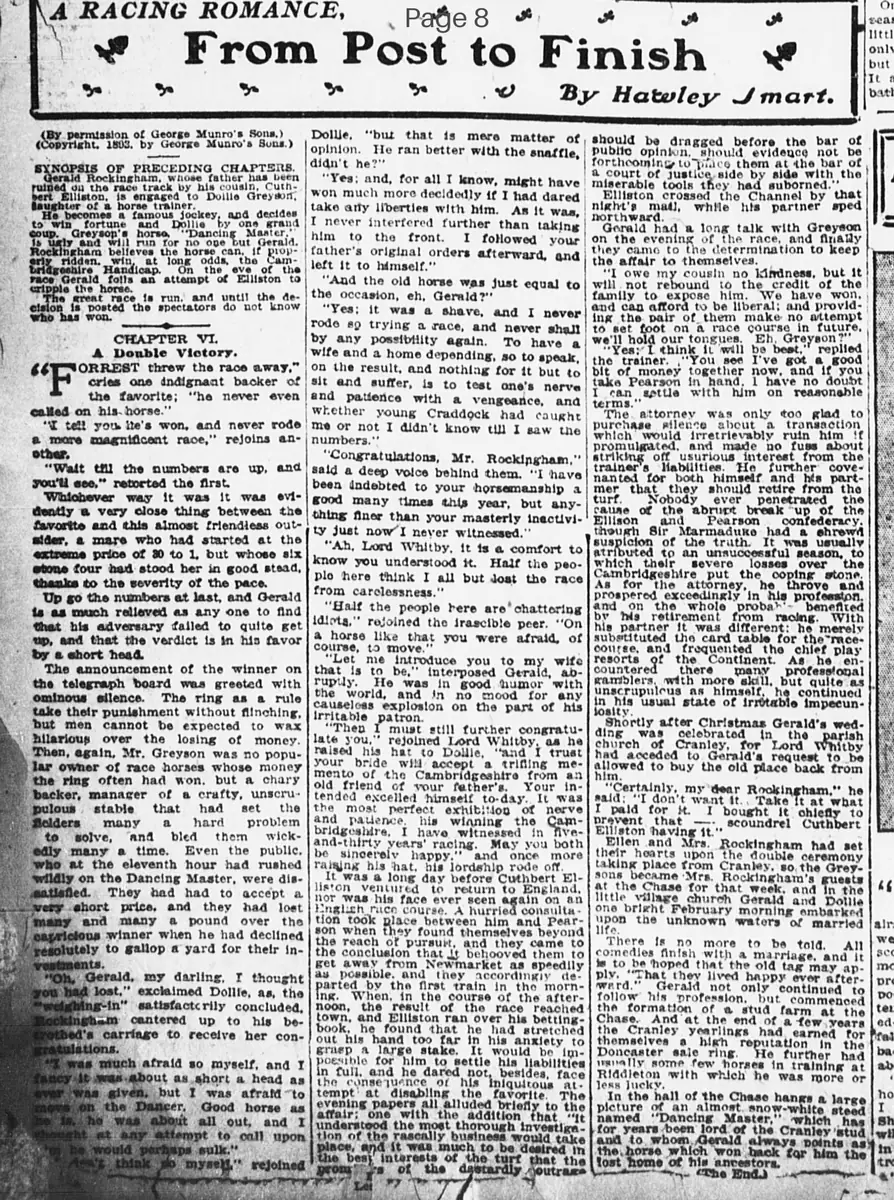
(By permission of George Munro's Sons.)
(Copyright, 1903, by George Munro's Sons.)
SYNOPSIS OF PRECEDING CHAPTERS.
Gerald Rockingham, whose father has been ruined on the race track by his cousin, Cuthbert Elliston, is engaged to Dollie Greyson, daughter of a horse trainer. He becomes a famous jockey, and decides to win fortune and Dollie by one grand coup. Greyson's horse, 'Dancing Master,' is ugly and will run for no one but Gerald. Rockingham believes the horse can, if properly ridden, win, at long odds, the Cambridgeshire Handicap. On the eve of the race Gerald foils an attempt of Elliston to cripple the horse. The great race is run, and until the decision is posted the spectators do not know who has won.
CHAPTER VI.
A Double Victory.
"Correst threw the race away."
"Of the favorite," cries one indignant backer of he never even called on his horse."
"I tell you it's won, and never rode a more magnificent race," rejoins another.
"Wait till the numbers are up, and you'll see," retorted the first.
Whichever way it was it was evidently a very close thing between the favorite and this almost friendless outsider, a mare who had started at the extreme price of 50 to 1, but whose six stone four had stood her in good stead, thanks to the severity of the pace.
Up go the numbers at last, and Gerald is as much relieved as any one to find that his adversary failed to quite get up, and that the verdict is in his favor by a short head.
The announcement of the winner on the telegraph board was greeted with ominous silence. The ring as a rule take their punishment without flinching, but men cannot be expected to wax hilarious over the losing of money.
Then, again, Mr. Greyson was no popular owner of race horses whose money the ring often had won, but a chary backer, manager of a crafty, unscrupulous stable that had set the Belders many a hard problem to solve, and bled them wickedly many a time.
Even the public, who at the eleventh hour had rushed wildly on the Dancing Master, were dissatisfied. They had to accept a very short price, and they had lost many and many a pound over the capricious winner when he had declined resolutely to gallop a yard for their investments.
"Oh, Gerald, my darling, I thought you had lost," exclaimed Dollie, as the "weighing-in" satisfactorily concluded. Rockingham cantered up to his betrothed's carriage to receive her congratulations.
"I was much afraid so myself, and I fancy it was about as short a head as ever was given, but I was afraid to move on the Dancer. Good horse as he is, he was about all out, and I caught at any attempt to call upon him, he would perhaps sulk."
"A good thing to think of myself," rejoined Dollie, "but that is mere matter of opinion. He ran better with the snaffle, didn't he?"
"Yes; and, for all I know, might have won much more decidedly if I had dared take any liberties with him. As it was, I never interfered further than taking him to the front. I followed your father's original orders afterward, and left it to himself."
"And the old horse was just equal to the occasion, eh, Gerald?"
"Yes; it was a shave, and I never rode so trying a race, and never shall by any possibility again. To have a wife and a home depending, so to speak, on the result, and nothing for it but to sit and suffer, is to test one's nerve and patience with a vengeance, and whether young Craddock had caught me or not I didn't know till I saw the numbers."
"Congratulations, Mr. Rockingham," said a deep voice behind them. "I have been indebted to your horsemanship a good many times this year, but anything finer than your masterly inactivity just now I never witnessed."
"Ah, Lord Whitby, it is a comfort to know you understood it. Half the people here think I all but lost the race from carelessness."
"Half the people here are chattering idiots," rejoined the irascible peer. "On a horse like that you were afraid, of course, to move."
"Let me introduce you to my wife that is to be," interposed Gerald, abruptly. He was in good humor with the world, and in no mood for any causeless explosion on the part of his irritable patron.
"Then I must still further congratulate you," rejoined Lord Whitby, as he raised his hat to Dollie. "And I trust your bride will accept a trifling memento of the Cambridgeshire from an old friend of your father's. Your intended excelled himself to-day. It was the most perfect exhibition of nerve and patience, his winning the Cambridgeshire, I have witnessed in five-and-thirty years' racing. May you both be sincerely happy," and once more raising his hat, he turned away.
It was a long day before Cuthbert Elliston ventured to return to England, nor was his face ever seen again on an English race course. A hurried consultation took place between him and Pearson when they found themselves beyond the reach of pursuit, and they came to the conclusion that it behooved them to get away from Newmarket as speedily as possible, and they accordingly departed by the first train in the morning. When, in the course of the afternoon, the result of the race reached town, and Elliston ran over his betting book, he found that he had stretched out his hand too far in his anxiety to sweep a large stake. It would be impossible for him to settle his liabilities in full, and he dared not, besides, face the indignation, or his iniquitous attempt at "disabling the favorite." The evening papers all alluded briefly to the affair; one with the addition that "It is understood the most thorough investigation of this rascally business would take place, and it was much to be desired in the best interests of the turf that the Xoeyys ot why dayty iowtr1 should be dragged before the bar of public opinion, should evidence not be forthcoming to place them at the bar of a court of justice-side by side with the miserable tools they had suborned."
Elliston crossed the Channel by that night's mail, while his partner sped northward.
Gerald had a long talk with Greyson on the evening of the race, and finally they came to the determination to keep the affair to themselves.
"I owe my cousin no kindness, but it will not rebound to the credit of the family to expose him. We have won, and can afford to be liberal; and providing the pair of them make no attempt to set foot on a race course in future, we'll hold our tongues. Eh, Greyson?"
"Yes; I think it will be best," replied the trainer. "You see I've got a good bit of money together now, and if you take Pearson in hand, I have no doubt I can settle with him on reasonable terms."
The attorney was only too glad to purchase silence about a transaction which would irretrievably ruin him if promulgated, and made no fuss about striking off usurious interest from the trainer's liabilities. He further covenanted for both himself and his partner that they should retire from the turf.
Nobody ever penetrated the cause of the abrupt break-up of the Ellison and Pearson confederacy, though Sir Marmaduke had a shrewd suspicion of the truth. It was usually attributed to an unsuccessful season, to which their severe losses over the Cambridgeshire put the coping stone.
As for the attorney, he throve and prospered exceedingly in his profession, and on the whole probably benefited by his retirement from racing. With his partner it was different; he merely substituted the card table for the race-course, and frequented the chief play resorts of the Continent. As he encountered there many professional gamblers, with more skill but quite as unscrupulous as himself, he continued in his usual state of irritable impecuniosity.
Shortly after Christmas Gerald's wedding was celebrated in the parish church of Cranley, for Lord Whitby had acceded to Gerald's request to be allowed to buy the old place back from him.
"Certainly, my dear Rockingham," he said; "I don't want it. Take it at what I paid for it. I bought it chiefly to prevent that scoundrel Cuthbert Elliston having it."
Ellen and Mrs. Rockingham had set their hearts upon the double ceremony taking place from Cranley, so the Greysons became Mrs. Rockingham's guests at the Chase for that week, and in the little village church Gerald and Dollie one bright February morning embarked upon the unknown waters of married life.
There is no more to be told. All comedies finish with a marriage, and it is to be hoped that the old tag may apply, "That they lived happy ever afterward." Gerald not only continued to follow his profession, but commenced the formation of a stud farm at the Chase. And at the end of a few years the Cranley yearlings had earned for themselves a high reputation in the Doncaster sale ring. He further had usually some few horses in training at Radleton with which he was more or less lucky.
In the hall of the Chase hangs a large picture of an almost snow-white steed named "Dancing Master," which has for years been lord of the Cranley stud, and to whom Gerald always points as the horse which won back for him the lost home of his ancestors.
(Copyright, 1903, by George Munro's Sons.)
SYNOPSIS OF PRECEDING CHAPTERS.
Gerald Rockingham, whose father has been ruined on the race track by his cousin, Cuthbert Elliston, is engaged to Dollie Greyson, daughter of a horse trainer. He becomes a famous jockey, and decides to win fortune and Dollie by one grand coup. Greyson's horse, 'Dancing Master,' is ugly and will run for no one but Gerald. Rockingham believes the horse can, if properly ridden, win, at long odds, the Cambridgeshire Handicap. On the eve of the race Gerald foils an attempt of Elliston to cripple the horse. The great race is run, and until the decision is posted the spectators do not know who has won.
CHAPTER VI.
A Double Victory.
"Correst threw the race away."
"Of the favorite," cries one indignant backer of he never even called on his horse."
"I tell you it's won, and never rode a more magnificent race," rejoins another.
"Wait till the numbers are up, and you'll see," retorted the first.
Whichever way it was it was evidently a very close thing between the favorite and this almost friendless outsider, a mare who had started at the extreme price of 50 to 1, but whose six stone four had stood her in good stead, thanks to the severity of the pace.
Up go the numbers at last, and Gerald is as much relieved as any one to find that his adversary failed to quite get up, and that the verdict is in his favor by a short head.
The announcement of the winner on the telegraph board was greeted with ominous silence. The ring as a rule take their punishment without flinching, but men cannot be expected to wax hilarious over the losing of money.
Then, again, Mr. Greyson was no popular owner of race horses whose money the ring often had won, but a chary backer, manager of a crafty, unscrupulous stable that had set the Belders many a hard problem to solve, and bled them wickedly many a time.
Even the public, who at the eleventh hour had rushed wildly on the Dancing Master, were dissatisfied. They had to accept a very short price, and they had lost many and many a pound over the capricious winner when he had declined resolutely to gallop a yard for their investments.
"Oh, Gerald, my darling, I thought you had lost," exclaimed Dollie, as the "weighing-in" satisfactorily concluded. Rockingham cantered up to his betrothed's carriage to receive her congratulations.
"I was much afraid so myself, and I fancy it was about as short a head as ever was given, but I was afraid to move on the Dancer. Good horse as he is, he was about all out, and I caught at any attempt to call upon him, he would perhaps sulk."
"A good thing to think of myself," rejoined Dollie, "but that is mere matter of opinion. He ran better with the snaffle, didn't he?"
"Yes; and, for all I know, might have won much more decidedly if I had dared take any liberties with him. As it was, I never interfered further than taking him to the front. I followed your father's original orders afterward, and left it to himself."
"And the old horse was just equal to the occasion, eh, Gerald?"
"Yes; it was a shave, and I never rode so trying a race, and never shall by any possibility again. To have a wife and a home depending, so to speak, on the result, and nothing for it but to sit and suffer, is to test one's nerve and patience with a vengeance, and whether young Craddock had caught me or not I didn't know till I saw the numbers."
"Congratulations, Mr. Rockingham," said a deep voice behind them. "I have been indebted to your horsemanship a good many times this year, but anything finer than your masterly inactivity just now I never witnessed."
"Ah, Lord Whitby, it is a comfort to know you understood it. Half the people here think I all but lost the race from carelessness."
"Half the people here are chattering idiots," rejoined the irascible peer. "On a horse like that you were afraid, of course, to move."
"Let me introduce you to my wife that is to be," interposed Gerald, abruptly. He was in good humor with the world, and in no mood for any causeless explosion on the part of his irritable patron.
"Then I must still further congratulate you," rejoined Lord Whitby, as he raised his hat to Dollie. "And I trust your bride will accept a trifling memento of the Cambridgeshire from an old friend of your father's. Your intended excelled himself to-day. It was the most perfect exhibition of nerve and patience, his winning the Cambridgeshire, I have witnessed in five-and-thirty years' racing. May you both be sincerely happy," and once more raising his hat, he turned away.
It was a long day before Cuthbert Elliston ventured to return to England, nor was his face ever seen again on an English race course. A hurried consultation took place between him and Pearson when they found themselves beyond the reach of pursuit, and they came to the conclusion that it behooved them to get away from Newmarket as speedily as possible, and they accordingly departed by the first train in the morning. When, in the course of the afternoon, the result of the race reached town, and Elliston ran over his betting book, he found that he had stretched out his hand too far in his anxiety to sweep a large stake. It would be impossible for him to settle his liabilities in full, and he dared not, besides, face the indignation, or his iniquitous attempt at "disabling the favorite." The evening papers all alluded briefly to the affair; one with the addition that "It is understood the most thorough investigation of this rascally business would take place, and it was much to be desired in the best interests of the turf that the Xoeyys ot why dayty iowtr1 should be dragged before the bar of public opinion, should evidence not be forthcoming to place them at the bar of a court of justice-side by side with the miserable tools they had suborned."
Elliston crossed the Channel by that night's mail, while his partner sped northward.
Gerald had a long talk with Greyson on the evening of the race, and finally they came to the determination to keep the affair to themselves.
"I owe my cousin no kindness, but it will not rebound to the credit of the family to expose him. We have won, and can afford to be liberal; and providing the pair of them make no attempt to set foot on a race course in future, we'll hold our tongues. Eh, Greyson?"
"Yes; I think it will be best," replied the trainer. "You see I've got a good bit of money together now, and if you take Pearson in hand, I have no doubt I can settle with him on reasonable terms."
The attorney was only too glad to purchase silence about a transaction which would irretrievably ruin him if promulgated, and made no fuss about striking off usurious interest from the trainer's liabilities. He further covenanted for both himself and his partner that they should retire from the turf.
Nobody ever penetrated the cause of the abrupt break-up of the Ellison and Pearson confederacy, though Sir Marmaduke had a shrewd suspicion of the truth. It was usually attributed to an unsuccessful season, to which their severe losses over the Cambridgeshire put the coping stone.
As for the attorney, he throve and prospered exceedingly in his profession, and on the whole probably benefited by his retirement from racing. With his partner it was different; he merely substituted the card table for the race-course, and frequented the chief play resorts of the Continent. As he encountered there many professional gamblers, with more skill but quite as unscrupulous as himself, he continued in his usual state of irritable impecuniosity.
Shortly after Christmas Gerald's wedding was celebrated in the parish church of Cranley, for Lord Whitby had acceded to Gerald's request to be allowed to buy the old place back from him.
"Certainly, my dear Rockingham," he said; "I don't want it. Take it at what I paid for it. I bought it chiefly to prevent that scoundrel Cuthbert Elliston having it."
Ellen and Mrs. Rockingham had set their hearts upon the double ceremony taking place from Cranley, so the Greysons became Mrs. Rockingham's guests at the Chase for that week, and in the little village church Gerald and Dollie one bright February morning embarked upon the unknown waters of married life.
There is no more to be told. All comedies finish with a marriage, and it is to be hoped that the old tag may apply, "That they lived happy ever afterward." Gerald not only continued to follow his profession, but commenced the formation of a stud farm at the Chase. And at the end of a few years the Cranley yearlings had earned for themselves a high reputation in the Doncaster sale ring. He further had usually some few horses in training at Radleton with which he was more or less lucky.
In the hall of the Chase hangs a large picture of an almost snow-white steed named "Dancing Master," which has for years been lord of the Cranley stud, and to whom Gerald always points as the horse which won back for him the lost home of his ancestors.
What sub-type of article is it?
Prose Fiction
What themes does it cover?
Love Romance
Commerce Trade
Moral Virtue
What keywords are associated?
Horse Racing
Jockey Victory
Betrayal
Marriage
Family Redemption
Literary Details
Title
Chapter Vi. A Double Victory.
Subject
The Cambridgeshire Handicap Race And Its Aftermath
Key Lines
"I Was Much Afraid So Myself, And I Fancy It Was About As Short A Head As Ever Was Given, But I Was Afraid To Move On The Dancer."
"Congratulations, Mr. Rockingham," Said A Deep Voice Behind Them. "I Have Been Indebted To Your Horsemanship A Good Many Times This Year, But Anything Finer Than Your Masterly Inactivity Just Now I Never Witnessed."
It Was A Long Day Before Cuthbert Elliston Ventured To Return To England, Nor Was His Face Ever Seen Again On An English Race Course.
Gerald's Wedding Was Celebrated In The Parish Church Of Cranley... Embarked Upon The Unknown Waters Of Married Life.
In The Hall Of The Chase Hangs A Large Picture Of An Almost Snow White Steed Named "Dancing Master," Which Has For Years Been Lord Of The Cranley Stud...