Thank you for visiting SNEWPapers!
Sign up free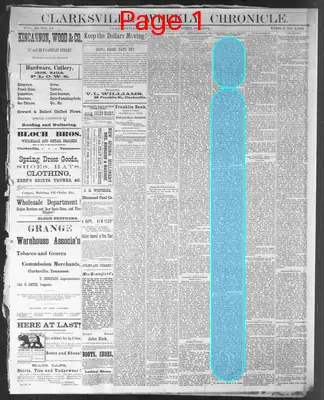
Clarksville Weekly Chronicle
Clarksville, Montgomery County, Tennessee
What is this article about?
On July 4, 1835, in Vicksburg, Mississippi, a national holiday barbecue celebration is disrupted by gamblers George Blackburn and Frank Cabler. Soldiers eject them, prompting threats of revenge. A vigilante committee led by Dr. William Bodley confronts remaining gamblers; Bodley is shot dead, sparking a mob that lynches five gamblers and attacks their dens, killing dozens and purging the town of gambling.
Merged-components note: Continuation of the eyewitness story from 1835 about events in Vicksburg, with sequential reading order and narrative flow.
Clipping

OCR Quality
Full Text
Philadelphia Times.
It is because I was in Vicksburg
when the event which I am about
to describe occurred that I am able
to give the exact facts of what was
the most exciting epoch in the his-
tory of that city up to the war.
'This occurrence, I believe, has never
been described-at least I have
never seen it-and it furnishes per-
haps better than anything else an
idea of the state of society as it ex-
isted at that period in the wild
southwest. On the Fourth of July,
1835, there was a grand celebration
in honor of the national holiday.
The town was gayly decorated,
bands were on the streets, and there
were evidences on every hand that
the day was one of general rejoicing.
A barbecue-- a favorite feature of
the Fourth of July celebrations in
the south-was the order of the day.
and to this everybody was invited.
For the time the utmost good feel-
ing reigned. Even the vengeance
sworn against the gamblers was for-
gotten, or, if not forgotten, at least
suspended.
Eminent speakers had been invit.
ed from other states, and among
those there on that day were Alex
ander McClung. of Kentucky. with
Foote and Prentiss. and others
equally well known in that day if
not so well remembered in this.
One table had been reserved for in-
vited guests and other eminent
persons present, and at this were
seated some 35 or 40 men. In such
a mixed assemblage as the barbe-
cue attracted, there were not un
naturally a large number of gamblers
professional gamblers, of whom
there were not less than 250 in the
city at that time. These gamblers
had their headquarters in a colony
of their own, or rather in three
houses, known as the "Kangaroos,
Nos. 1, 2 and 3." With them were
associated · the most abandoned
wretches of both sexes to be found
in the whole southwest. Some of
the notorious among these gamblers
were known in every state along
the Mississippi, among them being
George Blackburn, Frank Cabler,
Bill Skin. Alexander McCov, Jim
Hood and Tom Carr. The military
had turned out and were under
arms as part of the attractions of the
day. While the' speech-making
was going on, the gambler Black-
burn, who was present, in compa-
ny with Cabler, his partner, both
being seated at a table apart from
the speakers, began an interruption,
Blackburn remarking that he was
going to have some fun if he clean-
ed out the whole table. Somebody
shouted to Blackburn to sit down,
and not cause a disturbance. It was
no use. He was bound, he said, to
start the fun, and, so saying he
jumped on the table.
THE FUN STARTED IN EARNEST.
As he did so several of the sol-
diers jumped from the table where
they were sitting and demanded
that he sit down. Blackburn re-
fused and defied them. Presenting
their guns, the soldiers jammed
him off the table. He struggled
fiercely. but was finally overpower-
ed and cut in the struggle. Cabler.
who attempted to assist him, was al-
so mastered. Both men, bleeding but
still defiant, were then bound, a ca-
noe was got, and they were placed
in it and pushed from the shore. In
another moment they were floating
down the Mississippi. being rescued
by their fellows some half-mile be-
low. The gamblers were furious,
and threatening revenge, making
no secret of the threat that they
would burn the town down during
the night. The barbecue broke up.
It was known, everybody felt, that
the gamblers meant business, and
that the lives and property of all re-
spectable people were in the most
imminent danger when night came.
Nobody thought of anything but
safety, and the wildest excitement
prevailed. Citizens everywhere
were seen arming themselves to
await the struggle that all felt was
at hand. In the midst of all the
commotion, however, there were
some who did not lose their heads.
One of these was Dr. William Bod-
lev. of Kentucky. He quietly se-
lected a number of men, formed
them into a vigilance committee
and placed himself at their head.
This done, the vigilance commit.
tee assumed the offensive and sent
word to the gamblers that they on-
ly had five hours to leave Vicks-
burg or-! Many of them did so.
But in the meantime five gamblers
not idle. They were North. Heims,
Juch Bill Haines, John A. Murreli
and another man whose name I
have
forgotten.
These men
gathered at North's gambling rooms
near the river. Here they barricad-
ed themselves, and at the command
to leave swore that they would not
move and would kill any man who
interfered with them. Dr. Bodley.
hearing of this; went down to
North's place, as he said. to make
one last effort to convince them of
the folly of resisting the people. He
made his last effort-he had hardly
got within speaking distance when
a shot from one of the gamblers was
fired and Dr. Bodley fell dead in
his tracks.
He never breathed
again. The result may be imag-
ined. The peace loving citizens,
who but an hour before were simply
bent on self protection, were trans-
formed for the time into a blood
thirsty mob, and reckless of danger.
they charged the house, and break-
ing down the barricades captured
the five gamblers.
A TERRIBLE RETRIBUTION.
The "Kangaroos" were separated
from the city by a bayou," which
was crossed by a wooden structure
known by the suggestive name of
the "Bridge of Sighs." Across this
the frenzied people hurried the capt
ured gamblers. "On the other side
trees were selected and in less than
an hour after the murder of Dr. Bod-
ley the five gamblers were swing-
ing by the necks, dead. But this
was not the end; it was only the
beginning of the terrible retribution
to be exacted. The mob advanced
on the three houses known as the
"Kangaroos" and found that there
were still many of the gamblers who
had not taken to flight while there
was yet time. These were seized,
some of them shot down, others
driven into the river, and two of
them taken by the mob and thrown
from the "Bridge of Sighs" into the
stagnant waters of the bayou far be-
low. For over an hour this terrible
scene continued, before the ven-
geance of the mob' was satisfied and
their work considered done. How
many men perished that night will
never be known, but I have heard
of between 50 and 60 who were at
the "Kangaroos" on the Fourth of
July and who were never heard of
afterward. The bodies of the five
gamblers who were hanged were
kept swinging for two days,
a guard standing by with or-
ders to shoot down any man who
should attempt to remove them.
Nor were the people of Vicksburg
even then satisfied. They followed
the most notorious of the gamblers
into adjoining states. and more than
one fell a victim to their vengeance.
But they did their work thoroughly
—they rescued the town from the
domination of the cut-throats who
had ruled it. and thereafter. Vicks-
burg was never called, as she had
been before that memorable Fourth
of July, "the gambler's paradise."
What sub-type of article is it?
What themes does it cover?
What keywords are associated?
What entities or persons were involved?
Where did it happen?
Story Details
Key Persons
Location
Vicksburg
Event Date
Fourth Of July, 1835
Story Details
During a 1835 Independence Day barbecue in Vicksburg, gamblers Blackburn and Cabler disrupt proceedings and are ejected by soldiers. Threatening revenge, gamblers barricade themselves; vigilante leader Dr. Bodley is killed trying to negotiate, inciting a mob to lynch five gamblers, attack their dens, kill dozens, and purge the town of gambling.