Thank you for visiting SNEWPapers!
Sign up free
Literary
April 2, 1882
Knoxville Daily Chronicle
Knoxville, Knox County, Tennessee
What is this article about?
Tribute essay by Rev. F. E. Sturgis mourning the death of poet Henry Wadsworth Longfellow, praising him as America's national fireside bard, detailing his life, works like Evangeline and Hiawatha, and enduring legacy in hearts and homes worldwide.
Clipping
OCR Quality
98%
Excellent
Full Text
OUR DEAD POET.
BY REV. F. E. STURGIS.
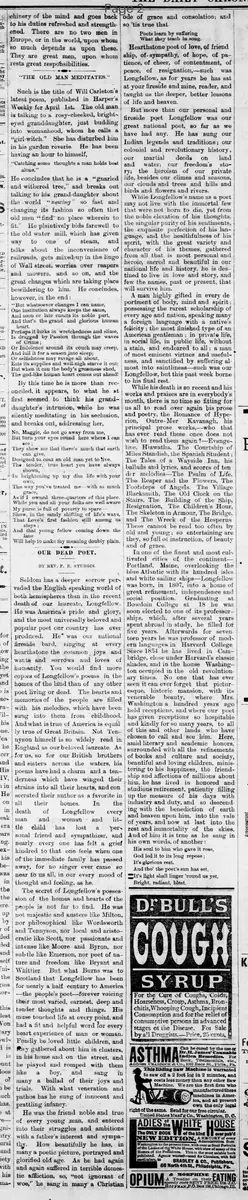
Seldom has a deeper sorrow pervaded the English speaking world of both hemispheres than in the recent death of our laureate, Longfellow. He was America's pride and glory, and the most universally beloved and popular poet our country has ever produced. He was our national fireside bard, singing at every hearthstone the common joys and wants and sorrows and loves of humanity. You would find more copies of Longfellow's poems in the homes of the land than of any other poet living or dead. The hearts and memories of the people are filled with his melodies, which have been sung into them from childhood. And what is true of America is equally true of Great Britain. Not Tennyson himself is so widely read in England as our beloved laureate. As for us, so for our British brothers and sisters across the waters, his poems have had a charm and a tenderness which have winged their strains into all their hearts, and consecrated their author as a favorite in all their homes. In the death of Longfellow every man and woman and little child has lost a personal friend and sympathizer, and nearly every one has felt a grief kindred to that one feels when one of the immediate family has passed away, for no singer ever came so near to us all, in our every mood of thought and feeling, as he. The secret of Longfellow's possession of the homes and hearts of the people is not far to find. He was not majestic and austere like Milton, nor philosophical like Wordsworth and Tennyson, nor local and aristocratic like Scott, nor passionate and intense like Moore and Byron, nor subtle like Emerson, nor poet of nature and freedom like Bryant and Whittier. But what Burns was to Scotland that Longfellow has been for nearly a half century to America—the people's poet—forever voicing their most varied, earnest, deep and tender thoughts and things. His muse touched life at every point, and had a fit and helpful word for every heart experience of man or woman. Fondly he loved little children, and they gathered about him in clusters, in his home and on the street, and he played and romped with them like a boy, and sang in many a ballad of their joys and trials. With what veneration and pathos has he sung of innocent and prattling infancy. He was the friend noble and true of every young man, and entered into their struggles and ambitions with a father's interest and sympathy. How beautifully he has, in many a poetic picture, portrayed and glorified old age. As he had again and again suffered in terrible domestic affliction, so, "not ignorant of woe," he sang in many a Christian ode of grace and consolation; and so 'tis true that Poets learn by suffering What they teach in song. Hearthstone poet of love, of friendship, of sympathy, of hope, of patience, of cheer, of contentment, of peace, of resignation,—such was Longfellow, as for years he has sat at your fireside and mine, reader, and taught us the deeper, better lessons of life and heaven. But more than our personal and fireside poet Longfellow was our great national poet, so far as we have had any. He has sung our Indian legends and traditions; our colonial and revolutionary history, our martial deeds on land and water; our freedom's story; the heroism of our private life, besides our climes and seasons, our clouds and trees and hills and birds and flowers and rivers. While Longfellow's name as a poet may not live with the immortal few that were not born to die, yet from the noble elevation of his thoughts, the singular purity of his sentiments, the exquisite perfection of his language, and the healthfulness of his spirit, with the great variety and character of his themes, gathered from all that is most personal and heroic, sacred and beautiful in our national life and history, he is destined to live in love and story, and few the names, past or present, that will survive him. A man highly gifted in every department of body, mind and spirit: possessing the rarest scholarship of every age and nation, speaking many a foreign language with a native's felicity; the most finished type of an American gentleman: in private life, in social life, in public life, without a stain, and endeared to all: a man of most eminent virtues and usefulness, and sanctified by suffering almost into saintliness—such was our Longfellow, but this past week borne to his final rest. While his death is so recent and his works and praises are in everybody's mouth, there is no time so fitting for us all to read over again his prose and poetry, the Romance of Hyperion, Outre-Mer, Kavanagh, his principal prose works,—who that has ever read these once does not wish to read them again?—Evangeline, Hiawatha, The Courtship of Miles Standish, the Spanish Student: The Tales of a Wayside Inn, his ballads and lyrics, and scores of tender melodies—The Psalm of Life, The Reaper and the Flowers, The Footsteps of Angels, The Village Blacksmith, The Old Clock on the Stairs, The Building of the Ship, Resignation, The Children's Hour, The Skeleton in Armour, The Bridge, and The Wreck of the Hesperus. These cannot be read too often by old and young; so entertaining are they, so full of instruction, of beauty and of grace. In one of the finest and most cultivated cities of the continent—Portland, Maine, overlooking the blue Atlantic with its hundred isles and white sailing ships—Longfellow was born, in 1807, into a home of great refinement, independence and social position. Graduating at Bowdoin College at 18 he was soon elected to one of its professorships, which, after several years spent abroad in study, he filled for five years. Afterwards for seventeen years he was professor of modern languages in Harvard College. Since 1854 he has lived in Cambridge, close under Harvard's classic shades, and in the house Washington occupied in the old revolutionary times. No one that has ever seen it can ever forget that picturesque, historic mansion, with its venerable beauty, where Mrs. Washington a hundred years ago held receptions, and where our poet has given receptions so hospitable and kindly for so many years, to all of this and other lands who have chosen to call and see him. Here, amid literary and academic honors, surrounded with all the refinements of books and culture and society, beautiful and loving children, ministering to his happiness, the friendship and affections of millions about him, he has lived in honored and studious retirement, patiently filling up the measure of his days with industry and duty, and so descending with the benediction of earth and heaven upon him, into the vale of years, and now at last into the rest and immortality of the skies. And of him it is true as he sang in his own words, of another:
His soul to him who gave it rose,
God led it to its long repose;
It's glorious rest.
And tho' the poet's sun has set,
It's light shall linger 'round us yet.
Bright, radiant, blest.
BY REV. F. E. STURGIS.
Seldom has a deeper sorrow pervaded the English speaking world of both hemispheres than in the recent death of our laureate, Longfellow. He was America's pride and glory, and the most universally beloved and popular poet our country has ever produced. He was our national fireside bard, singing at every hearthstone the common joys and wants and sorrows and loves of humanity. You would find more copies of Longfellow's poems in the homes of the land than of any other poet living or dead. The hearts and memories of the people are filled with his melodies, which have been sung into them from childhood. And what is true of America is equally true of Great Britain. Not Tennyson himself is so widely read in England as our beloved laureate. As for us, so for our British brothers and sisters across the waters, his poems have had a charm and a tenderness which have winged their strains into all their hearts, and consecrated their author as a favorite in all their homes. In the death of Longfellow every man and woman and little child has lost a personal friend and sympathizer, and nearly every one has felt a grief kindred to that one feels when one of the immediate family has passed away, for no singer ever came so near to us all, in our every mood of thought and feeling, as he. The secret of Longfellow's possession of the homes and hearts of the people is not far to find. He was not majestic and austere like Milton, nor philosophical like Wordsworth and Tennyson, nor local and aristocratic like Scott, nor passionate and intense like Moore and Byron, nor subtle like Emerson, nor poet of nature and freedom like Bryant and Whittier. But what Burns was to Scotland that Longfellow has been for nearly a half century to America—the people's poet—forever voicing their most varied, earnest, deep and tender thoughts and things. His muse touched life at every point, and had a fit and helpful word for every heart experience of man or woman. Fondly he loved little children, and they gathered about him in clusters, in his home and on the street, and he played and romped with them like a boy, and sang in many a ballad of their joys and trials. With what veneration and pathos has he sung of innocent and prattling infancy. He was the friend noble and true of every young man, and entered into their struggles and ambitions with a father's interest and sympathy. How beautifully he has, in many a poetic picture, portrayed and glorified old age. As he had again and again suffered in terrible domestic affliction, so, "not ignorant of woe," he sang in many a Christian ode of grace and consolation; and so 'tis true that Poets learn by suffering What they teach in song. Hearthstone poet of love, of friendship, of sympathy, of hope, of patience, of cheer, of contentment, of peace, of resignation,—such was Longfellow, as for years he has sat at your fireside and mine, reader, and taught us the deeper, better lessons of life and heaven. But more than our personal and fireside poet Longfellow was our great national poet, so far as we have had any. He has sung our Indian legends and traditions; our colonial and revolutionary history, our martial deeds on land and water; our freedom's story; the heroism of our private life, besides our climes and seasons, our clouds and trees and hills and birds and flowers and rivers. While Longfellow's name as a poet may not live with the immortal few that were not born to die, yet from the noble elevation of his thoughts, the singular purity of his sentiments, the exquisite perfection of his language, and the healthfulness of his spirit, with the great variety and character of his themes, gathered from all that is most personal and heroic, sacred and beautiful in our national life and history, he is destined to live in love and story, and few the names, past or present, that will survive him. A man highly gifted in every department of body, mind and spirit: possessing the rarest scholarship of every age and nation, speaking many a foreign language with a native's felicity; the most finished type of an American gentleman: in private life, in social life, in public life, without a stain, and endeared to all: a man of most eminent virtues and usefulness, and sanctified by suffering almost into saintliness—such was our Longfellow, but this past week borne to his final rest. While his death is so recent and his works and praises are in everybody's mouth, there is no time so fitting for us all to read over again his prose and poetry, the Romance of Hyperion, Outre-Mer, Kavanagh, his principal prose works,—who that has ever read these once does not wish to read them again?—Evangeline, Hiawatha, The Courtship of Miles Standish, the Spanish Student: The Tales of a Wayside Inn, his ballads and lyrics, and scores of tender melodies—The Psalm of Life, The Reaper and the Flowers, The Footsteps of Angels, The Village Blacksmith, The Old Clock on the Stairs, The Building of the Ship, Resignation, The Children's Hour, The Skeleton in Armour, The Bridge, and The Wreck of the Hesperus. These cannot be read too often by old and young; so entertaining are they, so full of instruction, of beauty and of grace. In one of the finest and most cultivated cities of the continent—Portland, Maine, overlooking the blue Atlantic with its hundred isles and white sailing ships—Longfellow was born, in 1807, into a home of great refinement, independence and social position. Graduating at Bowdoin College at 18 he was soon elected to one of its professorships, which, after several years spent abroad in study, he filled for five years. Afterwards for seventeen years he was professor of modern languages in Harvard College. Since 1854 he has lived in Cambridge, close under Harvard's classic shades, and in the house Washington occupied in the old revolutionary times. No one that has ever seen it can ever forget that picturesque, historic mansion, with its venerable beauty, where Mrs. Washington a hundred years ago held receptions, and where our poet has given receptions so hospitable and kindly for so many years, to all of this and other lands who have chosen to call and see him. Here, amid literary and academic honors, surrounded with all the refinements of books and culture and society, beautiful and loving children, ministering to his happiness, the friendship and affections of millions about him, he has lived in honored and studious retirement, patiently filling up the measure of his days with industry and duty, and so descending with the benediction of earth and heaven upon him, into the vale of years, and now at last into the rest and immortality of the skies. And of him it is true as he sang in his own words, of another:
His soul to him who gave it rose,
God led it to its long repose;
It's glorious rest.
And tho' the poet's sun has set,
It's light shall linger 'round us yet.
Bright, radiant, blest.
What sub-type of article is it?
Essay
Elegy
What themes does it cover?
Death Mortality
Patriotism
Moral Virtue
What keywords are associated?
Longfellow
Tribute
National Poet
Death
American Literature
Elegy
Fireside Bard
Poetic Legacy
What entities or persons were involved?
By Rev. F. E. Sturgis.
Literary Details
Title
Our Dead Poet.
Author
By Rev. F. E. Sturgis.
Subject
On The Death Of Longfellow
Form / Style
Commemorative Prose Tribute
Key Lines
He Was Our National Fireside Bard, Singing At Every Hearthstone The Common Joys And Wants And Sorrows And Loves Of Humanity.
But What Burns Was To Scotland That Longfellow Has Been For Nearly A Half Century To America—The People's Poet—Forever Voicing Their Most Varied, Earnest, Deep And Tender Thoughts And Things.
Hearthstone Poet Of Love, Of Friendship, Of Sympathy, Of Hope, Of Patience, Of Cheer, Of Contentment, Of Peace, Of Resignation,—Such Was Longfellow, As For Years He Has Sat At Your Fireside And Mine, Reader, And Taught Us The Deeper, Better Lessons Of Life And Heaven.
His Soul To Him Who Gave It Rose,
God Led It To Its Long Repose;
It's Glorious Rest.
And Tho' The Poet's Sun Has Set,
It's Light Shall Linger 'Round Us Yet.
Bright, Radiant, Blest.