Thank you for visiting SNEWPapers!
Sign up free
Gazette Of The United States
New York, New York County, New York
What is this article about?
In the US Supreme Court, the Attorney-General sought a mandamus against Pennsylvania circuit courts to enforce a pension law they deemed unconstitutional. Debate on his supervisory authority divided the judges evenly (Iredell, Johnson, Blair vs. Wilson, Cushing, Chief Justice), leading to postponement of the motion.
Clipping
OCR Quality
Full Text
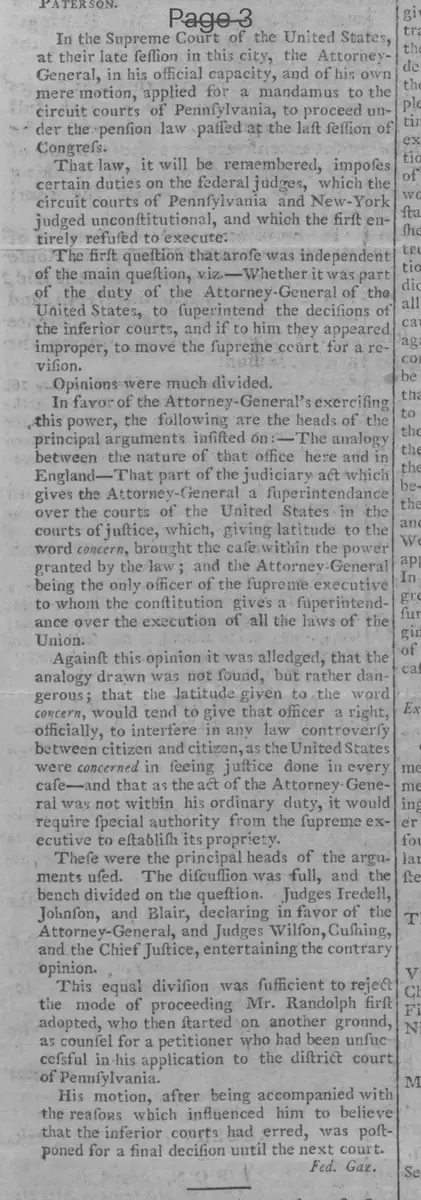
That law, it will be remembered, imposes certain duties on the federal judges, which the circuit courts of Pennsylvania and New-York judged unconstitutional, and which the first entirely refused to execute.
The first question that arose was independent of the main question, viz.—Whether it was part of the duty of the Attorney-General of the United States, to superintend the decisions of the inferior courts, and if to him they appeared improper, to move the supreme court for a revision.
Opinions were much divided.
In favor of the Attorney-General's exercising this power, the following are the heads of the principal arguments insisted on:—The analogy between the nature of that office here and in England—That part of the judiciary act which gives the Attorney-General a superintendence over the courts of the United States in the courts of justice, which, giving latitude to the word concern, brought the case within the power granted by the law; and the Attorney-General being the only officer of the supreme executive to whom the constitution gives a superintendence over the execution of all the laws of the Union.
Against this opinion it was alleged, that the analogy drawn was not sound, but rather dangerous; that the latitude given to the word concern, would tend to give that officer a right, officially, to interfere in any law controversy between citizen and citizen, as the United States were concerned in seeing justice done in every case—and that as the act of the Attorney-General was not within his ordinary duty, it would require special authority from the supreme executive to establish its propriety.
These were the principal heads of the arguments used. The discussion was full, and the bench divided on the question. Judges Iredell, Johnson, and Blair, declaring in favor of the Attorney-General, and Judges Wilson, Cushing, and the Chief Justice, entertaining the contrary opinion.
This equal division was sufficient to reject the mode of proceeding Mr. Randolph first adopted, who then started on another ground, as counsel for a petitioner who had been unsuccessful in his application to the district court of Pennsylvania.
His motion, after being accompanied with the reasons which influenced him to believe that the inferior courts had erred, was postponed for a final decision until the next court.
Fed. Gaz.
What sub-type of article is it?
What themes does it cover?
What keywords are associated?
What entities or persons were involved?
Where did it happen?
Story Details
Key Persons
Location
Supreme Court Of The United States In This City; Circuit Courts Of Pennsylvania And New York
Event Date
Late Session
Story Details
The Attorney-General applied for a mandamus to enforce the pension law, which Pennsylvania and New-York circuit courts deemed unconstitutional. Debate on his duty to superintend inferior courts divided the Supreme Court judges evenly, rejecting the initial motion; a new motion as counsel for a petitioner was postponed.