Thank you for visiting SNEWPapers!
Sign up free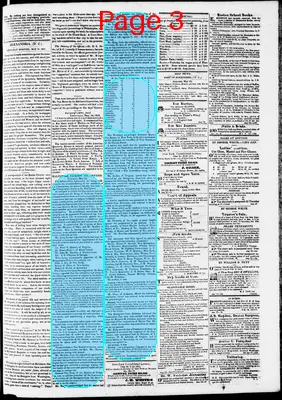
Phenix Gazette
Alexandria, Virginia
What is this article about?
The Baltimore Jackson Convention on May 22 organized with General Robert Lucas as president and nominated Martin Van Buren of New York as Vice Presidential candidate by a vote of 197-64-26, affirming support for Andrew Jackson. Held in Baltimore's Universalist Church due to space needs.
Merged-components note: The table presents the vote tally results directly following and related to the Baltimore Jackson Convention story; merging into a single coherent component.
Clipping
OCR Quality
Full Text
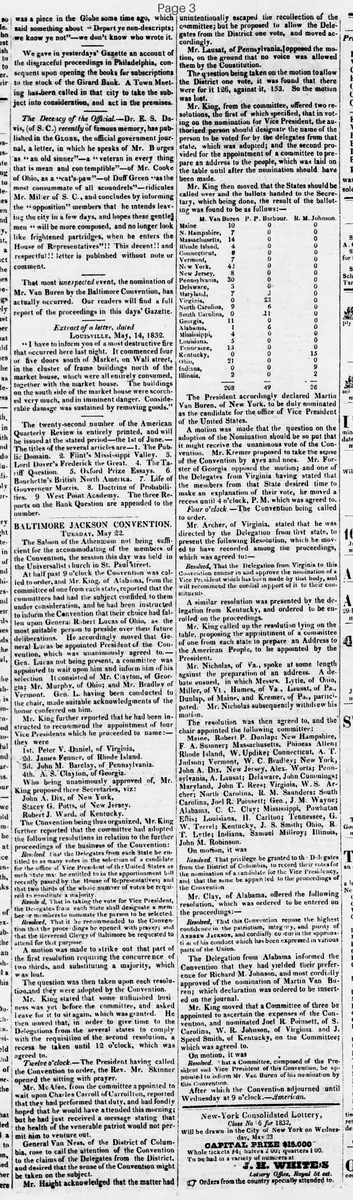
Tuesday, May 22.
The Saloon of the Athenæum not being sufficient for the accommodation of the members of the Convention, the session this day was held in the Universalist Church in St. Paul street.
At half past 9 o'clock the Convention was called to order, and Mr. King, of Alabama, from the committee of one from each state, reported that the committees had had the subject confided to them under consideration, and he had been instructed to inform the Convention that their choice had fallen upon General Robert Lucas of Ohio, as the most suitable person to preside over their future deliberations. He accordingly moved that General Lucas be appointed President of the Convention, which was unanimously agreed to.
Gen. Lucas not being present, a committee was appointed to wait upon him and inform him of his selection. It consisted of Mr. Clayton, of Georgia; Mr. Murphy, of Ohio; and Mr. Bradley of Vermont. Gen. L. having been conducted to the chair, made suitable acknowledgments of the honor conferred on him.
Mr. King further reported that he had been instructed to recommend the appointment of four Vice Presidents which he proceeded to name:—they were
1st: Peter V. Daniel, of Virginia.
2d. James Fenner, of Rhode Island.
3d. John M. Barclay, of Pennsylvania.
4th. A. S. Clayton, of Georgia.
Who being unanimously approved of, Mr. King proposed three Secretaries, viz:
John A. Dix, of New York,
Stacey G. Potts, of New Jersey.
Robert J. Ward, of Kentucky.
The Convention being thus organized, Mr. King further reported that the committee had adopted the following resolutions in relation to the further proceedings of the business of the Convention:
Resolved, That the Delegates from each State be entitled to as many votes in the selection of a candidate for the office of Vice President of the United States as such state may be entitled to in the apportionment bill recently passed by the House of Representatives; and that two thirds of the whole number of votes be required to constitute a majority.
Resolved, That in taking the vote for Vice President, the Delegates from each State shall designate a member or members to nominate the person to be selected.
Resolved, That it be recommended to the Convention that the proceedings be opened with prayer; and that the Reverend Clergy of Baltimore be requested to attend for that purpose.
A motion was made to strike out that part of the first resolution requiring the concurrence of two thirds, and substituting a majority, which was lost.
The question was then taken upon each resolution, and they were adopted by the Convention.
Mr. King stated that some unfinished business was yet before the committee, and asked leave for it to sit again, which was granted. He then moved that, in order to give time to the Delegations from the several states to comply with the requisition of the second resolution, a recess be taken until 12 o'clock, which was agreed to.
Twelve o'clock.—The President having called the Convention to order, the Rev. Mr. Skinner opened the sitting with prayer.
Mr. McAfee, from the committee appointed to wait upon Charles Carroll of Carrollton, reported that they had performed that duty, and had fondly hoped that he would have attended this morning; but he had just received a message stating that the health of the venerable patriot would not permit him to venture out.
General Van Ness, of the District of Columbia, rose to call the attention of the Convention to the claims of the Delegates from the District, and desired that the sense of the Convention might be taken on the subject.
Mr. Haight acknowledged that the matter had unintentionally escaped the recollection of the committee; but he proposed to allow the Delegates from the District one vote, and moved accordingly.
Mr. Lausat, of Pennsylvania, opposed the motion, on the ground that no voice was allowed them by the Constitution.
The question being taken on the motion to allow the District one vote, it was found that there were for it 126, against it, 153. So the motion was lost.
Mr. King, from the committee, offered two resolutions, the first of which specified, that in voting on the nomination for Vice President, the authorized person should designate the name of the person to be voted for by the delegates from that state, which was adopted; and the second provided for the appointment of a committee to prepare an address to the people, which was laid on the table until after the nomination should have been made.
Mr. King then moved that the States should be called over and the ballots handed to the Secretary, which being done, the result of the balloting was found to be as follows:
The President accordingly declared Martin Van Buren, of New York, to be duly nominated as the candidate for the office of Vice President of the United States.
A motion was made that the question on the adoption of the Nomination should be so put that it might receive the unanimous vote of the Convention. Mr. Kremer proposed to take the sense of the Convention by ayes and noes. Mr. Forster of Georgia opposed the motion;—and one of the Delegates from Virginia having stated that the members from that State desired time to make an explanation of their vote, he moved a recess until 4 o'clock, P. M. which was agreed to.
Four o'clock.—The Convention being called to order.
Mr. Archer, of Virginia, stated that he was directed by the Delegation from that state, to present the following Resolution, which he moved to have recorded among the proceedings, which was agreed to:—
Resolved, That the Delegation from Virginia to this Convention concur in and approve the nomination of a Vice President which has been made by that body, and will recommend the cordial support of it to their constituents.
A similar resolution was presented by the delegation from Kentucky, and ordered to be enrolled on the proceedings.
Mr. King called up the resolution lying on the table, proposing the appointment of a committee of one from each state to prepare an Address to the American People, to be appointed by the President.
Mr. Nicholas, of Va., spoke at some length against the preparation of an address. A debate ensued, in which Messrs. Lytle, of Ohio, Miller, of Vt., Humes, of Va., Lausat, of Pa., Dunlap, of Maine, and Kremer, of Pa., participated. Mr. Nicholas subsequently withdrew his motion.
The resolution was then agreed to, and the chair appointed the following committee:
Maine, Robert P. Dunlap; New Hampshire, F. A. Sumner; Massachusetts, Phineas Allen; Rhode Island, W. Updike; Connecticut, A. T. Judson; Vermont, W. C. Bradley; New York, John A. Dix, New Jersey, Alex. Worts; Pennsylvania, A. Lausat; Delaware, John Cummings; Maryland, John T. Rees; Virginia, W. S. Archer; North Carolina, R. M. Saunders; South Carolina, Joel R. Poinsett; Ga., J. M. Wayne; Alabama, C. C. Clay; Mississippi, Powhatan Ellis; Louisiana, H. Carlton; Tennessee, G. W. Terrell; Kentucky, J. S. Smith; Ohio, R. T. Lytle; Indiana, Samuel Milroy; Illinois, John M. Robinson.
On motion, it was
Resolved, That privilege be granted to the Delegates from the District of Columbia, to record their votes for the nomination of a candidate for the Vice Presidency, and that the same be appended to the proceedings of the Convention.
Mr. Clay, of Alabama, offered the following resolution, which was ordered to be entered on the proceedings:
Resolved, That this Convention repose the highest confidence in the patriotism, integrity, and purity of Andrew Jackson, and cordially concur in the approbation of his conduct which has been expressed in various parts of the Union.
The Delegation from Alabama informed the Convention that they had yielded their preference for Richard M. Johnson, and most cordially approved of the nomination of Martin Van Buren; which declaration was ordered to be inserted on the journal.
Mr. King moved that a Committee of three be appointed to ascertain the expenses of the Convention, and nominated Joel R. Poinsett, of S. Carolina, W. R. Johnson, of Virginia, and J. Speed Smith, of Kentucky, on the Committee; which was agreed to.
On motion, it was
Resolved, That a Committee, composed of the President and Vice President of this Convention, be appointed to inform Mr. Van Buren of his nomination by this Convention.
After which the Convention adjourned until Wednesday at 9 o'clock.—American.
| M. Van Buren | P. P. Barbour. | R. M. Johnson | |
| Maine | 10 | 0 | 0 |
| N. Hampshire, | 7 | 0 | 0 |
| Massachusetts, | 14 | 0 | 0 |
| Rhode Island, | 4 | 0 | 0 |
| Connecticut, | 8 | 0 | 0 |
| Vermont, | 7 | 0 | 0 |
| New York, | 42 | 0 | 0 |
| New Jersey, | 8 | 0 | 0 |
| Pennsylvania, | 30 | 0 | 0 |
| Delaware, | 3 | 0 | 0 |
| Maryland, | 7 | 3 | 0 |
| Virginia, | 0 | 23 | 0 |
| North Carolina, | 9 | 6 | 0 |
| South Carolina, | 0 | 11 | 0 |
| Georgia, | 11 | 0 | 0 |
| Alabama, | 1 | 6 | 0 |
| Mississippi, | 4 | 0 | 0 |
| Louisiana, | 5 | 0 | 0 |
| Tennessee, | 15 | 0 | 0 |
| Kentucky, | 0 | 0 | 15 |
| Ohio, | 21 | 0 | 0 |
| Indiana, | 0 | 0 | 9 |
| Illinois, | 2 | 0 | 2 |
What sub-type of article is it?
What themes does it cover?
What keywords are associated?
What entities or persons were involved?
Where did it happen?
Story Details
Key Persons
Location
Universalist Church In St. Paul Street, Baltimore
Event Date
Tuesday, May 22
Story Details
The convention elected officers, adopted voting rules requiring two-thirds majority, prayed, denied D.C. delegates a vote, balloted to nominate Martin Van Buren for Vice President with 197 votes against competitors, affirmed support for Andrew Jackson, appointed committees for address and expenses, and adjourned.