Thank you for visiting SNEWPapers!
Sign up free
Fremont Journal
Fremont, Sandusky County, Ohio
What is this article about?
Hon. Rufus Choate, Attorney General, argued before the Massachusetts Supreme Court that the state's Anti-Liquor Law, similar to Maine's, is constitutional, allowing prohibition of liquor sales after federal importation and destruction as nuisance if illegal.
Clipping
OCR Quality
Full Text
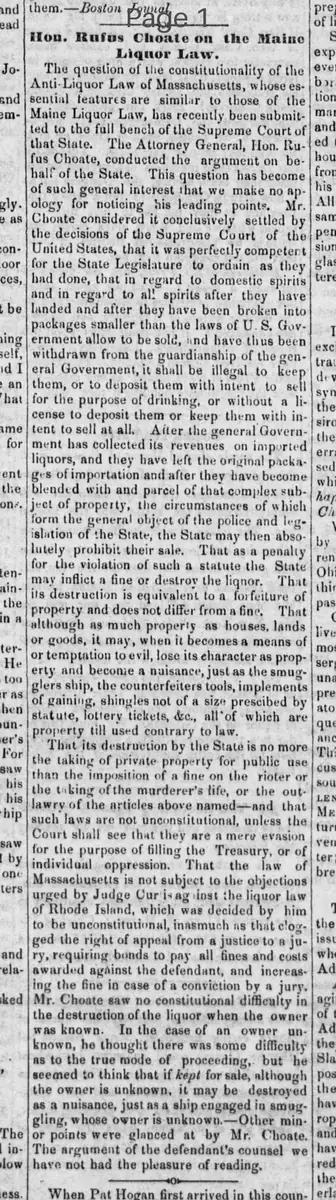
The question of the constitutionality of the Anti-Liquor Law of Massachusetts, whose essential features are similar to those of the Maine Liquor Law, has recently been submitted to the full bench of the Supreme Court of that State. The Attorney General, Hon. Rufus Choate, conducted the argument on behalf of the State. This question has become of such general interest that we make no apology for noticing his leading points. Mr. Choate considered it conclusively settled by the decisions of the Supreme Court of the United States, that it was perfectly competent for the State Legislature to ordain as they had done, that in regard to domestic spirits and in regard to all spirits after they have landed and after they have been broken into packages smaller than the laws of U. S. Government allow to be sold, and have thus been withdrawn from the guardianship of the general Government, it shall be illegal to keep them, or to deposit them with intent to sell for the purpose of drinking. or without a license to deposit them or keep them with intent to sell at all. After the general Government has collected its revenues on imported liquors, and they have left the original packages of importation and after they have become blended with and parcel of that complex subject of property, the circumstances of which form the general object of the police and legislation of the State, the State may then absolutely prohibit their sale. That as a penalty for the violation of such a statute the State may inflict a fine or destroy the liquor. That its destruction is equivalent to a forfeiture of property and does not differ from a fine. That although as much property as houses, lands or goods, it may, when it becomes a means of or temptation to evil, lose its character as property and become a nuisance, just as the smuggler's ship, the counterfeiter's tools, implements of gaming, shingles not of a size prescribed by statute, lottery tickets, &c., all of which are property till used contrary to law. That its destruction by the State is no more the taking of private property for public use than the imposition of a fine on the rioter or the taking of the murderer's life, or the outlawry of the articles above named—and that such laws are not unconstitutional, unless the Court shall see that they are a mere evasion for the purpose of filling the Treasury, or of individual oppression. That the law of Massachusetts is not subject to the objections urged by Judge Curtis against the liquor law of Rhode Island, which was decided by him to be unconstitutional, inasmuch as that clogged the right of appeal from a justice to a jury, requiring bonds to pay all fines and costs awarded against the defendant, and increasing the fine in case of a conviction by a jury. Mr. Choate saw no constitutional difficulty in the destruction of the liquor when the owner was known. In the case of an owner unknown, he thought there was some difficulty as to the true mode of proceeding, but he seemed to think that if kept for sale, although the owner is unknown, it may be destroyed as a nuisance, just as a ship engaged in smuggling, whose owner is unknown.—Other minor points were glanced at by Mr. Choate. The argument of the defendant's counsel we have not had the pleasure of reading.
What sub-type of article is it?
What keywords are associated?
What entities or persons were involved?
Where did it happen?
Domestic News Details
Primary Location
Massachusetts
Event Date
Recently
Key Persons
Event Details
The constitutionality of the Anti-Liquor Law of Massachusetts, similar to the Maine Liquor Law, was submitted to the Supreme Court. Hon. Rufus Choate argued for the state, asserting that states can prohibit sales of domestic and imported spirits after federal revenue collection, treat illegal liquor as a nuisance subject to destruction, and that this does not violate constitutional property rights, distinguishing it from the unconstitutional Rhode Island law.