Thank you for visiting SNEWPapers!
Sign up free
Alexandria Gazette
Alexandria, Alexandria County, District Of Columbia
What is this article about?
Wm. B. Lloyd protests his arrest in the U.S. Senate gallery on January 16, 1837, during the expunging of a resolution, where he was labeled a 'hired ruffian of the Bank' by Senator Benton and denied a hearing. He complains that Senator Thomas Morris refused to present his memorial and publishes it via the press to vindicate himself.
Clipping
OCR Quality
Full Text
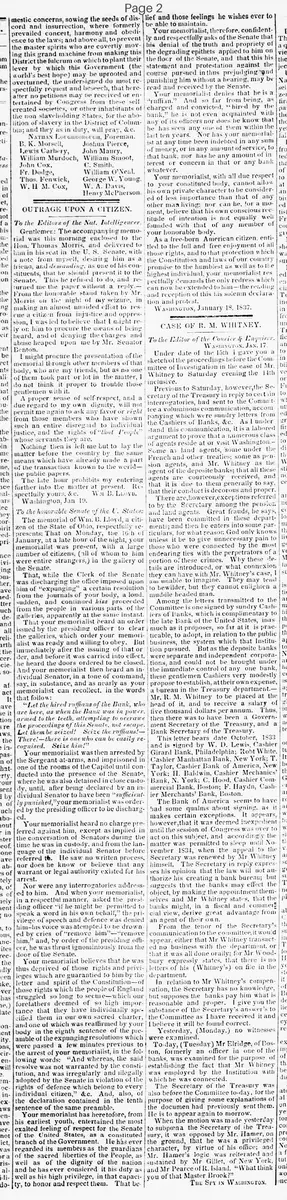
To the Editors of the Nat. Intelligencer.
Gentlemen: The accompanying memorial was this morning enclosed to the Hon. Thomas Morris, and delivered to him in his seat in the U. S. Senate, with a note from myself, desiring him as a friend, and demanding, as one of his constituents, that he should present it to the Senate. This he refused to do, and returned me the paper without a reply.
From the honorable stand taken by Mr. Morris on the night of my seizure, in making an almost unaided effort to rescue a citizen from injustice and oppression, I was led to believe that I might rely on him to procure the means of being heard, and of denying the charges and abuse heaped upon me by Mr. Senator Benton.
I might procure the presentation of the memorial through other members of that body, who are my friends, but as no one of them took part or lot in the matter, I do not think it proper to trouble those gentlemen with it.
A proper sense of self respect, and a due regard to my own dignity, will not permit me again to ask any favor or right from those members who have shown such an entire disregard to individual justice, and the rights of "that People" whose servants they are.
Nothing then is left me but to lay the matter before the country by the same means which have already made a part of the transaction known to the world—the public papers.
The late hour prohibits my entering further into the matter at present. Respectfully yours, &c.
WM B. LLOYD.
Washington, Jan 19.
To the honorable Senate of the U. States:
The memorial of Wm. B. Lloyd, a citizen of the State of Ohio, respectfully represents: That on Monday, the 16th of January, at a late hour of the night, your memorialist was present, with a large number of citizens, (all of whom to him were entire strangers,) in the gallery of the Senate.
That, while the Clerk of the Senate was discharging the office imposed upon him of "expunging" a certain resolution from the journals of your body, a loud, sudden, and continued hiss proceeded from the people in various parts of the galleries, apparently at the same instant.
That your memorialist heard an order issued by the presiding officer to clear the galleries, which order your memorialist was ready and willing to obey. But immediately after the issuing of that order, and before it was carried into effect, he heard the doors ordered to be closed. And your memorialist then heard an individual Senator, in a tone of command, say, in substance, and as nearly as your memorialist can recollect, in the words that follow:
"Let the hired ruffians of the Bank, who are here, as when the Bank was in power, armed to the teeth, attempting to overawe the proceedings of this Senate, not escape. Let them be seized! Seize the ruffians!—There!—there is one who can be easily recognised. Seize him!"
Your memorialist was then arrested by the Sergeant-at-arms, and imprisoned in one of the rooms of the Capitol until conducted into the presence of the Senate, where he was also detained in close custody, until, after being declared by an individual Senator to have been "sufficiently punished," your memorialist was ordered by the presiding officer to be discharged.
Your memorialist heard no charge preferred against him, except as implied in the conversation of Senators during the time he was in custody, and from the language of the individual Senator before referred to. He saw no written process, nor does he know or believe that any warrant or legal authority existed for his arrest.
Nor were any interrogatories addressed to him. And when your memorialist, in a respectful manner, asked the presiding officer "if he might be permitted to speak a word in his own behalf," the privilege of speech and defence was denied him—his voice was attempted to be drowned by cries of "remove him"—"remove him." and, by order of the presiding officer, he was thrust ignominiously from the door of the Senate.
Your memorialist believes that he was thus deprived of those rights and privileges which are guaranteed to him by the letter and spirit of the Constitution—of those rights which the people of England struggled so long to secure—which our forefathers deemed of so high importance that they have individually specified them in our own sacred charter, and one of which was reaffirmed by your body in the eighth sentence of the preamble of the expunging resolutions which were passed a few minutes previous to the arrest of your memorialist, in the following words: "And whereas, the said resolve was not warranted by the constitution, and was irregularly and illegally adopted by the Senate in violation of the rights of defence which belong to every individual citizen," &c. And, also, of the declaration contained in the tenth sentence of the same preamble.
Your memorialist has heretofore, from his earliest youth, entertained the most exalted feeling of respect for the Senate of the United States, as a constituted branch of the Government. He has ever regarded its members as the guardians of the sacred liberties of the People, as well as of the dignity of the nation and he has ever considered it his duty as well as his high privilege, in that capacity, to honor and respect them. That belief and those feelings he wishes ever to be able to maintain.
Your memorialist, therefore, confidently and respectfully asks of the Senate that his denial of the truth and propriety of the degrading epithets applied to him on the floor of the Senate, and that his statement and protestation against the course pursued in thus prejudging and punishing him without a hearing, may be read and received by the Senate.
Your memorialist denies that he is a "ruffian." And so far from being, as charged and convicted, "hired by the bank," he is not even acquainted with any of its officers nor does he know that he has seen any one of them within the last ten years. Nor has your memorialist at any time been indebted in any sum of money, or in any amount of service, to that bank, nor has he any amount of interest or concern in that or any bank whatever.
Your memorialist, with all due respect to your constituted body, cannot allow his own private character to be considered of less importance than that of any other man living: nor can he, for a moment, believe that his own conscious rectitude of intention is not equally well founded with that of any member of your honorable body.
As a free-born American citizen, entitled to the full and free enjoyment of all those rights, and to that protection which the Constitution and laws of our country promise to the humblest as well as to the highest individual, your memorialist respectfully demands the only redress which can now be extended to him—the reading and reception of this his solemn declaration and protest.
Washington, January 18, 1837.
What sub-type of article is it?
What themes does it cover?
What keywords are associated?
What entities or persons were involved?
Letter to Editor Details
Author
Wm B. Lloyd
Recipient
Editors Of The Nat. Intelligencer
Main Argument
wm. b. lloyd protests his arrest without due process in the senate, denial of right to defend himself against charges of being a 'hired ruffian of the bank,' and senator morris's refusal to present his memorial, demanding vindication through public disclosure.
Notable Details