Thank you for visiting SNEWPapers!
Sign up free
Letter to Editor
October 15, 1818
Alexandria Gazette & Daily Advertiser
Alexandria, Virginia
What is this article about?
H. responds to Lucius's satirical attack in the Gazette, defending his literary classifications, appreciation of Scottish vernacular poets like Burns, and correcting Lucius's grammatical errors and misconceptions about belles lettres, Milton, and French preachers.
Clipping
OCR Quality
98%
Excellent
Full Text
To the Editor,
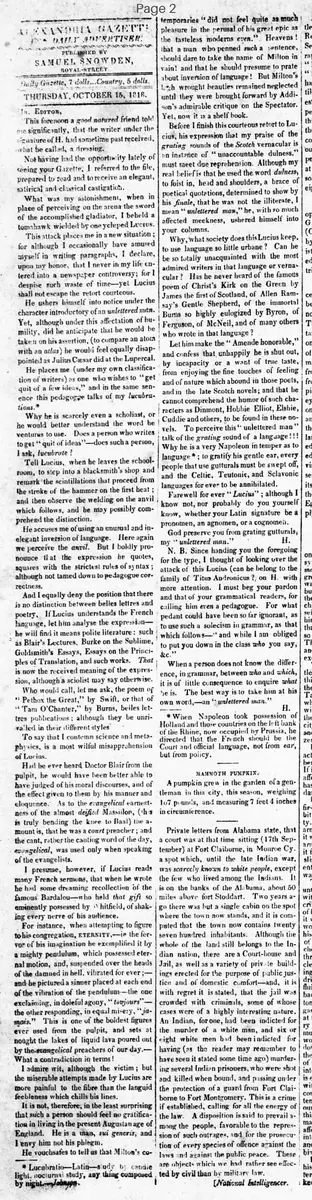
This forenoon a good natured friend told me significantly, that the writer under the signature of H. had sometime past received what he called, a dressing. Not having had the opportunity lately of seeing your Gazette, I referred to the file, prepared to read and to receive an elegant, satirical and classical castigation. What was my astonishment, when in place of perceiving on the arena the sword of the accomplished gladiator, I beheld a tomahawk wielded by one ycleped Lucius. This attack places me in a new situation; for although I occasionally have amused myself in writing paragraphs, I declare upon my honor, that I never in my life entered into a newspaper controversy; for I despise such waste of time—yet Lucius shall not escape the retort courteous. He ushers himself into notice under the character introductory of an unlettered man. Yet, although under this affectation of humility, did he anticipate that he would be taken on his assertion, (to compare an atom with an atlas) he would feel equally disappointed as Julius Caesar did at the Lupercal. He places me (under my own classification of writers) as one who wishes to "get quit of a few ideas," and in the same sentence this pedagogue talks of my lucubrations. Why he is scarcely even a scholiast, or he would better understand the word he ventures to use. Does a person who writes to get "quit of ideas"—does such a person, I ask, lucubrate? Tell Lucius, when he leaves the school room, to step into a blacksmith's shop and remark the scintillations that proceed from the stroke of the hammer on the first beat; and then observe the welding on the anvil which follows, and he may possibly comprehend the distinction. He accuses me of using an unusual and inelegant inversion of language. Here again we perceive the anvil. But I boldly pronounce that the expression he quotes, squares with the strictest rules of syntax; although not tamed down to pedagogue correctness. And I equally deny the position that there is no distinction between belles lettres and poetry. If Lucius understands the French language, let him analyse the expression—he will find it means polite literature: such as Blair's Lectures, Burke on the Sublime, Goldsmith's Essays, Essays on the Principles of Translation, and such works. That is now the received meaning of the expression, although a sciolist may say otherwise. Who would call, let me ask, the poem of "Pethox the Great," by Swift, or that of "Tam O'Shanter," by Burns, belles lettres publications: although they be unrivalled in their different styles. To say that I contemn science and metaphysics, is a most wilful misapprehension of Lucius. Had he ever heard Doctor Blair from the pulpit, he would have been better able to have judged of his moral discourses, and of the effect given to them by his manner and eloquence. As to the evangelical earnestness of the almost deified Massillon, (this is truly bending the knee to Baal) the amount is, that he was a court preacher; and the cant, rather the canting word of the day, evangelical, was used only when speaking of the evangelists. I presume, however, if Lucius reads many French sermons, that when he wrote he had some dreaming recollection of the famous Bardalou—who held that gift so eminently possessed by Whitefield, of shaking every nerve of his audience. For instance, when attempting to figure to his congregation, ETERNITY,—in the fervor of his imagination he exemplified it by a mighty pendulum, which possessed eternal motion, and, suspended over the heads of the damned in hell, vibrated for ever; and he pictured a sinner placed at each end of the vibration of the pendulum—the one exclaiming, in doleful agony, "toujours" the other responding, in equal misery, "jamais." This is one of the boldest figures ever used from the pulpit, and sets at nought the lakes of liquid lava poured out by the evangelical preachers of our day. What a contradiction in terms! I admire wit, although the victim; but the miserable attempts made by Lucius are more painful to the fibre than the languid feebleness which chills his lines. It is not, therefore, in the least surprising that such a person should feel no gratification in living in the present Augustan age of England. He is a man, sui generis, and I envy him not his phlegm. He vouchsafes to tell us that Milton's contemporaries "did not feel quite as much pleasure in the perusal of his great epic as the tasteless moderns even." Heavens! that a man who penned such a sentence, should dare to take the name of Milton in vain! and that he should presume to prate about inversion of language! But Milton's high wrought beauties remained neglected until they were brought forward by Addison's admirable critique on the Spectator. Yet, now it is a shelf book. Before I finish this courteous retort to Lucius, his expression that my praise of the grating sounds of the Scotch vernacular is an instance of "unaccountable dulness," must meet due reprehension. Although my real belief is that he used the word dulness to foist in, head and shoulders, a brace of poetical quotations, determined to show by his finale, that he was not the illiterate, I mean "unlettered man," he, with so much affected meekness, ushered himself into your columns. Why, what society does this Lucius keep, to use language so little urbane? Can he be so totally unacquainted with the most admired writers in that language or vernacular? Has he never heard of the famous poem of Christ's Kirk on the Green by James the first of Scotland, of Allan Ramsay's Gentle Shepherd, of the immortal Burns so highly eulogized by Byron, of Ferguson, of McNeil, and of many others who wrote in that language? Let him make the "Amende honorable," and confess that, unhappily he is shut out, by incapacity or a want of true taste, from enjoying the fine touches of feeling and of nature which abound in those poets, and in the late Scotch novels; and that he cannot comprehend the humor of such characters as Dininont, Hobbie Elliot, Elshie, Cuddie and others, to be found in these novels. To perceive this "unlettered man" talk of the grating sound of a language!!! Why he is a very Napoleon in temper as to language; to gratify his gentle ear, every people that use gutturals must be swept off, and the Celtic, Teutonic, and Sclavonic languages for ever to be annihilated. Farewell for ever "Lucius"; although I know not, nor probably do you yourself know, whether your Latin signature be a prenomen, an agnomen, or a cognomen. God preserve you from grating gutturals my "unlettered man."
H.
N. B. Since handing you the foregoing for the type, I thought of looking over the attack of this Lucius (can he belong to the family of Titus Andronicus?) on H. with more attention. I must beg your pardon and that of your grammatical readers, for calling him even a pedagogue. For what pedant could have been so far ignorant, as to use such a solecism in grammar, as that which follows—"and while I am obliged to put you down in the class who you say, &c." When a person does not know the difference, in grammar, between who and which, it is of little consequence to enquire what he is. The best way is to take him at his own word, an "unlettered man."
H.
* When Napoleon took possession of Holland and those countries on the left bank of the Rhine, now occupied by Prussia, he directed that the French should be the Court and official language, not from ear, but from policy.
* Lucubratio—Latin—study by candle light. nocturnal study, any thing composed by night.
This forenoon a good natured friend told me significantly, that the writer under the signature of H. had sometime past received what he called, a dressing. Not having had the opportunity lately of seeing your Gazette, I referred to the file, prepared to read and to receive an elegant, satirical and classical castigation. What was my astonishment, when in place of perceiving on the arena the sword of the accomplished gladiator, I beheld a tomahawk wielded by one ycleped Lucius. This attack places me in a new situation; for although I occasionally have amused myself in writing paragraphs, I declare upon my honor, that I never in my life entered into a newspaper controversy; for I despise such waste of time—yet Lucius shall not escape the retort courteous. He ushers himself into notice under the character introductory of an unlettered man. Yet, although under this affectation of humility, did he anticipate that he would be taken on his assertion, (to compare an atom with an atlas) he would feel equally disappointed as Julius Caesar did at the Lupercal. He places me (under my own classification of writers) as one who wishes to "get quit of a few ideas," and in the same sentence this pedagogue talks of my lucubrations. Why he is scarcely even a scholiast, or he would better understand the word he ventures to use. Does a person who writes to get "quit of ideas"—does such a person, I ask, lucubrate? Tell Lucius, when he leaves the school room, to step into a blacksmith's shop and remark the scintillations that proceed from the stroke of the hammer on the first beat; and then observe the welding on the anvil which follows, and he may possibly comprehend the distinction. He accuses me of using an unusual and inelegant inversion of language. Here again we perceive the anvil. But I boldly pronounce that the expression he quotes, squares with the strictest rules of syntax; although not tamed down to pedagogue correctness. And I equally deny the position that there is no distinction between belles lettres and poetry. If Lucius understands the French language, let him analyse the expression—he will find it means polite literature: such as Blair's Lectures, Burke on the Sublime, Goldsmith's Essays, Essays on the Principles of Translation, and such works. That is now the received meaning of the expression, although a sciolist may say otherwise. Who would call, let me ask, the poem of "Pethox the Great," by Swift, or that of "Tam O'Shanter," by Burns, belles lettres publications: although they be unrivalled in their different styles. To say that I contemn science and metaphysics, is a most wilful misapprehension of Lucius. Had he ever heard Doctor Blair from the pulpit, he would have been better able to have judged of his moral discourses, and of the effect given to them by his manner and eloquence. As to the evangelical earnestness of the almost deified Massillon, (this is truly bending the knee to Baal) the amount is, that he was a court preacher; and the cant, rather the canting word of the day, evangelical, was used only when speaking of the evangelists. I presume, however, if Lucius reads many French sermons, that when he wrote he had some dreaming recollection of the famous Bardalou—who held that gift so eminently possessed by Whitefield, of shaking every nerve of his audience. For instance, when attempting to figure to his congregation, ETERNITY,—in the fervor of his imagination he exemplified it by a mighty pendulum, which possessed eternal motion, and, suspended over the heads of the damned in hell, vibrated for ever; and he pictured a sinner placed at each end of the vibration of the pendulum—the one exclaiming, in doleful agony, "toujours" the other responding, in equal misery, "jamais." This is one of the boldest figures ever used from the pulpit, and sets at nought the lakes of liquid lava poured out by the evangelical preachers of our day. What a contradiction in terms! I admire wit, although the victim; but the miserable attempts made by Lucius are more painful to the fibre than the languid feebleness which chills his lines. It is not, therefore, in the least surprising that such a person should feel no gratification in living in the present Augustan age of England. He is a man, sui generis, and I envy him not his phlegm. He vouchsafes to tell us that Milton's contemporaries "did not feel quite as much pleasure in the perusal of his great epic as the tasteless moderns even." Heavens! that a man who penned such a sentence, should dare to take the name of Milton in vain! and that he should presume to prate about inversion of language! But Milton's high wrought beauties remained neglected until they were brought forward by Addison's admirable critique on the Spectator. Yet, now it is a shelf book. Before I finish this courteous retort to Lucius, his expression that my praise of the grating sounds of the Scotch vernacular is an instance of "unaccountable dulness," must meet due reprehension. Although my real belief is that he used the word dulness to foist in, head and shoulders, a brace of poetical quotations, determined to show by his finale, that he was not the illiterate, I mean "unlettered man," he, with so much affected meekness, ushered himself into your columns. Why, what society does this Lucius keep, to use language so little urbane? Can he be so totally unacquainted with the most admired writers in that language or vernacular? Has he never heard of the famous poem of Christ's Kirk on the Green by James the first of Scotland, of Allan Ramsay's Gentle Shepherd, of the immortal Burns so highly eulogized by Byron, of Ferguson, of McNeil, and of many others who wrote in that language? Let him make the "Amende honorable," and confess that, unhappily he is shut out, by incapacity or a want of true taste, from enjoying the fine touches of feeling and of nature which abound in those poets, and in the late Scotch novels; and that he cannot comprehend the humor of such characters as Dininont, Hobbie Elliot, Elshie, Cuddie and others, to be found in these novels. To perceive this "unlettered man" talk of the grating sound of a language!!! Why he is a very Napoleon in temper as to language; to gratify his gentle ear, every people that use gutturals must be swept off, and the Celtic, Teutonic, and Sclavonic languages for ever to be annihilated. Farewell for ever "Lucius"; although I know not, nor probably do you yourself know, whether your Latin signature be a prenomen, an agnomen, or a cognomen. God preserve you from grating gutturals my "unlettered man."
H.
N. B. Since handing you the foregoing for the type, I thought of looking over the attack of this Lucius (can he belong to the family of Titus Andronicus?) on H. with more attention. I must beg your pardon and that of your grammatical readers, for calling him even a pedagogue. For what pedant could have been so far ignorant, as to use such a solecism in grammar, as that which follows—"and while I am obliged to put you down in the class who you say, &c." When a person does not know the difference, in grammar, between who and which, it is of little consequence to enquire what he is. The best way is to take him at his own word, an "unlettered man."
H.
* When Napoleon took possession of Holland and those countries on the left bank of the Rhine, now occupied by Prussia, he directed that the French should be the Court and official language, not from ear, but from policy.
* Lucubratio—Latin—study by candle light. nocturnal study, any thing composed by night.
What sub-type of article is it?
Satirical
Persuasive
Provocative
What themes does it cover?
Education
Social Issues
What keywords are associated?
Literary Debate
Belles Lettres
Scottish Vernacular
Milton Critique
Grammar Solecism
French Preachers
Poetic Inversion
What entities or persons were involved?
H.
To The Editor
Letter to Editor Details
Author
H.
Recipient
To The Editor
Main Argument
h. defends his literary opinions against lucius's criticisms, asserting distinctions between belles lettres and poetry, praising scottish vernacular literature, and highlighting lucius's grammatical errors and ignorance.
Notable Details
References Julius Caesar At The Lupercal
Cites Blair's Lectures, Burke On The Sublime, Goldsmith's Essays
Discusses Massillon And Bardalou's Sermons
Mentions Milton's Paradise Lost And Addison's Critique
Praises Burns, Ramsay, Ferguson, And Scott's Novels
Corrects Lucius's Use Of 'Who' Vs. 'Which'