Thank you for visiting SNEWPapers!
Sign up free
The Anaconda Standard
Anaconda, Deer Lodge County, Montana
What is this article about?
U.S. railroad interests press for relief from Canadian Pacific's advantages under the 1861 consular seal law, which speeds Asian imports via Canada, while Canada tariffs U.S. goods to divert trade, prompting President Harrison's inquiry. (198 characters)
Clipping
OCR Quality
Full Text
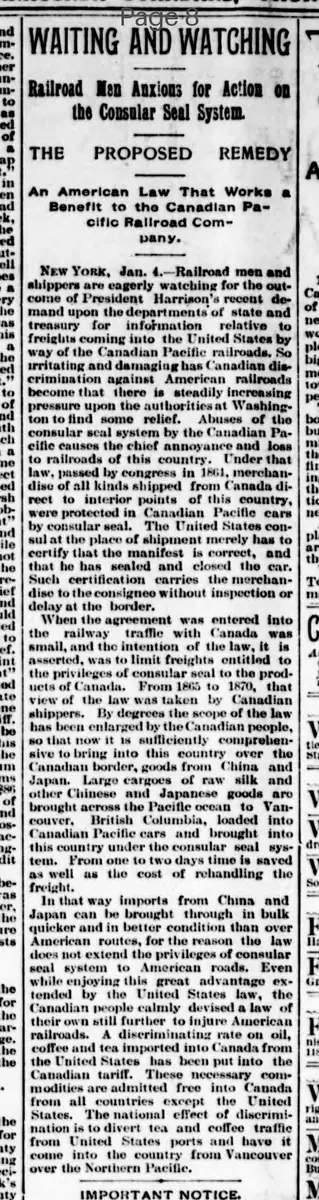
Railroad Men Anxious for Action on the Consular Seal System
THE PROPOSED REMEDY
An American Law That Works a Benefit to the Canadian Pacific Railroad Company.
New York, Jan. 4.—Railroad men and shippers are eagerly watching for the outcome of President Harrison's recent demand upon the departments of state and treasury for information relative to freights coming into the United States by way of the Canadian Pacific railroads. So irritating and damaging has Canadian discrimination against American railroads become that there is steadily increasing pressure upon the authorities at Washington to find some relief. Abuses of the consular seal system by the Canadian Pacific causes the chief annoyance and loss to railroads of this country. Under that law, passed by congress in 1861, merchandise of all kinds shipped from Canada direct to interior points of this country were protected in Canadian Pacific cars by consular seal. The United States consul at the place of shipment merely has to certify that the manifest is correct, and that he has sealed and closed the car. Such certification carries the merchandise to the consignee without inspection or delay at the border.
When the agreement was entered into the railway traffic with Canada was small, and the intention of the law, it is asserted, was to limit freights entitled to the privileges of consular seal to the products of Canada. From 1865 to 1870, that view of the law was taken by Canadian shippers. By degrees the scope of the law has been enlarged by the Canadian people, so that now it is sufficiently comprehensive to bring into this country over the Canadian border, goods from China and Japan. Large cargoes of raw silk and other Chinese and Japanese goods are brought across the Pacific ocean to Vancouver, British Columbia, loaded into Canadian Pacific cars and brought into this country under the consular seal system. From one to two days time is saved as well as the cost of rehandling the freight.
In that way imports from China and Japan can be brought through in bulk quicker and in better condition than over American routes, for the reason the law does not extend the privileges of consular seal system to American roads. Even while enjoying this great advantage extended by the United States law, the Canadian people calmly devised a law of their own still further to injure American railroads. A discriminating rate on oil, coffee and tea imported into Canada from the United States has been put into the Canadian tariff. These necessary commodities are admitted free into Canada from all countries except the United States. The national effect of discrimination is to divert tea and coffee traffic from United States ports and have it come into the country from Vancouver over the Northern Pacific.
What sub-type of article is it?
What themes does it cover?
What keywords are associated?
What entities or persons were involved?
Where did it happen?
Story Details
Key Persons
Location
New York, United States; Canadian Border; Vancouver, British Columbia
Event Date
Jan. 4
Story Details
Railroad men and shippers await action on President Harrison's inquiry into freights via Canadian Pacific railroads due to Canadian discrimination. The 1861 U.S. consular seal law, originally for Canadian products, now allows Chinese and Japanese goods to enter the U.S. faster via Canada, disadvantaging American routes. Canada imposes tariffs on U.S. oil, coffee, and tea, diverting traffic.