Thank you for visiting SNEWPapers!
Sign up free
The Evansville Daily Journal
Evansville, Vanderburgh County, Indiana
What is this article about?
In Herman vs. The State, Judge Perkins of the Indiana Supreme Court rules the 1855 liquor act unconstitutional, protecting natural rights to liberty, property, and beverage choice under the state constitution. The prisoner is discharged.
Merged-components note: This is a continuation of the habeas corpus court opinion story across pages 1 and 2, based on sequential reading order and matching text content on the legal doctrine and conclusion of the case.
Clippings
1 of 2
OCR Quality
Full Text
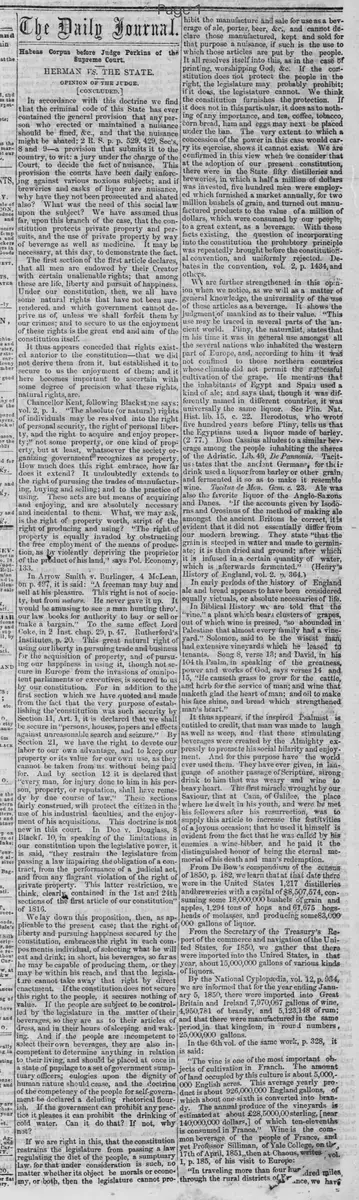
Habeas Corpus before Judge Perkins of the Supreme Court.
HERMAN VS. THE STATE.
OPINION OF THE JUDGE.
[CONCLUDED.]
In accordance with this doctrine we find that the criminal code of this State has ever contained the general provision that any person who erected or maintained a nuisance should be fined, &c., and that the nuisance might be abated; 2 R. S. p. 429, Sec's, 8 and 9—a provision that submits it to the country, to wit: a jury under the charge of the Court, to decide the fact of nuisance. This provision the courts have been daily enforcing against various noxious subjects; and if breweries and casks of liquor are nuisance, why have they not been prosecuted and abated also? What was the need of this special law upon the subject? We have assumed thus far, upon this branch of the case, that the constitution protects private property and persons, and the use of private property by way of beverage as well as medicine. It may be necessary, at this day, to demonstrate the fact.
The first section of the first article declares, that all men are endowed by their Creator with certain unalienable rights; that among these are life, liberty and pursuit of happiness.
Under our constitution, then, we all have some natural rights that have not been surrendered, and which government cannot deprive us of, unless we shall forfeit them by our crimes; and to secure to us the enjoyment of these rights is the great end and aim of the constitution itself.
It thus appears conceded that rights existed anterior to the constitution—that we did not derive them from it, but established it to secure to us the enjoyment of them; and it here becomes important to ascertain with some degree of precision what these rights, natural rights, are.
Chancellor Kent, following Blackstone says: vol. 2, p. 1. "The absolute (or natural) rights of individuals may be resolved into the right of personal security, the right of personal liberty, and the right to acquire and enjoy property;" not some property, or one kind of property, but at least, whatsoever the society organizing government recognizes as property.
How much does this right embrace, how far does it extend? It undoubtedly extends to the right of pursuing the trades of manufacturing, buying and selling; and to the practice of using.
These acts are but means of acquiring and enjoying, and are absolutely necessary and incidental to them. What, we may ask, is the right of property worth, stript of the right of producing and using? "The right of property is equally invaded by obstructing the free employment of the means of production, as by violently depriving the proprietor of the product of his land," says Pol. Economy, 133.
In Arrow Smith v. Ingersoll, 4 McLean, on p. 497, it is said: "A freeman may buy and sell at his pleasure.
This right is not of society, but from nature.
j.
He never gave it up. It would be amusing to see a man hunting thro' our law books for authority to buy or sell or make a bargain." To the same effect Lord Coke, in 2 Inst. chap. 29, p. 47. Rutherford's Institutes, p. 20. This great natural right of using our liberty in pursuing trade and business for the acquisition of property, and of pursuing our happiness in using it, though not secure in Europe from the invasions of omnipotent parliaments or executives, is secured to us by our constitution. For in addition to the first section which we have quoted and made from the fact that the very purpose of establishing the constitution was such security by Section 11, Art. 1, it is declared that we shall be secure in "persons, houses, papers and effects against unreasonable search and seizure." By Section 21, we have the right to devote our labor to our own advantage, and to keep our property or its value for our own use, as they cannot be taken from us without being paid for. And by section 12 it is declared that "every man, for injury done to him in his person, property, or reputation, shall have remedy by due course of law." These sections fairly construed, will protect the citizen in the use of his industrial faculties, and the enjoyment of his acquisitions. This doctrine is not new in this court. In Doe v. Douglass, 8 Blackf. 10, in speaking of the limitations in our constitution upon the legislative power, it is said, "they restrain the legislature from passing a law impairing the obligation of a contract, from the performance of a judicial act, and from any flagrant violation of the right of private property. This latter restriction, we think, clearly contained in the 1st and 24th sections of the first article of our constitution" of 1816.
We lay down this proposition, then, as applicable to the present case; that the right of liberty and pursuing happiness secured by the constitution, embraces the right in each compos mentis individual, of selecting what he will eat and drink; in short, his beverages, so far as he may be capable of producing them, or they may be within his reach, and that the legislature cannot take away that right by direct enactment. If the constitution does not secure this right to the people, it secures nothing of value. If the people are subject to be controlled by the legislature in the matter of their beverages, so they are as to their articles of dress, and in their hours of sleeping and waking. And if the people are incompetent to select their own beverages, they are also incompetent to determine anything in relation to their living, and should be placed at once in a state of pupilage to a set of government sumptuary officers; eulogies upon the dignity of human nature should cease, and the doctrine of the competency of the people for self-government be declared a deluding rhetorical flourish. If the government can prohibit any practice it pleases it can prohibit the drinking of cold water. Can it do that? If not, why not?
If we are right in this, that the constitution restrains the legislature from passing a law regulating the diet of the people, a sumptuary law, for that under consideration is such, no matter whether its object be morals or economy, or both, then the legislature cannot prohibit the manufacture and sale for use as a beverage of ale, porter, beer, &c., and cannot declare those manufactured, kept and sold for that purpose a nuisance, if such is the use to which those articles are put by the people.
It all resolves itself into this, as in the case of printing, worshipping God, &c. If the constitution does not protect the people in the right, the legislature may probably prohibit; if it does, the legislature cannot. We think the constitution furnishes the protection. If it does not in this particular, it does as to nothing of any importance, and tea, coffee, tobacco, corn bread, ham and eggs may next be placed under the ban. The very extent to which a concession of the power in this case would carry its exercise, shows it cannot exist. We are confirmed in this view when we consider that at the adoption of our present constitution, there were in the State fifty distilleries and breweries, in which a half a million of dollars was invested, five hundred men were employed which furnished a market annually, for two million bushels of grain, and turned out manufactured products to the value of a million of dollars, which were consumed by our people, to a great extent, as a beverage. With these facts existing, the question of incorporating into the constitution the prohibitory principle was repeatedly brought before the constitutional convention, and uniformly rejected. Debates in the convention, vol. 2, p. 1434, and others.
We are further strengthened in this opinion when we notice, as we will as a matter of general knowledge, the universality of the use of these articles as a beverage. It shows the judgment of mankind as to their value. "This use may be traced in several parts of the ancient world. Pliny, the naturalist, states that in his time it was in general use amongst all the several nations who inhabited the western part of Europe, and, according to him it was not confined to those northern countries whose climate did not permit the successful cultivation of the grape. He mentions that the inhabitants of Egypt and Spain used a kind of ale; and says that, though it was differently named in different countries, it was universally the same liquor. See Plin. Nat. Hist. lib. 15, c. 22. Herodotus, who wrote five hundred years before Pliny, tells us that the Egyptians used a liquor made of barley. (2 77.) Dion Cassius alludes to a similar beverage among the people inhabiting the shores of the Adriatic. Lib. 49, De Pannonis. Tacitus states that the ancient Germans; for their drink used a liquor from barley or other grain and fermented it so as to make it resemble wine. Tacitus de Mor. Germ. c. 23. Ale was also the favorite liquor of the Anglo-Saxons and Danes. "If the accounts given by Isodorus and Orosius of the method of making ale amongst the ancient Britons be correct, it is evident that it did not essentially differ from our modern brewing. They state "that the grain is steeped in water and made to germinate; it is then dried and ground; after which it is infused in a certain quantity of water, which is afterwards fermented." (Henry's History of England, vol. 2. p. 364.)
In early periods of the history of England ale and bread appears to have been considered equally victuals, or absolute necessaries of life.
In Biblical History we are told that the "vine," a plant which bears clusters of grapes, out of which wine is pressed, "so abounded in Palestine that almost every family had a vineyard." Solomon, said to be the wisest man, had extensive vineyards which he leased to tenants. Song 8, verse 13; and David, in his 104 th Psalm, in speaking of the greatness, power and works of God, says verses 14 and 15, "He causeth grass to grow for the cattle, and herb for the service of man; and wine that maketh glad the heart of man; and oil to make his face shine, and bread which strengthened man's heart."
It thus appears, if the inspired Psalmist is entitled to credit, that man was made to laugh as well as weep, and that these stimulating beverages were created by the Almighty expressly to promote his social hilarity and enjoyment. And for this purpose have the world ever used them. They have ever given, in language of another passage of Scripture, strong drink to him that was weary and wine to heavy heart. The first miracle wrought by our Saviour, that at Cana, of Galilee, the place where he dwelt in his youth, and were he met his followers after his resurrection, was to supply this article to increase the festivities of a joyous occasion; that he used it himself is evident from the fact that he was called by his enemies a wine-bibber, and he paid it the distinguished honor of being the eternal memorial of his death and man's redemption.
From De Bow's compendium of the census of 1850, p. 182, we learn that at that date there were in the United States 1,217 distilleries and breweries with a capital of $8,507,574, consuming some 18,000,000 bushels of grain and apples, 1,294 tons of hops and 61,675 hogheads of molasses, and producing some 83,000,000 gallons of liquor.
From the Secretary of the Treasury's Report of the commerce and navigation of the United States, for 1850, we gather that there were imported into the United States, in that year, about 15,000,000 gallons of various kinds of liquors.
By the National Cyclopaedia, vol. 12. p. 934, we are informed that for the year ending January 5, 1850, there were imported into Great Britain and Ireland 7,970,067 gallons of wine, 4,950,781 of brandy, and 5,123,148 of rum; and that there were manufactured in the same period in that kingdom, in round numbers, 25,000,000 gallons.
In the 6th vol. of the same work, p. 328, it is said:
"The vine is one of the most important objects of cultivation in France. The amount of land occupied by this culture is about 5,000,000 English acres. This average yearly produce is about 926,000,000 England gallons, of which about one-sixth is converted into brandy. The annual produce of the vineyards is estimated at about £28,500,000 sterling, [near 140,000,000 dollars,] of which ten-elevenths is consumed in France." Wine is the common beverage of the people of France, and yet Professor Silliman, of Yale College, on the 17th of April, 1851, then at Chaumont, writes; vol. 1, p. 185, of his visit to Europe:
"In traveling more than four hundred miles, through the rural districts of France, we have seen only a quiet, industrious population, peaceable in their habits, and as far as we had intercourse with them, courteous and kind in their manners. We have seen no rudeness, no broil or tumult—have observed no one who was not decently clad, or who appeared to be ill-fed. We are told, however, that the French peasantry live upon very small supplies of food, and in their houses are satisfied with very humble accommodations. Except in Paris, we have seen no instance of apparent suffering, and few even there; nor have we seen a single individual intoxicated or without shoes and stockings.
We have thus shown, from what we will take notice of historically, that the use of liquors as a beverage, article of trade and commerce, is so universal that they cannot be pronounced a nuisance. The world does not so regard them, and will not till the Bible is discarded and an overwhelming change in public sentiment, if not in man's nature, wrought.
And who, as we have asked, is to force the people to discontinue the use of beverages? Counsel say the maxim that you shall so use your own as not to injure another, justifies such a law by the legislature. But the maxim is misapplied; for it contemplates the free use by the owner of his property, but with such care as not to trespass upon his neighbor; while this prohibitory law forbids the owner to use his own in any manner, as a beverage.
It is based on the principle that a man shall not use at all for enjoyment what his neighbor may abuse—a doctrine that would, if enforced by law in general practice, annihilate society, make eunuchs of all men, or drive them into the cells of the monks, and bring the human race to an end, or continue it under the direction of licensed county agents.
Such, however, is not the principle upon which the Almighty governs the world. He made man a free agent, and to give him opportunity to exercise his will, to be virtuous or vicious as he should choose. He placed evil as well as good before him, he put the apple into the garden of Eden, and left upon man the responsibility of his choice, made it a moral question and left it so. He enacted as to that, a moral, not a physical prohibition. He could have easily enacted a physical prohibitory law by declaring the fatal apple a nuisance, and removing it. He did not. His purpose was otherwise, and he has since declared that the tares and wheat shall grow together to the end of the world. Man cannot, by prohibitory law, be robbed of his free agency. See Milton's Areopagitica or speech for liberty of unlicensed printing works, vol. 1, p.166.
But, notwithstanding the legislature cannot prohibit, it can, by enactments within constitutional limits, so regulate the use of intoxicating beverages, as to prevent most of the abuses of which the use may be subject. We do not say that it can all; for under our system of government, founded in a confidence in man's capacity to direct his own conduct, designed to allow to each individual the largest liberality consistent with the welfare of the whole, and to subject the private affairs of the citizens to the least possible governmental interference, some excesses will occur, and must be tolerated, subject only to such punishments as may be inflicted. This itself will be preventive in its influence. The happiness enjoyed in the exercise of general reasonably regulated liberty by all, overbalances the evil of occasional individual excess. "Order" must not be made to "reign" here as once "at Warsaw," by the annihilation of all freedom of action, crushing out, indeed, the spirit itself of liberty. With us, in the language of the then illustrious Burke, when defending the revolting American Colonies, something must be pardoned to the spirit of liberty.
What regulations of the liquor business would be constitutional, it is not for us to indicate in advance; but those which the legislature may from time to time prescribe, can be brought by the citizen to the constitutional test before the judiciary, and it will devolve upon that department to decide upon their consistency with the organic law; in fact, the question of power, of usurpation, between the people and the people's representatives; and in doing this, so far as it may devolve upon us, we shall cheerfully throw every doubt in favor of the latter, and of stringent regulations.
Such is the constitution of our government. Maize v. The State, 4 Ind., 342.—Thomas v. The Board of Commissioners of Clay county, 5 Ind., 557. Greencastle Township v. Black, 5 Ind., 557. Larmer v. The Trustees of Albion, 5 Hill, 121.—Dunham v. The Trustees of Rochester, 5 Cowen, 462.—Colter v. Doty, 5 Ohio Rep., 393.
It is like the case of laws for the collection of debts. The constitution prohibits the passage of an act impairing the obligation of a contract; yet the legislature may regulate the remedy upon contracts, but must regulate within such limits as not substantially to impair the remedy, as that would indirectly impair the obligation of the contract itself. Gantly's Lessee v. Ewing, 3 How., U. S. Rep., 707.
Regulations within constitutional limits, we have no doubt, if efficiently enforced, will accomplish, as we have said, nearly all that can reasonably be desired.
The legislature, we will add, may undoubtedly require the forfeiture of such particular portions of liquor as shall be kept for use in violation of proper regulations, as in the case of gunpowder stored in a populous city, and this forfeiture will be adjudged by the judiciary; see Cotter v. Doty, Supra; but neither all the gunpowder nor liquor in the State, accompanied by the prohibition of the further manufacture and use of the article, can be forfeited on account of the improper use of a given quantity, because the entirety of neither of the articles is a nuisance. It is not pretended to be so as to gunpowder, and we think we have shown it is not so as to liquor.
So it is doubtless competent for the legislature to establish proper police regulations to prevent the introducing of foreign paupers, &c., for there is a palpable difference between excluding a foreign, and expelling a citizen pauper. The Constitutional Convention thought it might have power to prohibit the ingress of foreign, while it might not compel the egress of resident negroes.
So, by such regulations, may the introduction of nuisances be prevented; for there is a wide difference between assuming to declare that a given thing is a nuisance, and the prohibiting of the introduction of what is conceded, or shall turn out to be, a nuisance.
And, in fact, the restrictions in the constitution upon the legislative power may operate for the benefit of those living under, and in some sense a party to, its provisions, and not for that of strangers. It will not be denied that but for the constitution and laws of the United States which impose the restriction the State, as an independent sovereignty, might exclude from her borders all foreign liquors, whether nuisances or not, unless indeed, the doctrine upon which Great Britain was defended in foreign trade with China at the cannon's mouth be correct, that in this day of Christian civilization, it is the duty of all nations to admit universal reciprocal trade and commerce, a doctrine, not yet, we think, incorporated into the code of international law.
And it would not follow "that, because the State might prohibit the introduction of foreign wheat, she could, therefore, prohibit the cultivation of it within the State by her own citizens. The right of the State to prevent the introduction of foreign objects does not depend upon the fact of their being nuisances, or offensive otherwise; but she does it, when not restrained by the constitution or laws of the United States in the exercise of her sovereign will.
This, however, is a topic involving questions of power between the State and Federal Governments which we do not intend discussing in the present opinion. We limit ourselves here to the question of the power of the legislature over property and pursuits of the citizen under the State constitution. The restrictions which we have examined upon the legislative power of the State were inserted in the constitution to protect the minority from the oppression of the majority, and all from the usurpation of the legislature, the members of which, under our plurality system of elections, may be returned by a minority of the people. They should, therefore, be faithfully maintained. They are the main safe guards to the persons and property of the State.
It is easy to see that when the people are smarting under losses from depreciated bank paper, a feeling might be aroused that would, under our plurality system, return a majority to the legislature, which would declare all banks a nuisance, confiscate their paper, and the buildings from which it issues.
So with railroads, when repeated wholesale murders are perpetrated by some of them.
And, in Great Britain and France, we have examples of the confiscation of the property of the churches even; which, here, the same constitution that protects the dealer in beer, would render safe from invasion by the legislative power.
In our opinion, for the reasons given above, the liquor act of 1855 is void. Let the prisoner be discharged.
What sub-type of article is it?
What themes does it cover?
What keywords are associated?
What entities or persons were involved?
Where did it happen?
Story Details
Key Persons
Location
Indiana
Event Date
1855
Story Details
Judge Perkins delivers an opinion in Herman vs. The State, arguing that the 1855 liquor act is unconstitutional as it violates natural rights to liberty, pursuit of happiness, and property, including the right to manufacture and consume beverages. The act is deemed void, and the prisoner is discharged.